Employees aren’t required to take breaks according to federal law. However, some US states have their own laws that mandate employers provide rest and/or meal breaks.
In this article, we’ll examine how federal and state break laws affect employers and employees in the US.
- Federal law doesn’t require employers to provide meal or rest breaks to their employees.
- Employers who offer meal breaks lasting less than 20 minutes must consider them compensable.
- Breaks that exceed 20 minutes are not considered compensable under federal law.
- Many states have established their own break regulations for lunch and meal breaks.
- In the US, there are usually 4 types of breaks: meal, rest, minor, and miscellaneous (other).
*Note: The information regarding break laws and regulations by state has been checked and updated for 2026.
What are break laws?
Break laws define when and how employees can use work breaks during their work. Although break regulations are determined at the federal and state levels, employers can decide whether to offer breaks and how long they will last — as long as they cover the minimum breaks mandated by state laws.
💡 DICA PROFISSIONAL DO CLOCKIFY
If you’re wondering how to handle employees missing shifts without any explanation, read this article:
Federal break laws vs. state break laws
The Fair Labor Standards Act (FLSA) doesn’t require employers to provide lunch or coffee breaks to employees. Federal laws apply in every US state only if no state law offers better benefits to employees. If that’s the case, the state law will take precedence.
Although federal law doesn’t mandate breaks, if the employer offers them, they must be paid if they last less than 20 minutes.
Moreover, the break time is counted towards hours worked and will be considered when determining any potential overtime the employee accrues.
Federal regulations don’t consider meal periods (which usually last at least 30 minutes) as work time, and employees aren’t compensated for them.
According to the federal PUMP Act, breastfeeding employees are entitled to take reasonable breaks to express milk for up to 1 year after the child’s birth. Employees must be provided a clean, shielded space for pumping milk other than a bathroom.
💡 DICA PROFISSIONAL DO CLOCKIFY
Need more information about the labor laws in your state? Check out our detailed labor laws guides by state:
How many breaks are required by law in an 8-hour shift?
Federal law doesn’t require any breaks in an 8-hour shift. However, some states mandate breaks. In Rhode Island, employees working 8-hour shifts must be provided a 30-minute unpaid meal break. Oregon employees must receive a 30-minute unpaid meal break after working 6 consecutive hours, and 2 paid rest periods of 10 minutes for 8-hour shifts.
Clockify by CAKE.com allows you to track work and break time easily. To track a break, simply switch the timer to Break mode and click Start break.
After that, you’ll be able to see the exact time of all logged breaks, allowing you to stay compliant.
Are 15-minute breaks required by law?
Federal law doesn’t require employers to provide 15-minute breaks. However, some specific states have laws in place that mandate rest breaks. For example, in New Hampshire and Utah, employers must allow employees to take 15-minute rest breaks for every 4 consecutive hours worked.
Break laws by state
Break laws differ across US states, and they’re usually classified into 4 categories:
- Meal breaks
- Rest breaks
- Minor breaks
- Other breaks
Take a look at the table below to get all the information you need regarding rest and lunch break laws by state.
| State | Meal break | Rest break | Breaks for minors | Other breaks |
|---|---|---|---|---|
| Alabama | Not required by state law; federal rules apply. | Federal rules apply. | / | Federal rules apply. According to federal law, breastfeeding employees are entitled to take reasonable breaks to pump at work for 1 year after the child’s birth. |
| Alaska | Not required by state law; federal rules apply. | Federal rules apply. | A break of at least 30 minutes after working more than 5 straight hours for 14- to 17-year-olds. | Federal rules apply. According to federal law, breastfeeding employees are entitled to take reasonable breaks to pump at work for 1 year after the child’s birth. |
| Arizona | A 30-minute unpaid meal break when working more than 5 hours in a day, and another 30-minute unpaid meal break when working more than 12 hours in a day. | A paid 10-minute break for every 4 hours worked. | / | Federal rules apply. According to federal law, breastfeeding employees are entitled to take reasonable breaks to pump at work for 1 year after the child’s birth. |
| Arkansas | Not required by state law; federal rules apply. | Federal rules apply. | Required for minors under 16 working in entertainment — the break duration is up to the employer. | The employer can require that the employee take a lactation break during rest and meal breaks, if provided. |
| California | A 30-minute unpaid meal break if an employee works for more than 5 consecutive hours, and an additional 30-minute unpaid meal period if the shift lasts for more than 10 hours. | A 10-minute rest period for every 4 hours worked. | / | The employer can require that the employee take a lactation break during rest and meal breaks, if possible. If the employee takes a separate break to express milk, the break need not be paid. Outdoor workers must be allowed additional breaks to cool off when working in the heat. |
| Colorado | A 30-minute unpaid meal break if an employee works for more than 5 consecutive hours. | A 10-minute rest period for every 4 hours worked. | / | Federal rules apply. According to federal law, breastfeeding employees are entitled to take reasonable breaks to pump at work for 1 year after the child’s birth. |
| Connecticut | A 30-minute unpaid meal break if an employee works for more than 7.5 consecutive hours. Exceptions: – If only one employee can perform the necessary duties. – If the break creates a threat to public safety measures. – If the operation requires that employees be available to respond to urgent matters. – If the employer has fewer than 5 employees on a shift. | Federal rules apply. | / | Breastfeeding employees are entitled to reasonable break time to express milk, separate from meal and rest breaks. |
| Delaware | A 30-minute unpaid meal break if an employee works for more than 7.5 consecutive hours. | Federal rules apply. | A 30-minute unpaid meal break for minor employees for every 5 consecutive hours. | Federal rules apply. According to federal law, breastfeeding employees are entitled to take reasonable breaks to pump at work for 1 year after the child’s birth. |
| District of Columbia | Not required by state law; federal rules apply. | Federal rules apply. | / | The employer must provide reasonable daily breaks for breastfeeding employees to express milk. |
| Florida | Not required by state law; federal rules apply. | Federal rules apply. | A 30-minute meal break for minor employees for every 4 consecutive hours worked. | Federal rules apply. According to federal law, breastfeeding employees are entitled to take reasonable breaks to pump at work for 1 year after the child’s birth. |
| Georgia | Not required by state law; federal rules apply. | Federal rules apply. | / | Mandatory paid lactation breaks for a reasonable amount of time. |
| Hawaii | Not required by state law; federal rules apply. | Federal rules apply. | A 30-minute paid meal break for employees aged 14 and 15 for every 5 consecutive hours worked. | Unpaid lactation breaks are mandatory for businesses with more than 50 employees. If there are fewer than 50 employees, it’s up to the employer to decide whether they will give a lactation break (unspecified amount of time). |
| Idaho | Not required by state law; federal rules apply. | Federal rules apply. | / | Federal rules apply. According to federal law, breastfeeding employees are entitled to take reasonable breaks to pump at work for 1 year after the child’s birth. |
| Illinois | A meal break of at least 20 minutes for employees who work 7.5-hour shifts, and an additional 20-minute meal break for shifts of 12 or more hours. | Federal rules apply. | A meal break of at least 30 minutes for employees under the age of 16 for every 5 consecutive hours worked. | Mandatory paid lactation breaks for a reasonable amount of time. |
| Indiana | Not required by state law; federal rules apply. | Federal rules apply. | All Indiana minors are entitled to 1 or 2 rest breaks that total at least 30 minutes if they work more than 6 consecutive hours. | Federal rules apply. According to federal law, breastfeeding employees are entitled to take reasonable breaks to pump at work for 1 year after the child’s birth. |
| Iowa | Not required by state law; federal rules apply. | Federal rules apply. | A 30-minute meal break for employees younger than 16 for every 5 consecutive hours worked. | Federal rules apply. According to federal law, breastfeeding employees are entitled to take reasonable breaks to pump at work for 1 year after the child’s birth. |
| Kansas | Not required by state law; federal rules apply. | Federal rules apply. | / | Federal rules apply. According to federal law, breastfeeding employees are entitled to take reasonable breaks to pump at work for 1 year after the child’s birth. |
| Kentucky | Employees are entitled to a reasonable meal period. | A rest break of at least 10 minutes for every 4 hours worked. | A 30-minute meal break for minor employees for every 5 consecutive hours worked. | Federal rules apply. According to federal law, breastfeeding employees are entitled to take reasonable breaks to pump at work for 1 year after the child’s birth. |
| Louisiana | Not required by state law; federal rules apply. | Federal rules apply. | A 30-minute meal break for minor employees for every 5 consecutive hours worked. | Federal rules apply. According to federal law, breastfeeding employees are entitled to take reasonable breaks to pump at work for 1 year after the child’s birth. |
| Maine | Not required by state law; federal rules apply. | A 30-minute unpaid break after working for 6 consecutive hours. | / | The employer must provide reasonable unpaid break time to breastfeeding employees or allow them to express milk during paid break time in privacy at a location other than a bathroom for up to 3 years after the child’s birth. |
| Maryland | Not required by state law; federal rules apply. | Federal rules apply. | A 30-minute break for minor employees for every 5 consecutive hours worked. | The employer is required to provide breaks to employees who work in a retail establishment. According to federal law, breastfeeding employees are entitled to take reasonable breaks to pump at work for 1 year after the child’s birth. |
| Massachusetts | An unpaid meal break of at least 30 minutes for working more than 6 hours a day. | Federal rules apply. | / | Federal rules apply. According to federal law, breastfeeding employees are entitled to take reasonable breaks to pump at work for 1 year after the child’s birth. |
| Michigan | Not required by state law; federal rules apply. | Federal rules apply. | A 30-minute break period for minor employees for every 5 consecutive hours worked. | Federal rules apply. According to federal law, breastfeeding employees are entitled to take reasonable breaks to pump at work for 1 year after the child’s birth. |
| Minnesota | When working 6 or more consecutive hours, employees must be allowed a meal break of at least 30 minutes. | Every 4 consecutive hours worked, employees must be allowed to take a rest break of at least 15 minutes. All breaks that take 20 minutes or less must be paid. | / | The employer is required to provide a reasonable amount of time to breastfeeding employees to express milk at work without any pay reduction. |
| Mississippi | Not required by state law; federal rules apply. | Federal rules apply. | / | Federal rules apply. According to federal law, breastfeeding employees are entitled to take reasonable breaks to pump at work for 1 year after the child’s birth. |
| Missouri | Not required by state law; federal rules apply. | Federal rules apply. | Employers aren’t required to provide breaks to youth workers — except for youth workers in the entertainment industry. Youth workers in the entertainment industry can’t work more than 5.5 hours without a meal break, and are entitled to a 15-minute break after every 2 hours of continuous work. | Federal rules apply. According to federal law, breastfeeding employees are entitled to take reasonable breaks to pump at work for 1 year after the child’s birth. |
| Montana | Not required by state law; federal rules apply. | Federal rules apply. | / | The employer can require that the employee take a lactation break during rest and meal breaks, if provided. |
| Nebraska | Not required by state law; federal rules apply. Exception: workers in workshops, manufacturing plants, and assembly lines must be provided a 30-minute unpaid meal break when working 8-hour shifts. | Federal rules apply. | / | Employees in mechanical establishments, workshops, and assembly plants are entitled to a 30-minute break for every 8 consecutive hours worked. According to federal law, breastfeeding employees are entitled to take reasonable breaks to pump at work for 1 year after the child’s birth. |
| Nevada | A 30-minute unpaid meal break for employees working 8 continuous hours. | 10-minute paid breaks every 4 hours of work. | / | Breastfeeding employees are entitled to take reasonable breaks to pump at work for 1 year after the child’s birth. |
| New Hampshire | A 30-minute unpaid meal break for employees working 5 continuous hours. | 15-minute paid rest breaks for every 4 consecutive hours worked. | / | Breastfeeding employees are entitled to take reasonable breaks to pump at work for 1 year after the child’s birth. |
| New Jersey | Not required by state law; federal rules apply. | Federal rules apply. | A 30-minute meal break for minor employees for every 5 consecutive hours. | The employer must provide reasonable break time to breastfeeding employees or allow them to express milk during paid break time in privacy at a location other than a bathroom. |
| New Mexico | Not required by state law; federal rules apply. | Federal rules apply. | / | The employer must provide reasonable break time to breastfeeding employees or allow them to express milk during paid break time in privacy at a location other than a bathroom. |
| New York | An unpaid meal break of at least 30 minutes for more than 6 hours worked. | Federal rules apply. | / | A 30-minute paid lactation break for breastfeeding employees for up to 3 years after the child’s birth. |
| North Carolina | Not required by state law; federal rules apply. | Federal rules apply. | A break of at least 30 minutes for employees under the age of 16 after 5 consecutive hours worked. | Breastfeeding employees are entitled to take reasonable breaks to pump at work. |
| North Dakota | A 30-minute unpaid break when an employee has been working for 5 continuous hours, and there are 2 or more employees on duty. | Federal rules apply. | / | Breastfeeding employees are entitled to reasonable and flexible break times to express milk at work. |
| Ohio | A 30-minute unpaid meal break for employees working 8.5-hour shifts. | Employees are allowed 2 rest periods up to 15 minutes when working 8-hour shifts. | A 30-minute break for minor employees who work 5 continuous hours a day. | Federal rules apply. According to federal law, breastfeeding employees are entitled to take reasonable breaks to pump at work for 1 year after the child’s birth. |
| Oklahoma | Not required by state law; federal rules apply. | Federal rules apply. | Employees under 16 must be provided a 30-minute break for every 5 hours worked or a 1-hour break for every 8 hours worked. | The employer must provide reasonable break time to breastfeeding employees or allow them to express milk at a clean, shielded location other than a bathroom. |
| Oregon | A 30-minute unpaid break for 6 or more hours of work, and additional meal periods for employees who work 14-hour shifts. | 2 paid 10-minute rest breaks for 8-hour work periods. | Same as adults for meal breaks for 16- and 17-year-olds, while 14- and 15-year-olds must be provided a meal break and 15-minute rest breaks instead of 10-minute breaks. | The employer must provide reasonable break time to breastfeeding employees or allow them to express milk at a shielded location other than a bathroom until the child is 18 months old. |
| Pennsylvania | Not required by state law; federal rules apply. | Federal rules apply. | A 30-minute break for minor employees who work 5 or more consecutive hours. | The employer must provide reasonable break time to breastfeeding employees or allow them to express milk at a shielded location other than a bathroom until the child is 2 years old. |
| Rhode Island | An unpaid 20-minute break for employees working 6-hour shifts and a 30-minute break for employees working 8-hour shifts. | Federal rules apply. | / | Federal rules apply. According to federal law, breastfeeding employees are entitled to take reasonable breaks to pump at work for 1 year after the child’s birth. |
| South Carolina | Not required by state law; federal rules apply. | Federal rules apply. | / | The employer must provide reasonable unpaid break time to breastfeeding employees or allow them to express milk in privacy at a location other than a bathroom for up to 1 year after the child’s birth. |
| South Dakota | Not required by state law; federal rules apply. | Federal rules apply. | / | Federal rules apply. According to federal law, breastfeeding employees are entitled to take reasonable breaks to pump at work for 1 year after the child’s birth. |
| Tennessee | A 1-hour unpaid meal break. | Federal rules apply. | / | Breastfeeding employees are entitled to additional breaks to pump at work. |
| Texas | Not required by state law; federal rules apply. | Federal rules apply. | / | Federal rules apply. According to federal law, breastfeeding employees are entitled to take reasonable breaks to pump at work for 1 year after the child’s birth. |
| Utah | An unpaid meal break of at least 30 minutes for each full-time workday. | A 15-minute rest break for every 4 hours worked. | A 30-minute break within the first 5 hours of the work shift, and a 10-minute break for every 4 consecutive hours worked. | Breastfeeding employees are entitled to daily break periods to pump at work for 1 year after the child’s birth. |
| Vermont | A reasonable time for a meal break must be provided. | Federal rules apply. | / | Federal rules apply. According to federal law, breastfeeding employees are entitled to take reasonable breaks to pump at work for 1 year after the child’s birth. |
| Virginia | A break of at least 30 minutes for employees working 6 consecutive hours. | Managers may permit employees to take one 15-minute rest break before and another 15-minute rest break after the mandatory lunch period. | A 30-minute break for minors under the age of 16 who work for 5 consecutive hours. | Breastfeeding employees are entitled to longer or more frequent breaks to express milk at work at a private location other than a bathroom. |
| Washington | Employees working shifts longer than 5 hours are entitled to an unpaid meal break of at least 30 minutes. If hours worked exceed the scheduled shift by at least 3 hours, employees must be given an additional 30-minute meal break within 5 hours from the end of the first meal break. | A break of at least 10 minutes after working for 4 consecutive hours. | Employees who are 16 and 17 years old must receive a meal break of at least 30 minutes after 5 consecutive hours worked, and at least a 10-minute rest break if the shift is longer than 4 hours. Employees under 16 need to be provided a meal break of at least 30 minutes for 4 consecutive hours worked, and a minimum 10-minute rest break. They must not work for more than 2 hours without receiving a meal or rest break. | Breastfeeding employees are entitled to longer or more frequent breaks to express milk at work at a private location other than a bathroom for up to 2 years after the child’s birth. |
| West Virginia | A meal break of at least 20 minutes for employees who work 6 or more hours a day. If the break doesn’t exceed 20 minutes, it must be paid. | Federal rules apply. | / | Federal rules apply. According to federal law, breastfeeding employees are entitled to take reasonable breaks to pump at work for 1 year after the child’s birth. |
| Wisconsin | Not required by state law; federal rules apply. | Federal rules apply. | Minor employees are entitled to a 30-minute meal break for every 6 consecutive hours of work. | Breastfeeding employees are entitled to a break to pump at work for 1 year after the child’s birth (unspecified amount of time). |
| Wyoming | Not required by state law; federal rules apply. | Federal rules apply. | / | Breastfeeding employees are entitled to take reasonable breaks to pump at work for 1 year after the child’s birth. |
Track employee breaks and work hours with Clockify by CAKE.com
Giving your employees breaks is a great way to boost their productivity and morale. If you decide to do so, you should track those breaks accordingly to avoid procrastination.
Clockify’s Kiosk helps you track employee breaks by allowing employees to clock in and out of work or start a break. All time entries are automatically saved and can later be used to calculate payroll and track work hours.
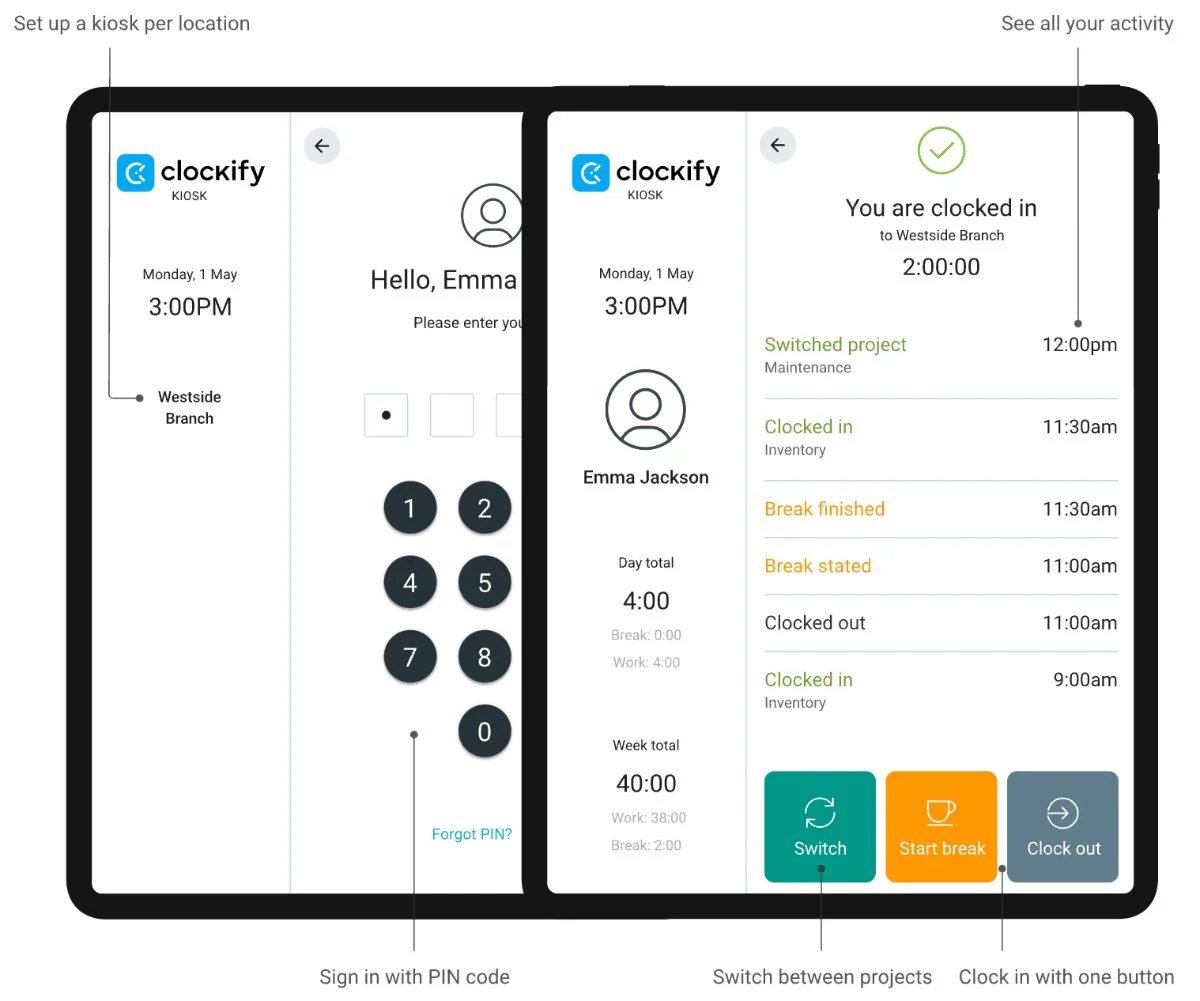
Every employee gets a unique PIN code or QR code they can use to easily clock in/out, start a break, or switch between projects. Photo capture, when enabled, prevents buddy punching, ensuring the employee returned from their break on time, without violating the break rules.
But the Kiosk isn’t the only way to track work and break time in Clockify. For instance, users can use the Timer or Manual mode. To speed up time tracking, here are a few web app shortcuts:
- N — to start the timer
- S — to stop the timer
- C — to continue tracking time on the latest entry
- M — to switch to manual mode
Regardless of the time tracking method used, employees can always submit tracked time for approval. Even if an employee forgets to track a mandatory break and the manager has already approved the weekly timesheet, the admin can withdraw approval to ensure the records reflect legal break compliance.
Frequently asked questions about break laws in the US
For more information about US break laws, check out this FAQ section, where we answer the most common questions.
Are breaks legally required in the US?
Employers in federally governed US states aren’t legally required to offer breaks to their employees. If they choose to do so, they must adhere to federal policies and pay for the breaks if they last less than 20 minutes.
If the state in question has its own break laws that offer better benefits to the employees, employers are legally required to adhere to them.
How long is a work lunch break?
There are no federal work break laws regarding the duration of lunch breaks. Most states that require meal breaks mandate that they be 30 minutes or more.
Do lunch breaks count as working hours?
If the work lunch break lasts 20 minutes or less, the break should be paid, according to federal law. If the employee works more than scheduled, this time will count toward overtime. Non-exempt employees must receive overtime pay in this case to ensure overtime compliance. This doesn’t apply to exempt employees.
Whether an exempt employee is entitled to a meal or rest break depends on state laws and the specific employer.
How long can you work without a break?
Federal law doesn’t require employers to provide breaks for employees. Therefore, if no state law requires breaks, employees can work the entire shift without a break.
What states require breaks?
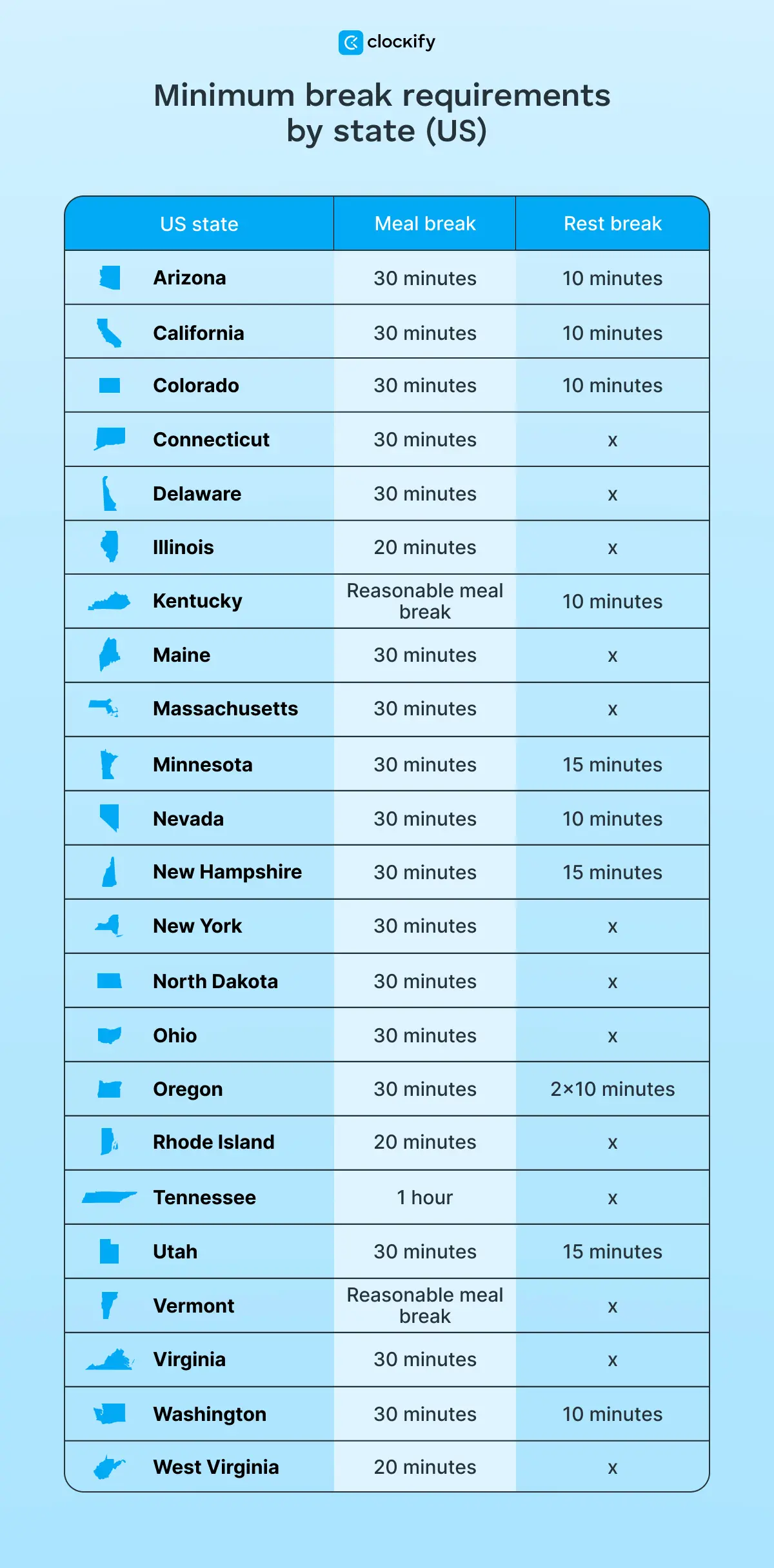
US states that legally require employers to provide meal and/or rest breaks to their employees are: Arizona, California, Colorado, Connecticut, Delaware, Illinois, Kentucky, Maine, Massachusetts, Minnesota, Nevada, New Hampshire, New York, North Dakota, Ohio, Oregon, Rhode Island, Tennessee, Utah, Vermont, Virginia, Washington, and West Virginia.
What happens if employers violate break laws?
Employers who violate break laws are subject to a break violation penalty. For example, Washington employees who fail to allow a minor employee to take a meal or rest break as per the Washington state break law can be fined between $300 and $1,000.

Conclusão/Aviso legal
Please bear in mind that this break laws guide was checked and updated in July 2026. Thus, it may not include changes introduced after it was published.
We strongly advise you to consult the appropriate institutions and/or certified representatives before acting on any legal matters.
Clockify is not responsible for any losses or risks incurred should this guide be used without legal guidance.
Como avaliamos esta publicação: Nossos redatores e editores monitoram as publicações e as atualizam quando novas informações são disponibilizadas para mantê-las atualizadas e relevantes.