Según la ley federal, los empleados no están obligados a tomar descansos. Sin embargo, algunos estados de EE. UU. tienen sus propias leyes que obligan a los empleadores a proporcionar pausas para descansar o comer.
En este artículo, analizaremos cómo las leyes federales y estatales sobre descansos afectan a empleadores y empleados en EE. UU.
- La ley federal no obliga a los empleadores a ofrecer pausas para comer o descansar a sus empleados.
- Los empleadores que decidan ofrecer pausas para comer de menos de 20 minutos deben considerarlas compensables.
- Los descansos que superan los 20 minutos no se consideran compensables bajo la ley federal.
- Muchos estados han establecido sus propias regulaciones de descanso cuando se trata de las pausas para comer.
- En Estados Unidos, normalmente hay cuatro tipos de descansos: descansos para comer, descansos para descansar, descansos breves y descansos varios (otro tipo).
*Nota: La información sobre las leyes y regulaciones de descanso por estado ha sido revisada y actualizada para 2026.
¿Qué son las leyes de descanso?
Las leyes sobre descansos definen cuándo y cómo los empleados pueden tomar descansos durante su jornada laboral. Si bien las regulaciones sobre descansos se establecen a nivel federal y estatal, los empleadores pueden decidir si ofrecen descansos y cuánto durarán, siempre y cuando cumplan con los descansos mínimos exigidos por las leyes estatales.
💡 CONSEJO PRO DE CLOCKIFY
Si te preguntas cómo manejar a los empleados que faltan turnos sin ninguna explicación, lee este artículo:
Leyes federales de descanso vs. leyes estatales de descanso
La Ley de Normas Justas de Trabajo (FLSA por sus siglas en inglés) no exige que los empleadores proporcionen almuerzos o pausas para tomar café a los empleados. Las leyes federales se aplican en todos los estados de EE. UU. sólo si ninguna ley estatal ofrece mejores beneficios a los empleados. Si ese es el caso, la ley estatal tendrá prioridad.
Aunque la ley federal no exige descansos, si el empleador los ofrece, se les debe pagar si duran menos de 20 minutos.
Además, el tiempo de descanso se cuenta con las horas trabajadas y se tendrá en cuenta al determinar las posibles horas extras que el empleado haya acumulado.
Las regulaciones federales no consideran los períodos de comida (que suelen durar al menos 30 minutos) como tiempo de trabajo, y los empleados no reciben compensación por ellos.
Según la Ley federal PUMP, las empleadas lactantes tienen derecho a tomar descansos razonables para extraer leche hasta un año después del nacimiento del bebé. Deben contar con un espacio limpio y protegido para extraer leche, distinto del baño.
💡 CONSEJO PRO DE CLOCKIFY
¿Necesitas más información sobre las leyes laborales de tu estado? Consulta nuestras guías detalladas de leyes laborales por estado:
¿Cuántos descansos exige la ley en un turno de 8 horas?
La ley federal no exige descansos en un turno de 8 horas. Sin embargo, algunos estados sí los exigen. En Rhode Island, los empleados que trabajan turnos de 8 horas deben tener un descanso para comer de 30 minutos sin remuneración. En Oregón, los empleados deben tener un descanso para comer de 30 minutos sin remuneración después de trabajar 6 horas consecutivas, y dos períodos de descanso remunerados de 10 minutos en turnos de 8 horas.
Clockify by CAKE.com te permite registrar fácilmente el tiempo de trabajo y los descansos. Para controlar un descanso, simplemente cambia el temporizador al Modo de descanso y haz clic en Iniciar descanso.
Después, podrás ver la hora exacta de todos los descansos registrados, lo que te permitirá cumplir con la normativa.
Sigue tus horas de trabajo y descansos
¿Los descansos de 15 minutos son obligatorios por ley?
La ley federal no exige que los empleadores proporcionen descansos de 15 minutos. Sin embargo, algunos estados tienen leyes que sí los exigen. Por ejemplo, en New Hampshire y Utah, los empleadores deben permitir a los empleados tomar descansos de 15 minutos por cada 4 horas consecutivas trabajadas.
Las leyes de descanso por estado
Las leyes sobre descansos varían entre los estados de EE. UU. y generalmente se clasifican en 4 categorías:
- Descansos para comer
- Pausas para descansar
- Descansos menores
- Otros descansos
Consulta la tabla a continuación para obtener toda la información que necesitas sobre las leyes de descanso y pausas para el almuerzo por estado.
| Estado | Pausa para comer | Pausa para descansar | Pausa para menores | Otros descansos |
|---|---|---|---|---|
| Alabama | No se exige por la ley estatal; se aplican las normas federales. | Se aplican las leyes federales. | / | Se aplican las leyes federales. Según la ley federal, las empleadas lactantes tienen derecho a tomar descansos razonables para extraerse leche en el trabajo durante un año después del nacimiento del niño. |
| Alaska | No se exige por la ley estatal; se aplican las normas federales. | Se aplican las normas federales. | Los descansos de 30 minutos después de trabajar más de 5 horas continuas, para los jóvenes de 14 a 17 años. | Se aplican las leyes federales. Según la ley federal, las empleadas lactantes tienen derecho a tomar descansos razonables para extraerse leche en el trabajo durante un año después del nacimiento del niño. |
| Arizona | Una pausa para comer de 30 minutos no remunerada cuando se trabaja más de 5 horas al día, y otra pausa para comer de 30 minutos no remunerada cuando se trabaja más de 12 horas al día. | Un descanso remunerado de 10 minutos por cada 4 horas trabajadas. | / | Se aplican las leyes federales. Según la ley federal, las empleadas lactantes tienen derecho a tomar descansos razonables para extraerse leche en el trabajo durante un año después del nacimiento del niño. |
| Arkansas | No se exige por la ley estatal; se aplican las normas federales. | Se aplican las normas federales. | Requerido para los menores de 16 años que trabajan en la industria del entretenimiento, la duración del descanso depende del empleador. | El empleador puede exigir que la empleada haga una pausa para amamantar durante los descansos y las pausas para comer, si estos se proporcionan. |
| California | Un descanso para comer de 30 minutos sin remuneración si un empleado trabaja más de 5 horas consecutivas, y un período adicional de 30 minutos sin remuneración si el turno dura más de 10 horas. | Un período de descanso de 10 minutos por cada 4 horas trabajadas. | / | El empleador puede exigir que la empleada tome un descanso para amamantar durante las pausas para comer y descansar, si es posible. Si la empleada toma un descanso aparte para extraer leche, este no tiene por qué ser remunerado. Los trabajadores al aire libre deben tener derecho a descansos adicionales para refrescarse cuando trabajan bajo el calor. |
| Colorado | Un descanso pagado de 30 minutos para comer si el empleado trabaja más de 5 horas consecutivas. | Un descanso de 10 minutos por cada 4 horas trabajadas. | / | Se aplica la ley federal. Según la ley federal, las empleadas que amamantan tienen derecho a tomar descansos razonables para extraerse leche en el trabajo durante un año después del nacimiento del niño.Según la ley federal, las empleadas que amamantan tienen derecho a tomar descansos razonables para extraerse leche en el trabajo durante un año después del nacimiento del niño. |
| Connecticut | Un descanso pagado de 30 minutos para comer si el empleado trabaja más de 7,5 horas consecutivas. Excepciones: – Si solo un empleado puede realizar los servicios necesarios, – Si el descanso representa una amenaza a las medidas de seguridad pública, – Si la operación requiere que los empleados están disponibles para responder a los asuntos urgentes, – Si el empleador tiene menos de 5 empleados en un turno particular. | Se aplican las normas federales. | / | Las empleadas lactantes tienen derecho a un tiempo de descanso razonable para extraerse leche, aparte de las pausas para comer y descansar. |
| Delaware | Un descanso pagado de 30 minutos para comer si el empleado trabaja más de 7,5 horas consecutivas. | Se aplican las normas federales. | Un descanso pagado de 30 minutos para comer para los empleados menores por cada 5 horas consecutivas. | Se aplican las normas federales. Según la ley federal, las empleadas lactantes tienen derecho a tomar descansos razonables para extraerse leche en el trabajo durante un año después del nacimiento del niño. |
| Distrito de Columbia | No se exige por la ley estatal; se aplican las normas federales. | Se aplican las normas federales. | / | El empleador debe proporcionar pausas diarias razonables para que las empleadas que están amamantando puedan extraerse leche. |
| Florida | No se exige por la ley estatal; se aplican las normas federales. | Se aplican las normas federales. | Un descanso pagado de 30 minutos para comer para los empleados menores por cada 4 horas consecutivas. | Se aplican las normas federales. Según la ley federal, las empleadas lactantes tienen derecho a tomar descansos razonables para extraerse leche en el trabajo durante un año después del nacimiento del niño. |
| Georgia | No se exige por la ley estatal; se aplican las normas federales. | Se aplican las normas federales. | / | Descansos obligatorios remunerados para la lactancia durante un tiempo razonable. |
| Hawái | No se exige por la ley estatal; se aplican las normas federales. | Se aplican las normas federales. | Los empleados de 14 y 15 años tendrán derecho a una pausa remunerada de 30 minutos para comer por cada 5 horas consecutivas trabajadas. | Las pausas para la lactancia no remuneradas son obligatorias para las empresas con más de 50 empleados. Si hay menos de 50 empleados, el empleador decide si concederá o no una pausa para la lactancia (de duración indeterminada). |
| Idaho | No se exige por la ley estatal; se aplican las normas federales. | Se aplican las normas federales. | / | Se aplican las normas federales. Según la ley federal, las empleadas lactantes tienen derecho a tomar descansos razonables para extraerse leche en el trabajo durante un año después del nacimiento del niño. |
| Illinois | Un descanso para comer de al menos 20 minutos para los empleados que trabajan turnos de 7,5 horas, y un descanso adicional de 20 minutos para los turnos de 12 horas o más. | Se aplican las normas federales. | Los empleados menores de 16 años tendrán derecho a una pausa para comer de al menos 30 minutos por cada 5 horas consecutivas trabajadas. | Descansos obligatorios remunerados para la lactancia durante un tiempo razonable. |
| Indiana | No se exige por la ley estatal; se aplican las normas federales. | Se aplican las normas federales. | Todos los menores de Indiana tienen derecho a 1 o 2 descansos que sumen al menos 30 minutos si trabajan más de 6 horas consecutivas. | Se aplican las normas federales. Según la ley federal, las empleadas lactantes tienen derecho a tomar descansos razonables para extraerse leche en el trabajo durante un año después del nacimiento del niño. |
| Iowa | No se exige por la ley estatal; se aplican las normas federales. | Se aplican las normas federales. | Los empleados menores de 16 años tendrán derecho a una pausa para comer de 30 minutos por cada 5 horas consecutivas trabajadas. | Se aplican las normas federales.
Según la ley federal, las empleadas lactantes tienen derecho a tomar descansos razonables para extraerse leche en el trabajo durante un año después del nacimiento del niño. |
| Kansas | No se exige por la ley estatal; se aplican las normas federales. | Se aplican las normas federales. | / | Se aplican las normas federales. Según la ley federal, las empleadas lactantes tienen derecho a tomar descansos razonables para extraerse leche en el trabajo durante un año después del nacimiento del niño. |
| Kentucky | Los empleados tienen derecho a un descanso para comer razonable. | Un descanso de 10 minutos por cada 4 horas de trabajo. | Un descanso pagado de 30 minutos para comer para los empleados menores por cada 5 horas consecutivas de trabajo. | Se aplican las normas federales. Según la ley federal, las empleadas que están amamantando tienen derecho a tomar descansos razonables para extraerse leche en el trabajo durante un año después del nacimiento del niño. |
| Louisiana | No se exige por la ley estatal; se aplican las normas federales. | Se aplican las normas federales. | Un descanso pagado de 30 minutos para comer para los empleados menores por cada 5 horas consecutivas de trabajo. | Se aplican las normas federales. Según la ley federal, las empleadas que están amamantando tienen derecho a tomar descansos razonables para extraerse leche en el trabajo durante un año después del nacimiento del niño. |
| Maine | No se exige por la ley estatal; se aplican las normas federales. | Un descanso de 30 minutos después de trabajar 6 horas consecutivas. | / | El empleador debe proporcionar un tiempo de descanso razonable sin remuneración a las empleadas lactantes o permitirles extraer leche durante el tiempo de descanso remunerado en privado en un lugar que no sea un baño, hasta por 3 años después del nacimiento del niño. |
| Maryland | No se exige por la ley estatal; se aplican las normas federales. | Se aplican las normas federales. | Un descanso pagado de 30 minutos para comer para los empleados menores por cada 5 horas consecutivas de trabajo. | El empleador está obligado a proporcionar descansos para los empleados que trabajan en establecimientos minoristas. Según la ley federal, las empleadas que están amamantando tienen derecho a tomar descansos razonables para extraerse leche en el trabajo durante un año después del nacimiento del niño. |
| Massachusetts | Un descanso de 30 minutos no pagado para comer por trabajar más de 6 horas al día. | Se aplican las normas federales. | / | Se aplican las normas federales. Según la ley federal, las empleadas lactantes tienen derecho a tomar descansos razonables para extraerse leche en el trabajo durante un año después del nacimiento del niño. |
| Míchigan | No se exige por la ley estatal; se aplican las normas federales. | Se aplican las normas federales. | Un descanso pagado de 30 minutos para comer para los empleados menores por cada 5 horas consecutivas. | Se aplican las normas federales. Según la ley federal, las empleadas lactantes tienen derecho a tomar descansos razonables para extraerse leche en el trabajo durante un año después del nacimiento del niño. |
| Minnesota | Cuando trabajen 6 horas o más consecutivas, los empleados deberán tener derecho a una pausa para comer de al menos 30 minutos. | Por cada 4 horas consecutivas trabajadas, los empleados deben tener derecho a un descanso de al menos 15 minutos. Todos los descansos de 20 minutos o menos deben ser remunerados. | / | El empleador está obligado a proporcionar a las empleadas que están amamantando un tiempo razonable para extraerse leche en el trabajo sin que ello conlleve ninguna reducción salarial. |
| Misisipi | No se exige por la ley estatal; se aplican las normas federales. | Se aplican las normas federales. | / | Se aplican las normas federales. Según la ley federal, las empleadas lactantes tienen derecho a tomar descansos razonables para extraerse leche en el trabajo durante un año después del nacimiento del niño. |
| Misuri | No se exige por la ley estatal; se aplican las normas federales. | Se aplican las normas federales. | Los empleadores no están obligados a proporcionar descansos a los jóvenes que trabajan, excepto a aquellos que trabajan en la industria del entretenimiento. Los jóvenes que trabajan en esta industria no pueden trabajar más de 5,5 horas sin un descanso para comer y tienen derecho a un descanso de 15 minutos después de cada 2 horas de trabajo continuo. | Se aplican las normas federales. Según la ley federal, las empleadas lactantes tienen derecho a tomar descansos razonables para extraerse leche en el trabajo durante un año después del nacimiento del niño. |
| Montana | No se exige por la ley estatal; se aplican las normas federales. | Se aplican las normas federales. | / | El empleador puede exigir que la empleada haga una pausa para amamantar durante los descansos y las pausas para comer, si estos se proporcionan. |
| Nebraska | No es obligatorio por ley estatal; se aplican las normas federales. Excepción: los trabajadores de talleres, plantas de fabricación y líneas de montaje deben tener derecho a un descanso para comer de 30 minutos sin remuneración cuando trabajen turnos de 8 horas. | Se aplican las normas federales. | / | Los empleados de talleres mecánicos, fábricas y plantas de ensamblaje tienen derecho a un descanso de 30 minutos por cada 8 horas consecutivas trabajadas. Según la ley federal, las empleadas lactantes tienen derecho a tomar descansos razonables para extraerse leche en el trabajo durante un año después del nacimiento del bebé. |
| Nevada | Un descanso de 30 minutos para comer para los empleados que trabajan 8 horas consecutivas. | Los descansos de 10 minutos por cada 4 horas de trabajo. | / | Las empleadas lactantes tienen derecho a tomar descansos razonables para extraerse leche en el trabajo durante un año después del nacimiento del niño. |
| Nuevo Hampshire | Un descanso de 30 minutos para comer para los empleados que trabajan 5 horas consecutivas. | Descansos remunerados de 15 minutos por cada 4 horas consecutivas trabajadas. | / | Las empleadas lactantes tienen derecho a tomar descansos razonables para extraerse leche en el trabajo durante un año después del nacimiento del niño. |
| Nueva Jersey | No se exige por la ley estatal; se aplican las normas federales. | Se aplican las normas federales. | Un descanso para comer de 30 minutos para empleados menores por cada 5 horas consecutivas. | El empleador debe proporcionar un tiempo de descanso razonable a las empleadas lactantes o permitirles extraerse leche durante el tiempo de descanso remunerado en privado y en un lugar que no sea un baño. |
| Nuevo México | No se exige por la ley estatal; se aplican las normas federales. | Se aplican las normas federales. | / | El empleador debe proporcionar un tiempo de descanso razonable a las empleadas lactantes o permitirles extraerse leche durante el tiempo de descanso remunerado en privado y en un lugar que no sea un baño. |
| Nueva York | Un descanso para comer no remunerado de al menos 30 minutos por cada 6 horas trabajadas. | Se aplican las normas federales. | / | Las empleadas que estén amamantando tendrán derecho a una pausa remunerada de 30 minutos para la lactancia durante un máximo de 3 años después del nacimiento del niño. |
| Carolina del Norte | No se exige por la ley estatal; se aplican las normas federales. | Se aplican las normas federales. | Una pausa de 30 minutos para los empleados menores de 16 años que trabajan 5 horas consecutivas al día. | Las empleadas lactantes tienen derecho a tomar descansos razonables para extraerse leche en el trabajo. |
| Dakota del Norte | Un descanso no remunerado de 30 minutos cuando un empleado ha estado trabajando durante 5 horas continuas y hay 2 o más empleados de turno. | Se aplican las normas federales. | / | Las empleadas lactantes tienen derecho a pausas razonables y flexibles para extraerse leche en el trabajo. |
| Ohio | Un descanso para comer de 30 minutos sin remuneración para los empleados que trabajan turnos de 8,5 horas. | Los empleados tienen derecho a 2 períodos de descanso de hasta 15 minutos por cada 8 horas trabajadas. | Un descanso de 30 minutos para los empleados menores que trabajen 5 horas seguidas al día. | Se aplican las normas federales. Según la ley federal, las empleadas que están amamantando tienen derecho a tomar descansos razonables para extraerse leche en el trabajo durante un año después del nacimiento del niño. |
| Oklahoma | No se exige por la ley estatal; se aplican las normas federales. | Se aplican las normas federales. | Los empleados menores de 16 años deben tener derecho a un descanso de 30 minutos por cada 5 horas trabajadas o a un descanso de 1 hora por cada 8 horas trabajadas. | El empleador debe proporcionar un tiempo de descanso razonable a las empleadas lactantes o permitirles extraerse leche en un lugar limpio y aislado que no sea un baño. |
| Oregón | Un descanso no remunerado de 30 minutos por cada 6 horas o más de trabajo, y períodos de comida adicionales para los empleados que trabajan turnos de 14 horas. | Dos períodos de descanso de hasta 10 minutos por cada 8 horas de trabajo. | Los jóvenes de 16 y 17 años tienen las mismas pausas para comer que los adultos, mientras que los de 14 y 15 años deben tener una pausa para comer y descansos de 15 minutos en lugar de descansos de 10 minutos. | El empleador debe proporcionar un tiempo de descanso razonable a las empleadas que estén amamantando o permitirles extraerse leche en un lugar protegido que no sea un baño hasta que el niño cumpla 18 meses. |
| Pensilvania | No se exige por la ley estatal; se aplican las normas federales. | Se aplican las normas federales. | Una pausa de 30 minutos para los empleados menores que trabajan 5 horas continuas al día. | El empleador debe proporcionar un tiempo de descanso razonable a las empleadas que estén amamantando o permitirles extraerse leche en un lugar protegido que no sea un baño hasta que el niño cumpla 2 años. |
| Rhode Island | Un descanso de 20 minutos para los empleados que trabajan 6 horas consecutivas y un descanso de 30 minutos si trabajan durante 8 horas seguidas. | Se aplican las normas federales. | / | Se aplican las normas federales. Según la ley federal, las empleadas lactantes tienen derecho a tomar descansos razonables para extraerse leche en el trabajo durante un año después del nacimiento del niño. |
| Carolina del Sur | No se exige por la ley estatal; se aplican las normas federales. | Se aplican las normas federales. | / | El empleador debe proporcionar un tiempo de descanso razonable sin remuneración a las empleadas lactantes o permitirles extraerse leche en privado en un lugar que no sea un baño durante un máximo de 1 año después del nacimiento del niño. |
| Dakota del Sur | No se exige por la ley estatal; se aplican las normas federales. | Se aplican las normas federales. | / | Se aplican las normas federales. Según la ley federal, las empleadas lactantes tienen derecho a tomar descansos razonables para extraerse leche en el trabajo durante un año después del nacimiento del niño. |
| Tennessee | Una pausa para comer de una hora sin remuneración. | Se aplican las normas federales. | / | Las empleadas que están amamantando tienen derecho a pausas adicionales para extraerse leche en el trabajo. |
| Texas | No se exige por la ley estatal; se aplican las normas federales. | Se aplican las normas federales. | / | Se aplican las normas federales. Según la ley federal, las empleadas lactantes tienen derecho a tomar descansos razonables para extraerse leche en el trabajo durante un año después del nacimiento del niño. |
| Utah | Un descanso para comer no remunerado de al menos 30 minutos por cada jornada laboral completa. | Se aplican las normas federales. | Un descanso de 30 minutos a más tardar a las 5 horas del turno de trabajo, 10 minutos de pausa por cada 4 horas de trabajo consecutivo. | Las empleadas lactantes tienen derecho a pausas diarias para extraerse leche en el trabajo durante un año después del nacimiento del niño. |
| Vermont | Se debe proporcionar un tiempo razonable para la pausa para comer. | Se aplican las normas federales. | / | Se aplican las normas federales. Según la ley federal, las empleadas lactantes tienen derecho a tomar descansos razonables para extraerse leche en el trabajo durante un año después del nacimiento del niño. |
| Virginia | Un descanso de al menos 30 minutos para los empleados que trabajen 6 horas consecutivas. | Los gerentes pueden permitir que los empleados tomen un descanso de 15 minutos antes y otro descanso de 15 minutos después del período de almuerzo obligatorio. | Un descanso de 30 minutos para los menores de 16 años que trabajen durante 5 horas consecutivas. | Las empleadas lactantes tienen derecho a pausas más largas o más frecuentes para extraerse leche en el trabajo en un lugar privado que no sea un baño. |
| Washington | Los empleados que trabajen turnos de más de 5 horas tienen derecho a una pausa para comer no remunerada de al menos 30 minutos. Si las horas trabajadas superan el turno programado en al menos 3 horas, los empleados deben recibir una pausa para comer adicional de 30 minutos dentro de las 5 horas siguientes a la finalización de la primera pausa. | Un descanso de 10 minutos después de trabajar 4 horas consecutivas. | Los empleados de 16 y 17 años deben recibir un descanso para comer de al menos 30 minutos después de 5 horas consecutivas de trabajo, y un descanso de al menos 10 minutos si el turno supera las 4 horas. Los empleados menores de 16 años deben recibir un descanso para comer de al menos 30 minutos por cada 4 horas consecutivas de trabajo, y un descanso mínimo de 10 minutos. No deben trabajar más de 2 horas sin recibir un descanso para comer o descansar. | Las empleadas lactantes tienen derecho a pausas más largas o más frecuentes para extraerse leche en el trabajo en un lugar privado que no sea un baño, hasta dos años después del nacimiento del niño. |
| Virginia Occidental | Los empleados que trabajen 6 horas o más al día tendrán derecho a una pausa para comer de al menos 20 minutos. Si la pausa no supera los 20 minutos, deberá ser remunerada. | Se aplican las normas federales. | / | Se aplican las normas federales. Según la ley federal, las empleadas lactantes tienen derecho a tomar descansos razonables para extraerse leche en el trabajo durante un año después del nacimiento del niño. |
| Wisconsin | No se exige por la ley estatal; se aplican las normas federales. | Se aplican las normas federales. | Los empleados menores de edad tienen derecho a un descanso para comer de 30 minutos por cada 6 horas consecutivas de trabajo. | Las empleadas lactantes tienen derecho a un descanso para extraerse leche en el trabajo durante 1 año después del nacimiento del niño (período de tiempo no especificado). |
| Wyoming | No se exige por la ley estatal; se aplican las normas federales. | Se aplican las normas federales. | / | Las empleadas lactantes tienen derecho a tomar descansos razonables para extraerse leche en el trabajo durante un año después del nacimiento del niño. |
Controla los descansos y las horas de trabajo de tus empleados con Clockify by CAKE.com
Proporcionar descansos a tus empleados es una buena manera de aumentar su productividad y su moral. Sin embargo, si decides hacerlo, debes hacer un seguimiento adecuado de estos descansos para evitar la procrastinación.
La función integrada de quiosco de Clockify te ayuda a seguir las pausas de los empleados al permitirles fichar su entrada y salida del trabajo o iniciar un descanso. Todas las entradas de tiempo se guardan automáticamente y se pueden usar más tarde para calcular la nómina y hacer un seguimiento de las horas de trabajo.
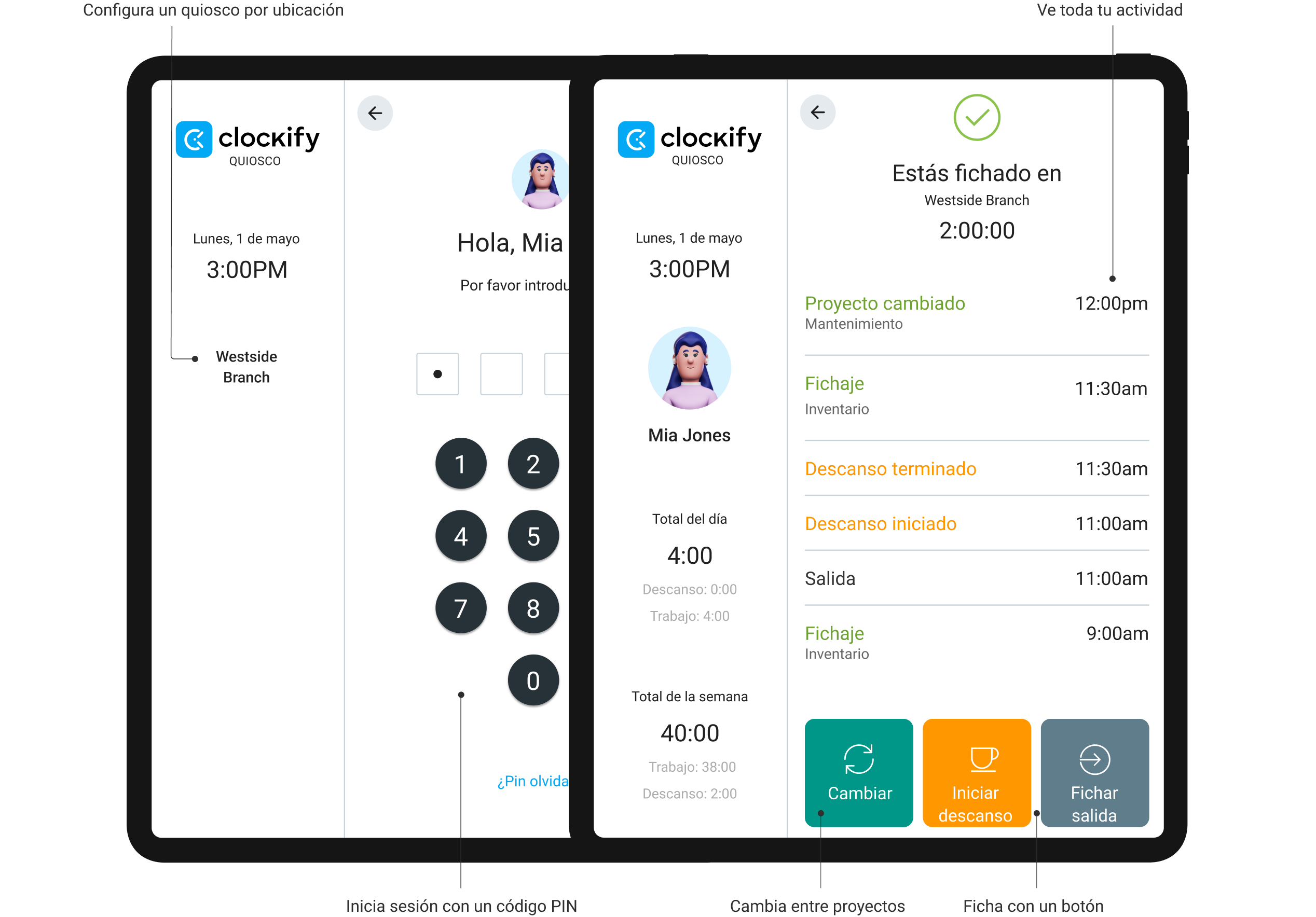
Cada empleado recibe un código PIN o QR único que puede usar para fichar su entrada y salida fácilmente, iniciar un descanso o cambiar de proyecto. La captura de foto, cuando está activada, evita el “buddy punching”, asegurando que el empleado regrese de su descanso a tiempo y sin infringir las normas.
Pero el quiosco no es la única forma de registrar el tiempo de trabajo y descanso en Clockify. Por ejemplo, los usuarios pueden utilizar el temporizador o el modo manual. Para agilizar el control de tiempo, aquí hay algunos atajos de teclado en la aplicación web:
- N — para iniciar el temporizador
- S — para detener el temporizador
- C — para continuar registrando el tiempo en la última entrada
- M — para cambiar al modo manual
Independientemente del método de registro de tiempo utilizado, los empleados siempre pueden enviar sus horas registradas para la aprobación. Incluso si un empleado olvida registrar un descanso obligatorio y el gerente ya ha aprobado la planilla semanal, el administrador puede revocar la aprobación para garantizar que los registros reflejen el cumplimiento de las normas sobre descansos.
Preguntas frecuentes sobre las leyes de descanso en EE. UU.
Para obtener más información sobre las leyes estadounidenses sobre los descansos, consulta esta sección de preguntas frecuentes, donde respondemos a las preguntas más comunes.
¿Son legalmente requeridos los descansos en EE. UU.?
Los empleadores que trabajan en los estados de EE. UU. gobernados por el gobierno federal no tienen una obligación legal de ofrecer descansos a sus empleados. Si deciden hacerlo, necesitan cumplir con las políticas federales y pagar los descansos si duran menos de 20 minutos.
Si el estado en cuestión tiene sus propias leyes de descanso que ofrecen mejores beneficios a los empleados, los empleadores tienen una obligación legal de adherirse a ellas.
¿Cuánto dura una pausa para comer?
No existen leyes federales que regulen la duración de las pausas para el almuerzo. La mayoría de los estados que exigen pausas para comer estipulan que estas deben durar 30 minutos o más.
¿Los descansos para comer cuentan como horas de trabajo?
Si la pausa para el almuerzo dura 20 minutos o menos, debe ser remunerada, según la ley federal. Si el empleado trabaja más horas de las planificadas, este tiempo se contabilizará como horas extras. En este caso, los empleados no exentos deben recibir el pago de horas extras para garantizar el cumplimiento de la normativa. Esto no aplica a los empleados exentos.
El derecho de un empleado exento a una pausa para comer o descansar depende de las leyes estatales y del empleador específico.
¿Cuánto tiempo se puede trabajar sin pausa?
La ley federal no obliga a los empleadores a ofrecer pausas a los empleados. Por lo tanto, si ninguna ley federal exige descansos, los empleados pueden trabajar todo el tiempo que quieran sin pausa.
¿Qué estados exigen descansos?
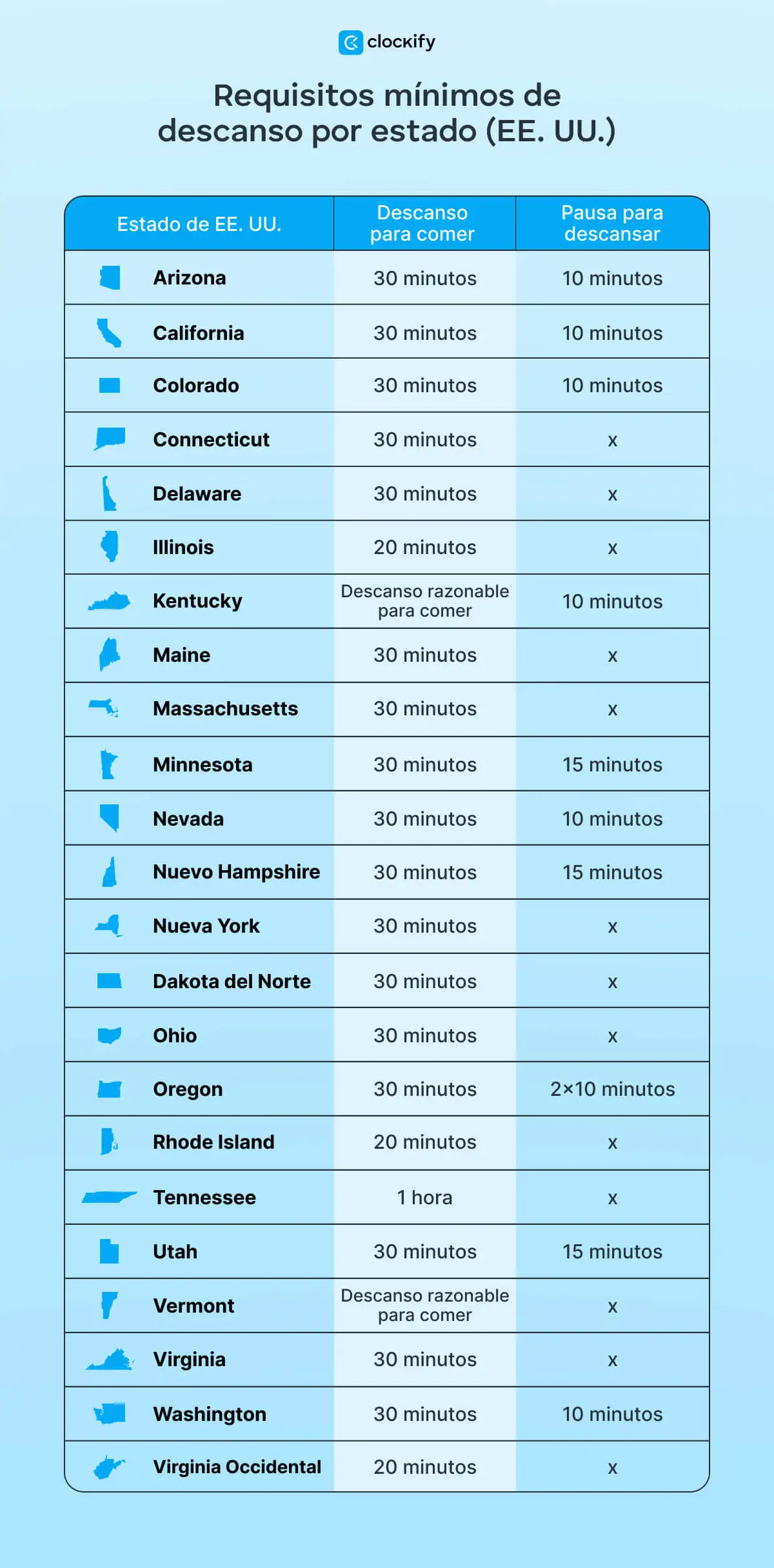
Los estados de EE. UU. que legalmente exigen que los empleadores proporcionen pausas para comer o descansar a sus empleados son: Arizona, California, Colorado, Connecticut, Delaware, Illinois, Kentucky, Maine, Massachusetts, Minnesota, Nevada, Nuevo Hampshire, Nueva York, Dakota del Norte, Ohio, Oregón, Rhode Island, Tennessee, Utah, Vermont, Virginia, Washington y Virginia Occidental.
¿Qué sucede si los empleadores infringen las leyes sobre descansos?
Los empleadores que infringen las leyes sobre descansos están sujetos a una multa. Por ejemplo, en Washington, los empleadores que no permiten que un empleado menor de edad tome un descanso para comer o descansar, según lo estipula la ley estatal, pueden ser multados con entre 300 $ y 1000 $.

Conclusión y descargo de responsabilidad
Ten en cuenta que esta guía de leyes de descansos fue revisada y actualizada en julio de 2026. Por lo tanto, es posible que no incluya los cambios introducidos después de su publicación.
Te recomendamos consultar las instituciones adecuadas y/o los representantes certificados antes de tomar acciones legales.
Clockify no es responsable de ningunas pérdidas o riesgos incurridos si esta guía se usa sin la orientación legal.
Cómo revisamos esta publicación: Nuestros escritores y editores monitorean las publicaciones y las actualizan cuando hay nueva información disponible, para mantenerlas frescas y relevantes.