Classify apps & websites
You can turn raw activity tracking data into meaningful insights by classifying detected applications and websites in Activity monitoring.
To start classifying apps and websites:
- Zu Monitoring
- Wählen Productivity
- Assign the following classifications to each app/website:
- Productive: Used for work-related activities
- Neutral: Used for context-dependent activities
- Unproductive: Used for non-work activities
- Undefined: No rule for this app/website yet
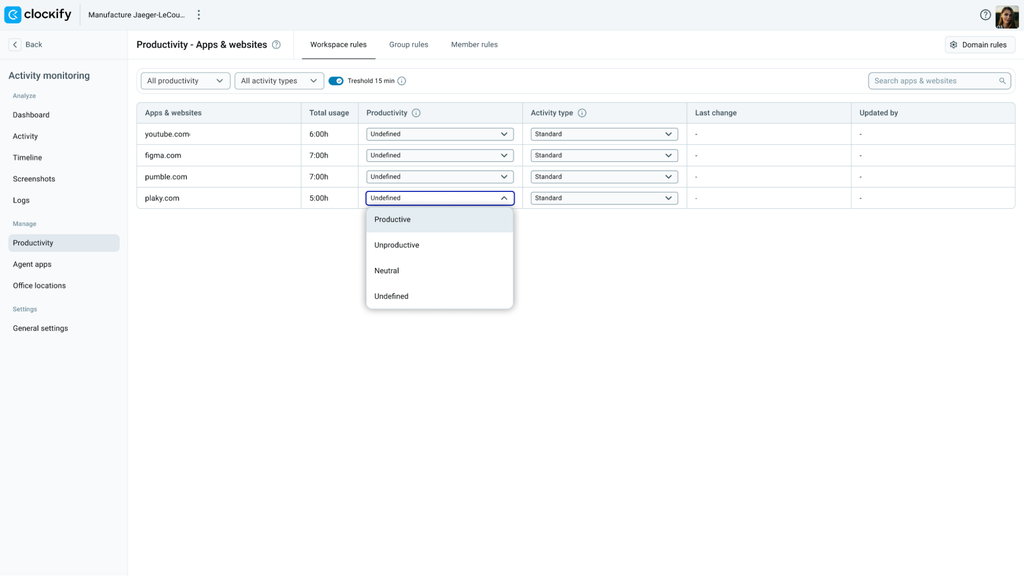
Use the filters above the table view the productivity and activity type by category. Enable the Threshold 15 min toggle to see tools that have more than 15 minutes of activity.
Important Hierarchy Rules #
To track and categorize user activity, the system evaluates productivity rules using three priority levels.
Scope priority #
Productivity rules are resolved using a specific priority order: Member → Group → Workspace.

- Member rules always override Group and Workspace rules
- Group rules override default Workspace configurations
- Workspace rules act as the global fallback for the entire organization
Admins can classify productivity for these rules in the Productivity – Apps & Websites nicht sehen.
Cross-functional group conflict resolution #
If an employee belongs to different groups that classify the same app or website differently, the system resolves the conflict by applying the most permissive rule.

Example: If an employee belongs to both Group A (with youtube.com marked as Unproductive) and Group B (with youtube.com marked as Productive), the system will treat youtube.com as Productive.
This rule prevents cross-functional employees from being unfairly penalized while performing legitimate work across different teams and ensures that their productivity scores remain accurate.
Rule priority (within the same scope) #
When the system evaluates rules within a single scope level (e.g. Workspace-level rules), priority is given to exact matches.

- Specific rule: Exact matches (e.g. docs.google.com) always take the highest priority.
- Domain Wildcard rule: Broad, catch-all rules (e.g. *.google.com) only apply when no specific rule exists.
- Undefined: Final fallback state if no specific or wildcard rules exist.
Use domain wildcard rules #
A domain wildcard rule is a “catch-all” setting that automatically applies a classification to every possible subdomain under a main site.
Instead of manually categorizing each subdomain (like mail.google.com and docs.google.com) one by one, a wildcard rule covers them all instantly.
How to create a domain wildcard rule:
- Klicke auf Domain rules at the upper right corner in the Productivity page
- Im Abschnitt Domain pattern field under the Input Pattern section, input the syntax strictly starting with *. (for example, *.plaky.com). Only standard numbers, lowercase letters, hyphens, and dots are allowed.
- Assign the Productivity (Productive, Unproductive, or Neutral) and the Anwendungsbereich (Workspace, Group, or Member) from the dropdowns
- Klicke auf Add Rule
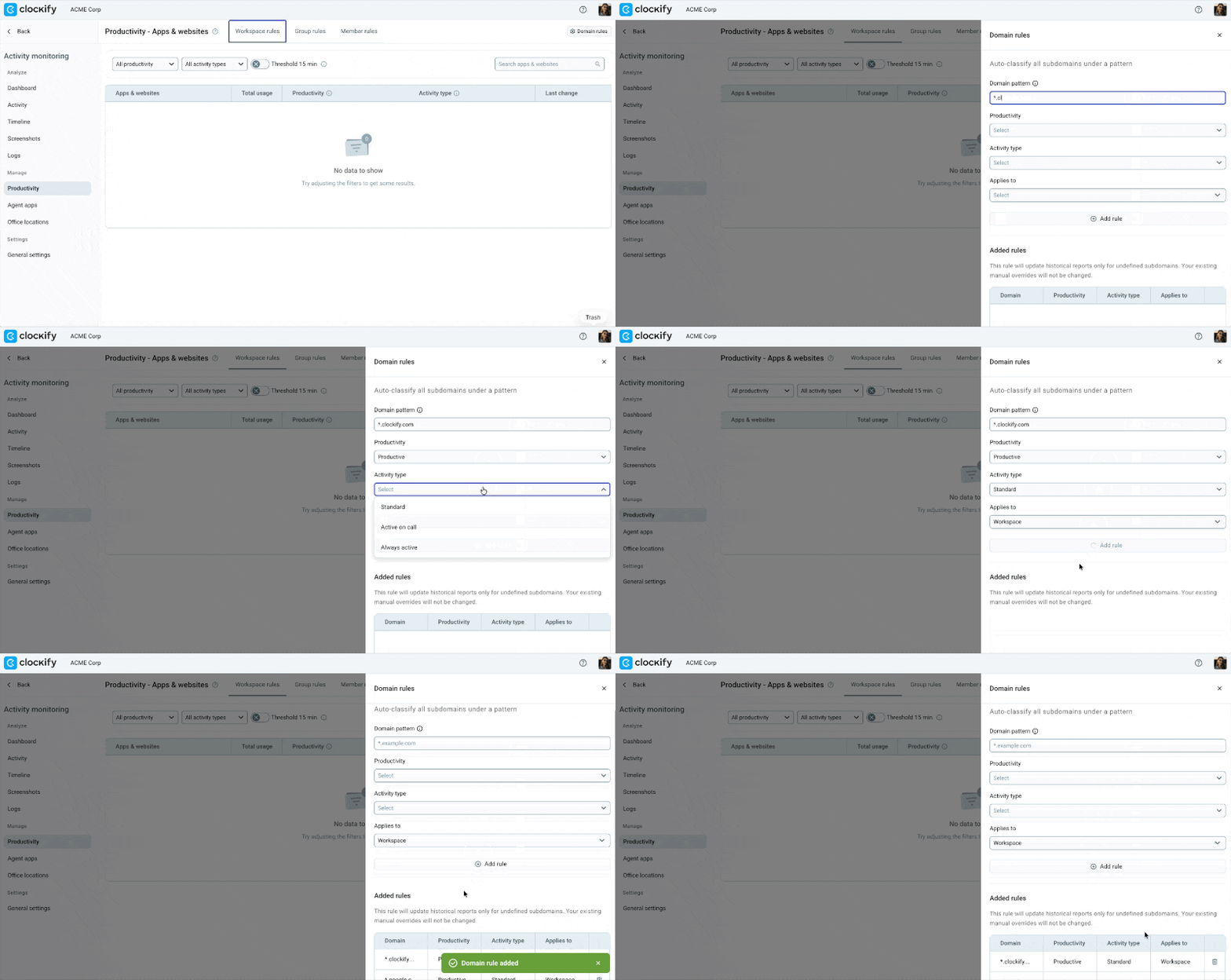
The newly created rule should now be visible in the Added rules table.
Häufig gestellte Fragen #
What happens if an employee belongs to multiple groups with conflicting productivity rules?
The productivity rule is applied based on this priority: Productive overrides Neutral, and Neutral overrides Unproductive. This logic prevents cross-functional employees from being unfairly penalized when performing legitimate tasks across different teams.
How does the system track active time for different types of applications, such as video conferencing tools?
Workspace admins can assign specific activity types to dictate how active time is interpreted for each application or website. The system uses three distinct tracking methods:
- Standard: Tracks active time based strictly on keyboard and mouse movement.
- Active on Call: Keeps the user active while their microphone or camera is in use.
- Always Active: Keeps the user active as long as the application is open and in focus on the screen.
Can Team Managers set up domain wildcard rules for the entire workspace?
No, team managers cannot modify workspace defaults or create workspace domain rules. Team managers only have permission to manage rules for the specific teams, groups, and members assigned to them. Creating company-wide domain rules, managing workspace defaults, and triggering historical recalculations is exclusively restricted to admins.
Why might a recently used application or website not appear in the directory table?
If an application or website has a total usage time of less than 15 minutes, it will be automatically hidden from the main directory view.