
As of 2026, 26 states have right-to-work laws covering both private and public-sector workers. This guide covers the full list of right-to-work states and what these laws mean for employers.
- A right-to-work law prohibits employers from requiring employees to join a labor union or pay union dues as a condition of employment.
- In 2026, 26 US states (plus Guam) have right-to-work laws covering both private and public-sector employees.
- Michigan repealed its right-to-work law effective Feb. 13, 2024, but public-sector workers remain protected by a federal constitutional right.
- Multi-state employers must apply different rules in different locations based on each state’s right-to-work status. This is where a workforce management tool like Clockify can make a difference.
What is a right-to-work state?
A right-to-work state is a US state that has passed a right-to-work law prohibiting employers from requiring union membership or union dues as a condition of employment.
In a right-to-work state, workers can choose whether to join a union without risking their jobs. Similarly, employers also can’t withdraw union dues from an employee’s wages without their consent.
What is a union security agreement?
A union security agreement is a contract between an employer and a labor union that requires employees to join the union or pay union dues as a condition of keeping their jobs. Right-to-work laws specifically prohibit these agreements.
In states without right-to-work laws, union security agreements are generally permitted.
What is the opposite of a right-to-work state?
The opposite of a right-to-work state is a state without a right-to-work law. In those states, employers may enter into union security agreements that make union membership or fee payment a condition of employment. Roughly half of US states fall into this category.
Staying on top of labor law compliance gets harder as your workforce grows across state lines. A workforce management tool like Clockify helps you keep accurate, location-specific records for every employee. That way, you’re always ready to apply the right rules and respond to compliance questions as they come up.

How many states have right-to-work laws?
As of 2026, 26 US states (plus Guam) have right-to-work laws that apply to both private and public-sector workers.
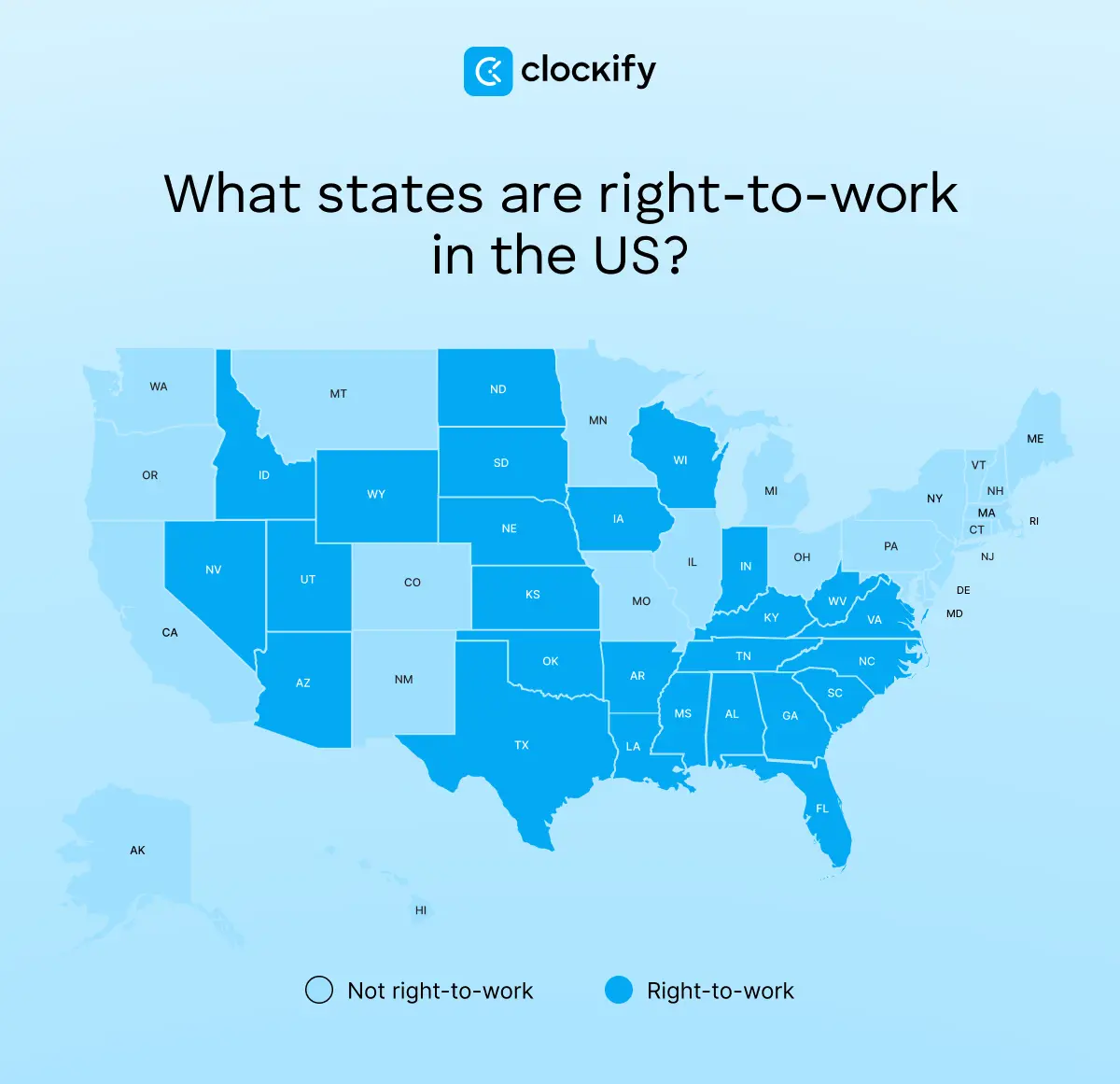
Michigan right-to-work update
In February 2024, Michigan repealed its right-to-work law, making it the first state in decades to roll back such protections. The repeal means private sector workers in Michigan can now be required to pay union dues as a condition of employment.
Public sector workers in Michigan are in a different position, as they’re protected by a federal constitutional right rather than a state law. The US Supreme Court established this right in its 2018 ruling in Janus v. American Federation of State, County, and Municipal Employees (AFSCME). The ruling held that public employees can’t be compelled to financially support a union because this protection is rooted in the First Amendment, and no state legislature can override it.
So, while Michigan no longer has a right-to-work law on its books, public sector workers there still can’t be forced to pay union dues. That protection exists because of federal constitutional law, not because Michigan chose to preserve it.
What right-to-work laws mean for employers
Right-to-work laws impose clear restrictions on what employers may require of workers regarding union membership.
Here’s what employers in right-to-work states CAN’T DO:
- Require employees to join a labor union as a condition of employment
- Require employees to pay union dues or fees as a condition of employment
- Require employees to leave a labor union as a condition of employment
- Discriminate in hiring or retention based on union membership or nonmembership
If a union is present in their workplace, here’s what employers in right-to-work states still MUST DO:
- Recognize the union as the bargaining representative of covered employees
- Bargain collectively in good faith, as required by the National Labor Relations Act (NLRA)
- Honor the terms of any existing collective bargaining agreement
The NLRA is a federal law that governs private-sector employees’ rights to organize and bargain collectively. It applies in all 50 states, regardless of right-to-work status.
💡 CLOCKIFY-PRO-TIPP
Learn more about compliance laws and regulations for businesses operating in the US:
Multi-state employers
If your business operates across multiple states, you must apply different rules depending on each state’s right-to-work status. For example, a payroll deduction that’s prohibited in Texas may be legally required under a collective bargaining agreement in California.
Penalties for violating right-to-work laws vary by state. According to the National Right to Work Foundation (NRTW):
- Some states classify violations as misdemeanors, including Florida, South Dakota, Tennessee, and Utah.
- Some states allow employees to pursue civil damages, such as Kansas.
- Other states route penalties through labor relations boards.
Document which state’s labor rules apply to each employee based on their work location, and review your employment agreements accordingly.
See what else is regulated by the rule of law in each state with our detailed state labor laws guides.
List of right-to-work states (2026)
The following 26 states have right-to-work laws covering both private and public-sector employees:
US states with right-to-work laws | ||
|---|---|---|
| Alabama | Kentucky | South Dakota |
| Arizona | Louisiana | Tennessee |
| Arkansas | Mississippi | Texas |
| Florida | Nebraska | Utah |
| Georgia | Nevada | Virginia |
| Idaho | North Carolina | West Virginia |
| Indiana | North Dakota | Wisconsin |
| Iowa | Oklahoma | Wyoming |
| Kansas | South Carolina | *Guam |
*Guam is an organized, unincorporated territory of the United States.
States without right-to-work laws (2026)
The following states and the District of Columbia don’t have right-to-work laws. Union security agreements may be permitted under applicable state law in these jurisdictions.
US states without right-to-work laws | ||||
|---|---|---|---|---|
| Alaska | District of Columbia | Massachusetts | New Hampshire | Oregon |
| California | Hawaii | Michigan | New Jersey | Pennsylvania |
| Colorado | Illinois | Minnesota | New Mexico | Rhode Island |
| Connecticut | Maine | Missouri | New York | Vermont |
| Delaware | Maryland | Montana | Ohio | Washington |
State-by-state right-to-work status
The table below shows the right-to-work status of all 50 US states and the District of Columbia. For states without right-to-work laws, this table applies to workers employed by federal, state, or local governments.
| State | Right-to-work law | Explanation of the law | Additional notes |
|---|---|---|---|
| Alabama | ✅ | Alabama’s right-to-work law states that no employer may require employees, as a condition of employment, to join a union, remain in a union they previously joined, or pay union dues as a nonmember. | / |
| Alaska | ❌ | / | Following the Janus v. AFSCME decision, Alaska’s Attorney General stated that the state should prohibit employers from withdrawing union dues from an employee’s paycheck without the employee’s explicit authorization. |
| Arizona | ✅ | Arizona’s right-to-work law prohibits employers from denying employment based on union membership or nonmembership, and from coercing employees into joining a union. | / |
| Arkansas | ✅ | Arkansas’s right-to-work law states that employees are free to join, form, or assist a labor union, bargain collectively or individually, or refuse to join a union. Employees who refuse to join a union aren’t required to pay union dues. | / |
| California | ❌ | / | Under California’s State Employer-Employee Relations Act, state employees may join or refrain from joining a labor union. However, a nonmember may be required to pay a fair share fee for the union’s representational services. |
| Colorado | ❌ | / | Under the Colorado Labor Peace Act, employees at most workplaces have the right to join or refrain from joining a labor union. However, employers may enter into an all-union agreement that requires employees to pay union dues as a condition of employment. |
| Connecticut | ❌ | / | Under Connecticut’s Labor Relations Act, most employers can’t require an employee to join a union or refrain from doing so. However, employers may enter into an agreement requiring union membership as a condition of employment. Following the Janus v. AFSCME decision, public employers can’t deduct union fees from a nonmember’s wages without the employee’s authorization. |
| Delaware | ❌ | / | Under Delaware’s Public Employment Relations Act, public employees have the right to join or refrain from joining a labor union. However, employers may enter into a collective bargaining agreement requiring nonmembers to pay a fair share fee through their wages. |
| District of Columbia | ❌ | / | Under DC Code Section 1-617.06, all employees have the right to join or refrain from joining a labor union. However, an employee may be required to become a union member as a condition of employment if an agreement requires it. If no such agreement exists and the employee opts out of membership, they may still be required to pay union fees under DC Code Section 1-617.11. |
| Florida | ✅ | Florida’s right-to-work law protects employees’ rights to join or form a labor union, refrain from joining a union, and choose their own representative for collective bargaining. Violations are classified as a second-degree misdemeanor. | / |
| Georgia | ✅ | Georgia’s right-to-work law makes it unlawful to coerce employees into joining or leaving a labor union, or to require any payment to a labor organization as a condition of employment. | / |
| Hawaii | ❌ | / | Under Hawaii Revised Statutes Section 89-3, public employees have the right to join or refrain from joining a labor union. However, employers may enter into a collective bargaining agreement requiring all employees to join the union or pay an equivalent amount in dues as a condition of employment. |
| Idaho | ✅ | Idaho’s right-to-work law guarantees freedom of choice in employment. Employers can’t require employees, as a condition of employment, to join or remain in a union against their will, to pay any amount to a labor organization, or to be cleared by a labor union before being hired. | / |
| Illinois | ❌ | / | Under the Illinois Public Labor Relations Act, public employees have the right to join or refrain from joining a labor union. Employers may enter into a collective bargaining agreement requiring nonmembers to pay a fair share fee. |
| Indiana | ✅ | Indiana’s right-to-work law prohibits agreements that would require employees to become union members, pay union dues or fees, or pay an equivalent amount to a charity or third party. | / |
| Iowa | ✅ | Iowa’s right-to-work law gives employees the freedom to organize, join, or assist a labor union, participate in collective bargaining, refuse to join a union, or pay union dues voluntarily. | / |
| Kansas | ✅ | Kansas’s right-to-work law states that no one may be denied work on the basis of union membership or nonmembership. Employees whose rights are violated may take civil action for damages. | / |
| Kentucky | ✅ | Kentucky’s right-to-work law gives employees the freedom to choose whether to join or financially support a union. The law applies to most employees, with the exception of federal workers such as those in the airline industry. | / |
| Louisiana | ✅ | Louisiana’s right-to-work law states that all workers may join or refrain from joining any labor organization without fear of punishment. | / |
| Maine | ❌ | / | Under Maine’s Municipal Public Employees Labor Relations Law, public employees have the right to join or refrain from joining a labor union. However, an employee may be required to pay a fair share fee for union representational services. |
| Maryland | ❌ | / | Under Maryland’s Labor and Employment Statute, any oral or written promise about union membership made between an employer and an employee is invalid. Under Maryland’s Collective Bargaining Law, state employees may join or refrain from joining a union. Employers may not deduct a fair-share fee from nonmembers’ wages without their consent. However, employees may still be required to pay union fees if they are represented by that union. |
| Massachusetts | ❌ | / | Under Massachusetts Labor Relations Law, employees at most workplaces have the right to join or refrain from joining a labor union. However, employers may enter into an agreement that requires union membership or payment of dues as a condition of employment. |
| Michigan | ❌ | / | Michigan repealed its right-to-work law in February 2024. Private sector workers in Michigan can now be required to pay union dues as a condition of employment. However, public sector workers are still protected under federal constitutional law. Under the Janus v. AFSCME decision, public employees can’t be compelled to financially support a union. |
| Minnesota | ❌ | / | Under Minnesota Statutes Section 179A.06, public employees have the right to join or refrain from joining a labor union. Employers may enter into an all-union agreement with the employees’ representative. Nonmembers may also be required to pay a fair share fee for union representational services. |
| Mississippi | ✅ | Mississippi’s right-to-work law prohibits denying employment to anyone for refusing to join a labor organization or refusing to pay union fees. | / |
| Missouri | ❌ | / | Under Missouri’s Revised Statutes of Missouri (RSMo) Section 105.510, employees have the right to join or refrain from joining a labor union. However, this act applies only in counties where a majority of voters have approved it by ballot question. |
| Montana | ❌ | / | Under Montana Code Annotated Section 39-31-201, public employees have the right to join a labor union or bargain collectively. Whether employees may refrain from joining isn’t clearly stated in the statute. State employees represented by a union may be required to pay a union fee if a collective bargaining agreement requires it. |
| Nebraska | ✅ | Nebraska’s right-to-work law prohibits denying employment on the basis of union membership or nonmembership. No individual, association, or corporation may enter into any agreement excluding anyone from employment based on union affiliation or lack thereof. | / |
| Nevada | ✅ | Nevada’s right-to-work law makes it unlawful to enter into any agreement requiring a person to become a member of a labor union or refrain from doing so as a condition of employment. | / |
| New Hampshire | ❌ | / | Under New Hampshire’s Public Employee Labor Relations Act, public employers can’t deny employees the right to join a labor union or bargain collectively. Employees may be required to pay certain fees to a union if they’re represented by that union. |
| New Jersey | ❌ | / | The New Jersey Law Against Discrimination prohibits employers and labor unions from discriminating against people based on race, age, gender, marital status, or other protected characteristics. |
| New Mexico | ❌ | / | Under New Mexico House Bill 85, employers not governed by the NLRA may enter into union security agreements with labor organizations. |
| New York | ❌ | / | Under the New York State Public Employees’ Fair Employment Act, public employees have the right to join or refrain from joining a labor union. However, employers may enter into an agreement requiring union membership as a condition of employment. |
| North Carolina | ✅ | North Carolina’s right-to-work law makes it unlawful to require union membership, payment of union dues, or leaving a labor union as a condition of employment. | / |
| North Dakota | ✅ | North Dakota’s right-to-work law gives employees the freedom to join, form, or assist a labor union, bargain collectively through a representative of their choice, or refuse to join a union. | / |
| Ohio | ❌ | / | Under the Ohio Revised Code, any oral or written promise about union membership made between an employer and employee is invalid. Public employees have the right to join or refrain from joining a labor union. However, employers may enter into an agreement requiring nonmembers to pay a fair share fee as a condition of employment. |
| Oklahoma | ✅ | Oklahoma’s right-to-work law makes it unlawful to use employment conditions to require union membership or nonmembership, require payment of union dues, or require workers to be cleared through a labor union before being hired. | / |
| Oregon | ❌ | / | Under Oregon Revised Statutes Section 663.110, employees at most workplaces have the right to join or refrain from joining a labor union. However, employers may enter into an agreement requiring each employee to become a union member as a condition of employment. |
| Pennsylvania | ❌ | / | Under the Pennsylvania Labor Relations Act, employees at most workplaces have the right to join a labor union or bargain collectively. Employers may enter into an agreement requiring union membership as a condition of employment. |
| Rhode Island | ❌ | / | Under the Rhode Island Labor Relations Act, employees at most workplaces have the right to join or refrain from joining a labor union. However, employers may enter into an agreement that requires union membership or payment of dues as a condition of employment. |
| South Carolina | ✅ | South Carolina’s right-to-work law prohibits employers from using the condition of employment to require union membership, leaving a union, or payment of union dues. | / |
| South Dakota | ✅ | South Dakota’s right-to-work law makes it unlawful to deny work to someone for refusing to join or leave a labor organization, or to enter into any agreement that would violate a person’s right to work. Violations are classified as misdemeanors. | / |
| Tennessee | ✅ | Tennessee’s right-to-work law allows employees to freely join or leave a labor organization, bargain individually or collectively, and refuse to pay union fees. Employer violations are classified as a Class A misdemeanor. | / |
| Texas | ✅ | Texas’s right-to-work law protects workers from being denied employment for refusing to join or leave a labor organization, or for failing to pay union fees. | / |
| Utah | ✅ | Utah’s right-to-work law makes it unlawful for employers to require any person to join or refrain from joining a labor union, or to pay union dues, as a condition of employment. Violations are classified as a misdemeanor. A person denied employment in violation of this law is entitled to compensation. | / |
| Vermont | ❌ | / | Under Vermont’s State Employees Labor Relations Act, state employees have the right to join or refrain from joining a labor union. Employers may enter into an agreement requiring union membership as a condition of employment. Nonmembers may also be required to pay a fair share fee for union representational services. |
| Virginia | ✅ | Virginia’s right-to-work law prohibits employers from denying employment based on union membership or nonmembership, from requiring payment of union fees, or from entering into any agreement that requires union membership as a condition of employment. | / |
| Washington | ❌ | / | Under Revised Code of Washington Section 41.80.050, state employees have the right to join or refrain from joining a labor union. Nonmember employees may be required to pay a fair share fee for union representational services. |
| West Virginia | ✅ | West Virginia’s right-to-work law gives employees the freedom to join or leave any labor union and to refuse to pay union dues. | / |
| Wisconsin | ✅ | Wisconsin’s right-to-work law gives employees the right to join any labor organization or refrain from doing so. Employees also can’t be required to pay union dues. | / |
| Wyoming | ✅ | Wyoming’s right-to-work law prohibits employers from requiring employees to join a labor union or pay union dues as a condition of employment. | / |
History of right-to-work laws
Right-to-work laws in the United States emerged from the labor legislation of the 1930s and 1940s.
The National Labor Relations Act, also known as the Wagner Act, was passed in 1935. It established private-sector employees’ rights to organize, form labor unions, and bargain collectively. The Wagner Act also permitted union security agreements, meaning employers and unions could require union membership as a condition of employment.
The Labor Management Relations Act, commonly known as the Taft-Hartley Act, amended the NLRA in 1947. It gave individual states the authority to pass right-to-work laws prohibiting mandatory union membership and dues.
Recording precise hours is essential for compliance with timekeeping laws because payroll deductions, overtime calculations, and wage disputes all depend on an accurate record of hours worked.
Clockify lets employees track work hours by project, task, or client — either manually or with the Timer. Each entry is timestamped and tied to a specific employee.

Try Clockify to improve compliance
Who is covered under right-to-work laws?
According to the National Labor Relations Board, most private-sector workers are covered by the National Labor Relations Act (applies only at the federal level).
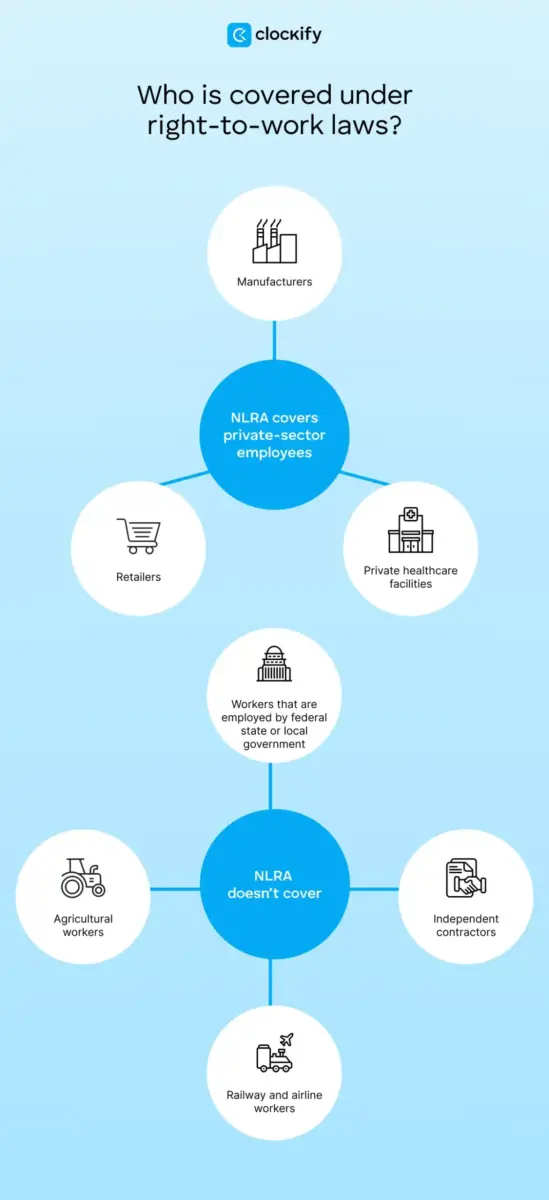
To be more specific, the NLRA refers to most private-sector employees, such as those employed in:
- Retail
- Manufacturing
- Private healthcare facilities
On the other hand, the NLRA doesn’t cover:
- Agricultural workers
- Independent contractors
- Workers who are employed by federal, state, or local government
- Railway and airline workers (governed by the Railway Labor Act, not the NLRA)
As for those workers not covered by the NLRA, their right-to-work laws vary by state.
💡 CLOCKIFY-PRO-TIPP
If you employ contractors or freelancers, the following articles will help you understand how to track their work hours and pay them properly:
Right-to-work vs. at-will employment: What’s the difference?
Right-to-work laws govern the relationship between employees and labor unions. These laws determine whether workers can be forced to join a union or pay union fees to keep their jobs.
At-will employment laws govern the employer-employee relationship with respect to employment termination. In an at-will state, an employer can dismiss an employee at any time, for any legal reason, without prior notice or cause. The employee can also leave at any time without penalty.
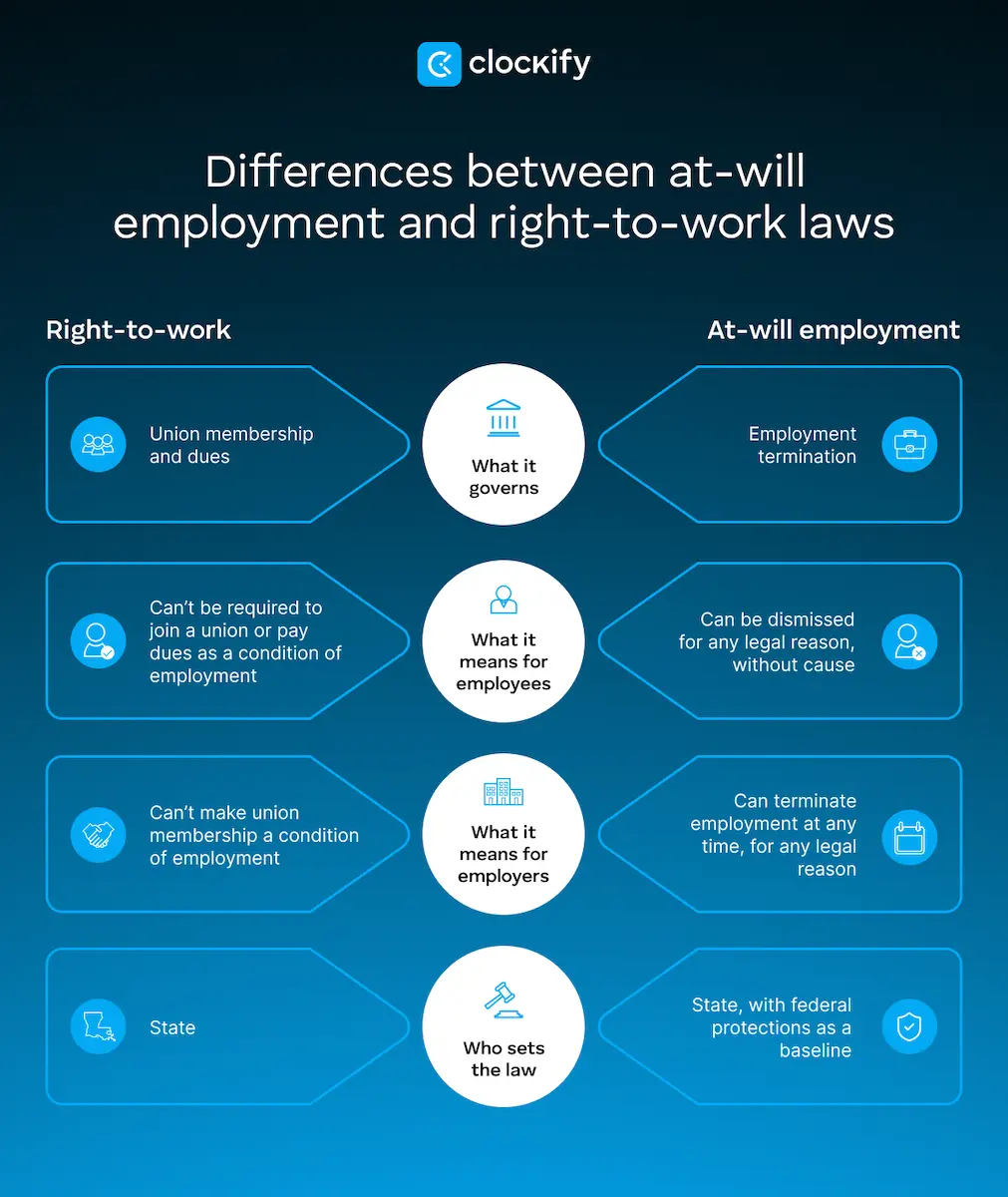
Here’s a direct comparison:
| Differences | Right-to-work | At-will employment |
|---|---|---|
| What it governs | Union membership and dues | Employment termination |
| What it means for employees | Can’t be required to join a union or pay dues as a condition of employment | Can be dismissed for any legal reason, without cause |
| What it means for employers | Can’t make union membership a condition of employment | Can terminate employment at any time, for any legal reason |
| Who sets the law | State | State, with federal protections as a baseline |
A state can have right-to-work laws without being an at-will state, and vice versa.
For a full breakdown, see our guide on at-will employment states.
Manage workforce compliance with Clockify by CAKE.com
Operating across multiple states means managing different labor law requirements for different employees, including right-to-work rules.
A powerful tool like Clockify helps with the parts of compliance that depend on accurate records, such as:
- Where employees work
- How many hours workers log
- How that data is documented over time
Clockify von CAKE.com KOSTENLOS testen
If you have employees in multiple states, you can make the location tag a required field, so no one can create a time entry without tying it to a specific state.

Tagging employees by location means payroll and HR teams always know which state’s rules apply to which employee, without having to cross-reference spreadsheets or rely on memory.
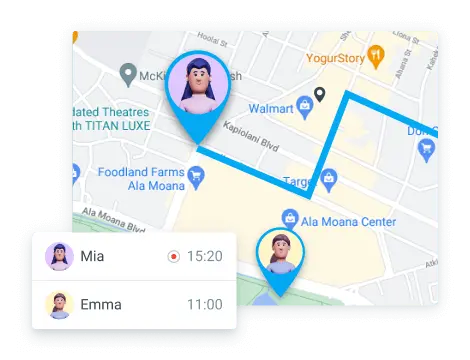
Additionally, Clockify’s Location feature provides GPS tracking for employees who log in via Kiosk or the mobile app. This is especially useful for tracking the location of on-site workers.
Clockify by CAKE.com also generates reports that break down hours, overtime, and time off by employee, team, project, tag, and date range. Reports can be exported as PDF, CSV, or Excel files.

Labor law compliance often comes down to recordkeeping. If your business is ever audited (e.g., for union-related grievances), exportable reports give you a fast way to produce the records that an auditor or attorney requests.
Clockify gives HR and payroll teams one system to track employee work data across all locations, regardless of which state’s labor laws apply to a given employee.
KOSTENLOS bei Clockify registrieren
FAQs about right-to-work states
To provide you with additional information about right-to-work states, we’ve answered some frequently asked questions.
What makes a state a right-to-work state?
A state becomes a right-to-work state by passing a law that prohibits employers from requiring employees to join a labor union or pay union dues as a condition of employment.
How many states have right-to-work laws?
As of 2026, 26 states have passed right-to-work laws covering both private and public-sector workers. Michigan repealed its right-to-work law in 2024, even though public-sector workers there are still protected by a federal constitutional right.
Do right-to-work laws hurt unions?
Right-to-work laws could hurt unions by reducing the dues revenue available to unions, since membership and dues payments are voluntary. Unions in right-to-work states must still represent all employees in a bargaining unit — including those who choose not to pay dues. This is commonly referred to as the “free-rider effect.”
What are the pros and cons of right-to-work laws?
Pros of right-to-work laws:
- Workers can choose whether to join a union or pay dues.
- Employers have more flexibility in employment agreements.
Cons of right-to-work laws:
- Unions receive less funding, which may limit their bargaining capacity.
- Non-dues-paying workers still benefit from union negotiations (the free-rider effect).
Is right-to-work law a good thing?
Whether a right-to-work law is good depends on perspective. Right-to-work laws protect individual workers from being forced to fund a union.
Supporters argue that this increases worker freedom and encourages business growth. Critics argue these laws weaken collective bargaining power and can lead to lower wages. The economic evidence is genuinely mixed, and this is a politically contested question with reasonable disagreements on both sides.
What are the disadvantages of right-to-work laws?
The main disadvantage of right-to-work laws is reduced union funding. When dues are optional, unions collect less revenue, which can limit their capacity to negotiate wages and benefits on behalf of workers.
How can I tell if my state is right-to-work?
To see whether your state is right-to-work, check the state table in this guide, or refer to the National Right to Work Foundation (NRTW).

Disclaimer
We hope our right-to-work states guide for 2026 has helped you better understand the concept and regulations regarding right-to-work laws in the United States.
Please bear in mind that this article was written in Q2 of 2026. Thus, it may not include changes introduced after it was published.
Right-to-work laws are subject to change, so always verify current law with an official source or a qualified labor attorney before making compliance decisions.
Clockify by CAKE.com isn’t responsible for any losses or risks incurred should this guide be used without legal guidance.
So haben wir diesen Beitrag überprüft: Unsere Autoren und Redakteure überwachen die Beiträge und aktualisieren sie, wenn neue Informationen verfügbar werden, um sie aktuell und relevant zu halten.