When new hires join your company, you need to provide them with performance standards — the expectations about their roles and responsibilities in the workplace. Such expectations apply to all employees in your company.
In this article, we’ll guide you through the purpose of performance standards, give examples, and explain how to create them.
- Performance standards define expectations, requirements, and threshold that workers have to meet at their workplace.
- Types of performance management are strategic, operational, and individual performance management.
- Performance standards should be motivational, realistic, transparent, and should include a trial period.
- When creating performance standards, you should focus on the positions instead of individuals, choose parameters and tasks, and include error rates and KPIs.
What are performance standards?
Performance standards are the rules that define requirements, expectations, and threshold employees have to meet in the workplace. Performance standards should be:
- Specific
- Objective
- Realistic
Employers must have performance standards in a written format.
Enhance performance with Clockify
The most common elements of performance standards are:
- Quality. This component refers to how well employees perform their job, and how accurate, useful, and effective they are.
- Quantity. This element refers to the amount of work produced. Employees should be aware of the results they have to achieve in the workplace.
- Timeliness. Employees should know their deadlines, and these deadlines should be realistic.
Managers and employers should decide how to measure these elements — whether with numbers or by describing each element. Also, performance standards should include the person responsible for analyzing and measuring employee performance.
What is the goal of performance standards?
The goal of performance standards is to ensure that both employers and employees are on the same page regarding job expectations. That’s why managers need to provide their new employees with the performance standards during the first month of employment.
Once an employer or a manager has evaluated the employees, their expectations can be:
- Met — if an employee showed adequate performance.
- Exceeded — if the performance is beyond well.
- Not met — if the performance is below the performance standards levels.
In the case of insufficient performance, the employer or supervisor has to issue a Performance Improvement Plan (PIP). The purpose of this document is to help an employee improve their performance.
The PIP happens in the last phase of the performance management cycle — the review phase. In brief, this is the phase when managers track employee performance — easily by tracking work hours and attendance with Clockify.
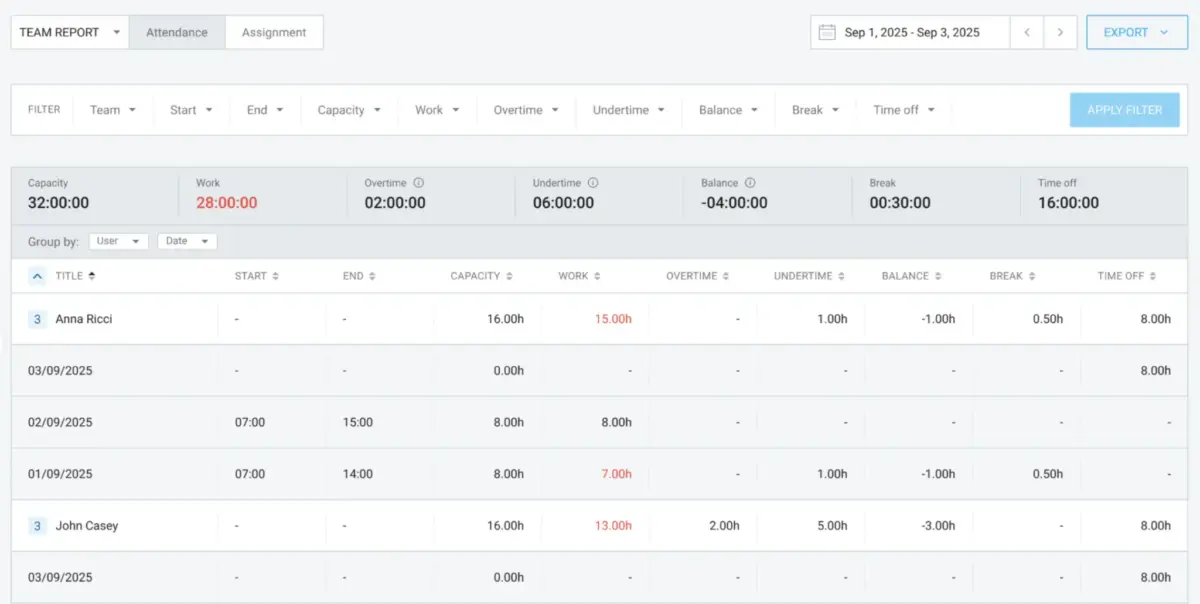
Clockify allows managers to review tracked hours, breaks, overtime, and capacity with an Attendance report. Just filter by employee to see an overview of their work hours.
How do you create a performance standard?
If you’re unsure how to start and what requirements you should cover when creating a performance standard, here are a few simple steps to ease this process.
#1: Focus on the position, not individual
No matter how many employees there are in the same position, the performance standards should be the same for all.
When it comes to general tasks that employees from various departments do, standards should be identical for conducting these tasks.
#2: Decide what tasks should be included in the standard
Choose what tasks are the most important for each position. Then, write performance standards only for these tasks.
By choosing the most significant ones, you’ll have a brief standard.
#3: Choose parameters that make a performance standard successful
Here are some indicators of an effective performance:
- Precision
- Respecting deadlines
- Customer satisfaction
- Showing signs of leadership
- Productivity
- Proactivity
- Creativity
- Quality of work
An employee with the beyond-expectations performance will show qualities such as:
- Professionalism
- Constantly following professional protocols
- Constantly improving their performance
- Showing engagement
- Being meticulous
- Having visionary ideas and solutions
- Expressing their own opinions

#4: Include KPIs
If you want to evaluate how individuals or teams are performing, you can also do this with Key Performance Indicators (KPIs).
KPIs can help you find out how your company is performing and if it’s going toward achieving its goals. As you can imagine, all workers need to align their performance with the company’s objectives. Plus, they need to do their job following performance standards.
When an employee shows inferior performance, one of the solutions can be a Performance Improvement Plan.
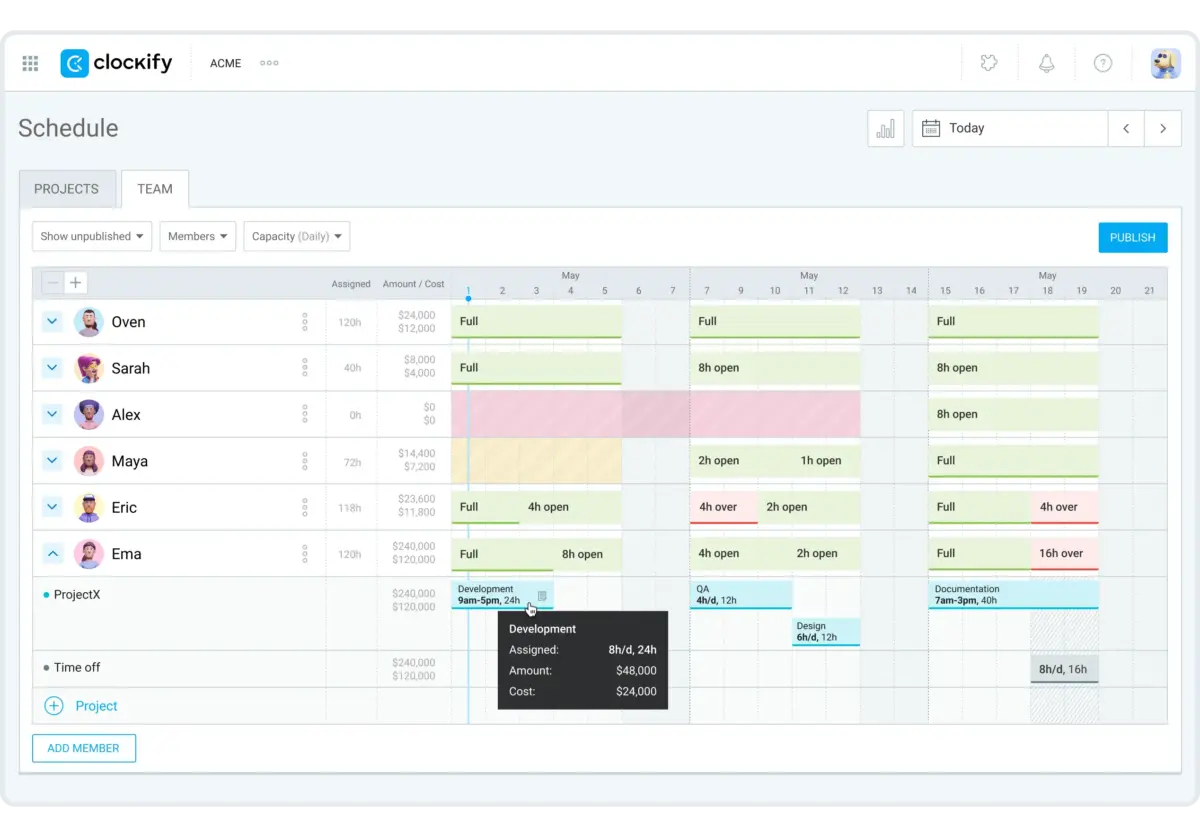
To keep an eye on team performance, you can use Clockify Scheduling. With this feature, you can schedule who works on what tasks, set recurring assignments, and see how your projects are progressing.
#5: Create standards for solid performance first, then the others
When creating performance standards, start with positive aspects. Then, continue with the qualities of the above-expected performance.
Once you have these 2 categories, focus on indicators that are below the solid levels. You can use phrases like this:
- An employee proves a solid performance when…
- An employee proves an above-expected performance when…
- An employee proves a below-appropriate performance when…
The in-depth explanation for each sentence will depend on the employee’s position.
#6: Think about the error rates
Decide how many errors are too many. For example, an employee can have a performance below the suitable levels twice. But if this happens again, you may give them an “Improvement needed” rating.
Track productivity with Clockify
What are the 3 levels of performance management?
There are 3 levels of performance management:
- Strategic performance management
- Operational performance management
- Individual performance management
Performance management is the communication process between employers and employees, which also involves giving feedback to the workers.
The purpose of strategic performance management is to achieve overall organizational goals. To accomplish these objectives, company management strives to answer these questions:
- Does this company have a strategy for achieving its goals and does the company implement it?
- Is the organization bringing the expected results?
The intention behind operational performance management is to get operational goals — to find out which specific projects and activities are working within the organization.
To reach these objectives, managers and employers have to answer the following questions:
- Is each department or project fulfilling its targets?
- Are operational activities aligned with the organizational strategy? If so, how do these activities promote organizational strategy?
Individual performance management focuses on the performance of each employee in the company. This process begins with setting work goals and standards, reviewing employee performance, and enhancing individual learning skills.
To carry out these goals, company management needs to get answers to these questions:
- How are individuals working?
- How can they boost their performance?
When reviewing employees’ work, performance standards are your point of reference. These standards are vital because they analyze diverse areas of performance.
What else to consider when establishing performance standards?
Here’s what to consider when setting performance standards for your team.
Standards should be realistic
As a manager, you should set realistic expectations and targets for your employees. Having achievable performance standards will make workers more inspired to do their job better.
One way to set targets for your team is to use Clockify goal tracker. In Clockify, you can add your goal as a project, then break it down into several tasks.
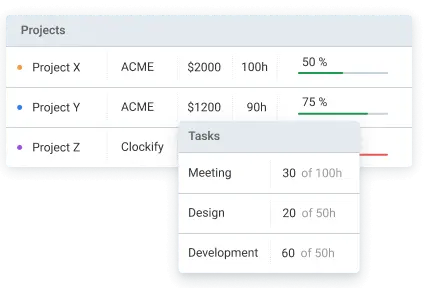
Next, instruct your employees to track their working hours by:
- Using a timer
- Logging time manually
- Recording time in a timesheet
You can even add estimates to your targets, so you can compare tracked vs. estimated tracked time.
With Clockify as an employee attendance tracker, you’ll know who was working on what tasks and for how long. Employee time tracking is beneficial to your employees, because they’ll be able to review their project progress. Also, Clockify allows you to duplicate time entries, which saves a lot of time if you have recurring tasks.
Standards should have a trial period
A trial period for performance standards should be between 6 and 8 weeks. Your employees should be included in a trial, as well as HR staff.
Once the trial period is over, ask your workers if current standards are suitable for them. If there are any issues, slightly modify the measures.
Including your employees in creating performance standards will boost trust between you and them, and they’ll feel like valued members of the company. Plus, this will increase employee productivity, too.
Standards should be transparent to all employees
Managers and employers have to be transparent about performance standards.
Throughout the year, leaders should remind employees about these measures. If workers need an explanation for some part of the standard, you as a manager should provide them with clarification.
What are the examples of performance standards?
Let’s see examples of performance standards in different fields.
#1: Performance standards for teachers
Let’s find out what performance standards would look like for teachers.
| Performance standards | What does it include? |
|---|---|
| Professional knowledge | The teacher shows an understanding of the curriculum and subject content, but understands the developmental needs of the students as well. The teacher also needs to show accurate knowledge and skills applicable to the subject areas taught. |
| Instructional planning | The teacher makes plans according to the curriculum and other appropriate standards, in order to fulfill the needs of the students. |
| Instructional delivery | The teacher uses diverse instructional strategies in order to enhance students’ existing knowledge and skills. |
| Assessment of and for student learning | The teacher analyzes all relevant data about the students, in order to evaluate their progress and provide students (and their parents) with constructive feedback. |
| Learning environment | The teacher takes advantage of all available resources, standards, and procedures, to create a student-centered environment for learning. |
| Professionalism | The teacher shows dedication to professional ethics and effectively takes part in the learning process of each student. The teacher also needs to have positive relationships with all parents/guardians by maintaining effective communication with them. |
| Student academic progress | The overall success of the students, as well as their academic progress, depends a lot on the teacher’s quality of work. |
The purpose of these measures is to find the proper ways of presenting the curriculum to the students. Besides, teachers have to maintain positive relationships with students’ parents or guardians.
💡 CLOCKIFY PRO TIP
Are you a teacher? Learn how to use a time tracker to monitor student attendance, track their progress, and create invoices:
#2: Performance standards for administrative assistants
Here’s an example of performance standards for administrative assistants.
| Performance standards | What does it include? |
|---|---|
| Supervising support functions | The administrative assistant makes sure that work priorities are clearly set up and followed. Also, the administrative assistant supervises the performance of the support staff. |
| Arranging correspondence | The administrative assistant ensures that the composition is aligned with the department’s tone. The composition has to be professional, grammatically correct, and clear. |
| Creating and updating complex files and databases | The administrative assistant has to make sure that databases are updated regularly and to show other employees how to use and interpret databases. |
| Preparing travel arrangements and documents | All travel arrangements have to be done on time and to be within the budget. The administrative assistant needs to ensure that all travel documents contain accurate data. |
When it comes to administrative assistants, their performance standards include supervising support functions, arranging correspondence, and ensuring that all files and databases are well organized and updated.
#3: Performance standards for technical support providers
Let’s take a look at an example of performance standards for technical support providers.
| Performance standard | What does it include? |
|---|---|
| Maintaining technical support | The technical support provider needs to identify an issue that a user is experiencing and tries to resolve it. Also, the technical support provider installs hardware and software to the users. The interactions with the user have to be friendly. |
| Making recommendations | Per customer’s request, the technical support provider needs to make recommendations according to customers’ wishes. These recommendations have to be consistent with budget guidelines. |
| Following the latest trends in the field | The technical support provider needs to attend all training programs in order to stay informed. When interacting with customers, the technical support provider has to follow customer service guidelines, to provide customers with accurate data and to respond on time. |
The purpose of these measures is to ensure that technical support providers offer only accurate information to users. Besides, technical support providers need to act friendly and to be as responsive as possible.
#4: Performance standards linked with the company’s goals
According to Lenny Pollack, a Professor of Practice at Penn State University, you can also link performance standards with responsibilities and company goals.
So, for instance, one of the hotel’s objectives is to improve their customer service. The first person you see when you enter is a receptionist, whose responsibility is to greet visitors.
But, how the receptionist will greet visitors is what matters. To enhance customer service, the receptionist has to be friendly and welcome visitors with a smile. Plus, the receptionist needs to provide them with as much information about the hotel as they need and solve any client issues.
By following these performance standards, the receptionist will present excellent performance and achieve the company’s goal.
Use Clockify by CAKE.com to increase performance at work
Performance standards have to be achievable, specific, and easy to understand.
To get real-time feedback on how you or others on the team are performing, you can use Clockify by CAKE.com.
With Clockify’s Dashboard, you can:
- See a breakdown by project or billable status.
- View your team’s or your personal time.
- Catch the latest activity per team member and the timeframe that you’re interested in checking.
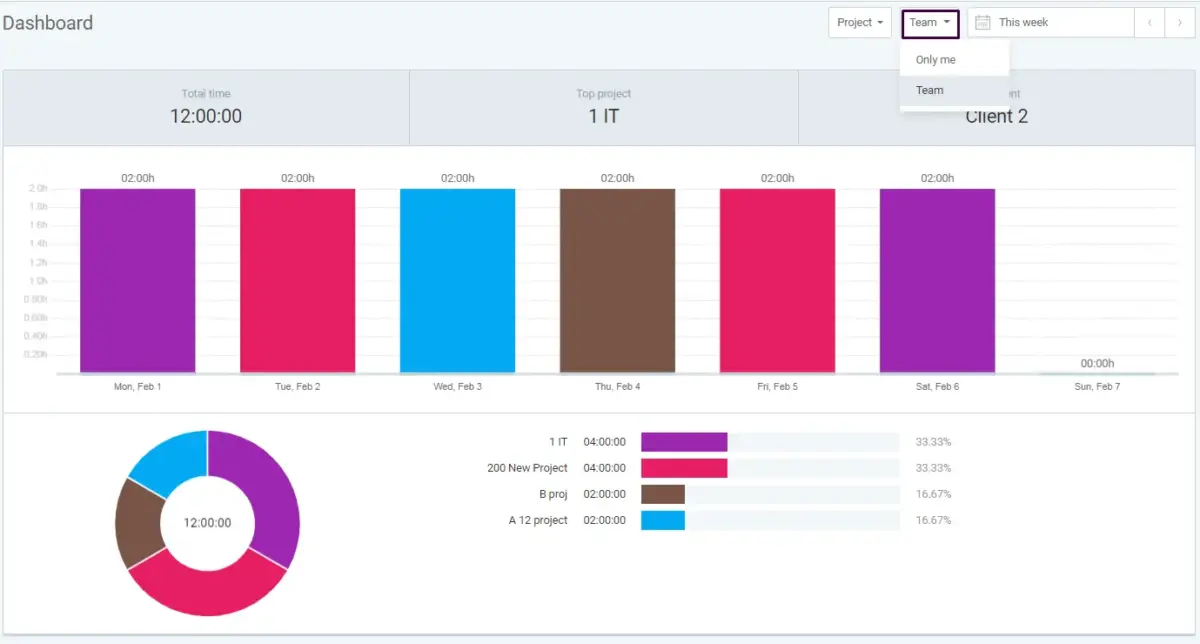
If you notice that someone consistently takes longer to complete tasks, you can address the issue promptly. This proactive approach not only improves individual performance but also enables you to make informed decisions about pay raises — or other measures to enhance overall performance.
Thanks to Clockify, you can objectively assess everyone’s performance and increase trust within your team. Clockify is part of the CAKE.com Bundle, together with Plaky — project and task management tool and Pumble — team chat app.