

Alex Beadon
Founder of Together We Launch
"We use Clockify to see where our time is going and how to solve any problems. It’s just so beneficial."
More stories

Find new apps that fit you team's needs
Free payroll templates for all business setups. Automate payroll processing and keep tabs on your labor budget and compliance. Download, customize, and print.

Payroll templates are worksheets that calculate wages and expenses for each hourly employee. They can be customized to fit any payroll cycle — weekly, biweekly, monthly, or annual. In particular, they help you:
Payroll templates organize and auto-calculate the necessary data by employee. This way, you can run accurate payroll every time, keep pay records in one place, and ensure fair wages. Ready-made payroll templates also save hours that you can spend on big-picture things — like analyzing labor trends or setting next month’s budget.
All templates are available in Google Sheets, Excel, and PDF.
Basic Payroll Templates Payroll Templates With Overtime Payroll Templates With PTO Payroll Templates With Overtime and PTO Payroll Budget Template Payroll Schedule Template Payroll Register Template Payroll Calendar Template
🎓 How to Create Quarterly and Annual Budget Reports With Clockify
This free payroll template gives you a quick glance at your team’s hourly totals and payments. Specifically, it’s built to help you:
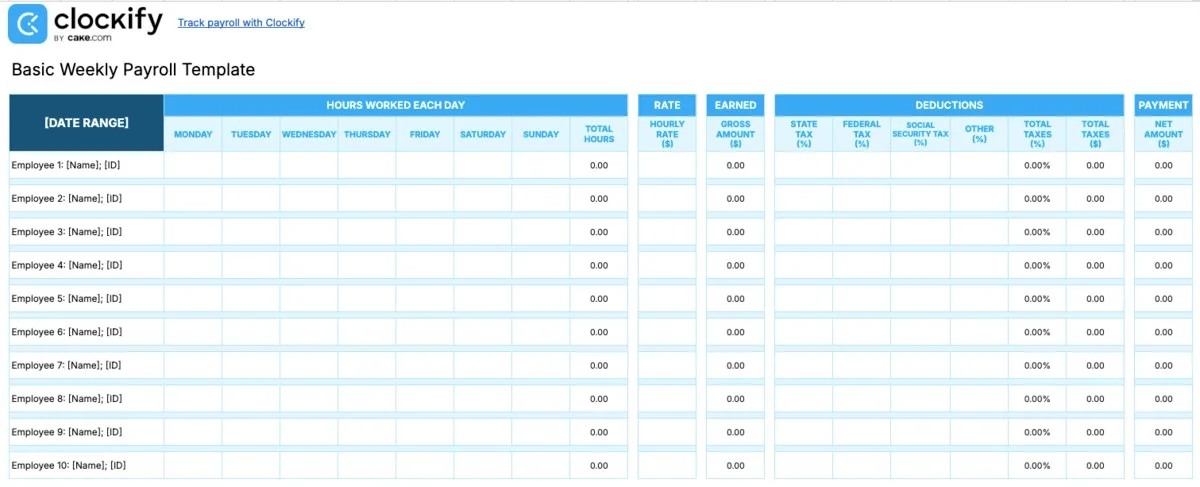
Best for: Managers who want to bypass complex payroll software. It also suits freelancers, contractors, and small teams with predictable work hours.
⬇️ Basic Weekly Payroll Template — Google Sheets • Excel
⬇️ Basic Biweekly Payroll Template — Google Sheets • Excel
⬇️ Basic Monthly Payroll Template — Google Sheets • Excel
⬇️ Basic Yearly Payroll Template — Google Sheets • Excel

The payroll template with overtime calculates your employee’s exact net pay based on their regular and extra hours. Separate columns for overtime hours, rates, and pay help to ensure overtime compliance.
FYI: Under the Fair Labor Standards Act (FLSA), non-exempt workers must be paid at least 1.5 times their normal rate after 40 hours in a workweek. But overtime laws vary by state, so stay informed about local guidelines.
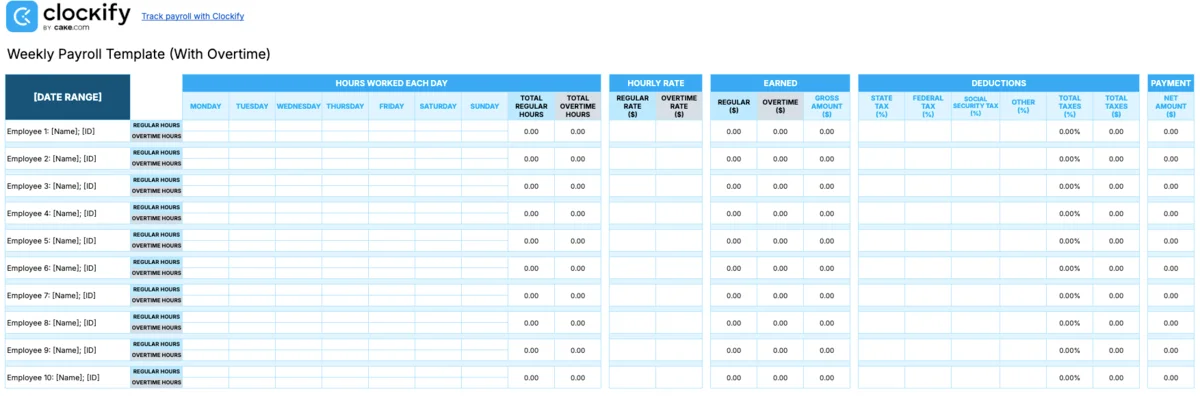
Best for: Small-to-medium businesses that are often short-staffed and overwhelmed with projects, which leads to long office hours. Teams with fluctuating schedules who rely on extra work — especially in industries such as retail, construction, and healthcare.
⬇️ Weekly Payroll Template (With Overtime) — Google Sheets • Excel
⬇️ Biweekly Payroll Template (With Overtime) — Google Sheets • Excel
⬇️ Monthly Payroll Template (With Overtime) — Google Sheets • Excel
⬇️ Yearly Payroll Template (With Overtime) — Google Sheets • Excel
🎓 A Guide to Overtime Pay + Free Overtime Calculator
Do your teammates have time off perks? You’ll need a quick yet thorough payroll system to track PTO (paid time off). This payroll sheet template counts time off as part of the total work hours for each worker.
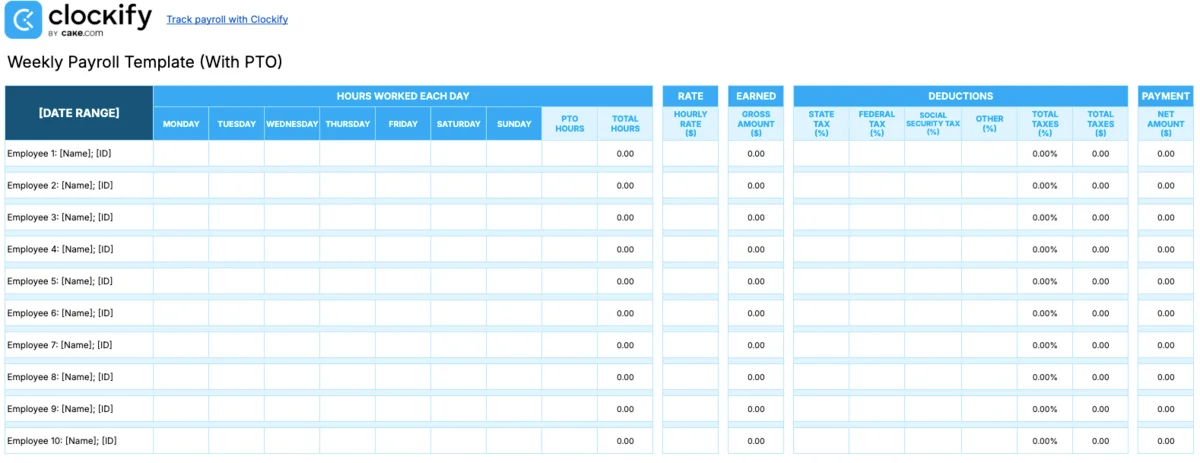
Best for: Managers at growing companies who struggle to manage workloads during employee absences. Businesses in booming industries like IT can use payroll templates with PTO tracking to prevent underpayments.
⬇️ Weekly Payroll Template (With PTO) — Google Sheets • Excel
⬇️ Biweekly Payroll Template (With PTO) — Google Sheets • Excel
⬇️ Monthly Payroll Template (With PTO) — Google Sheets • Excel
⬇️ Yearly Payroll Template (With PTO) — Google Sheets • Excel

This payroll sheet template tracks each employee’s work hours, including overtime hours and rate, and total PTO hours.
As your company grows beyond 50 employees, so do your reporting and compliance requirements. So, you’ll need built-in calculations to simplify billing and create clean pay stubs.
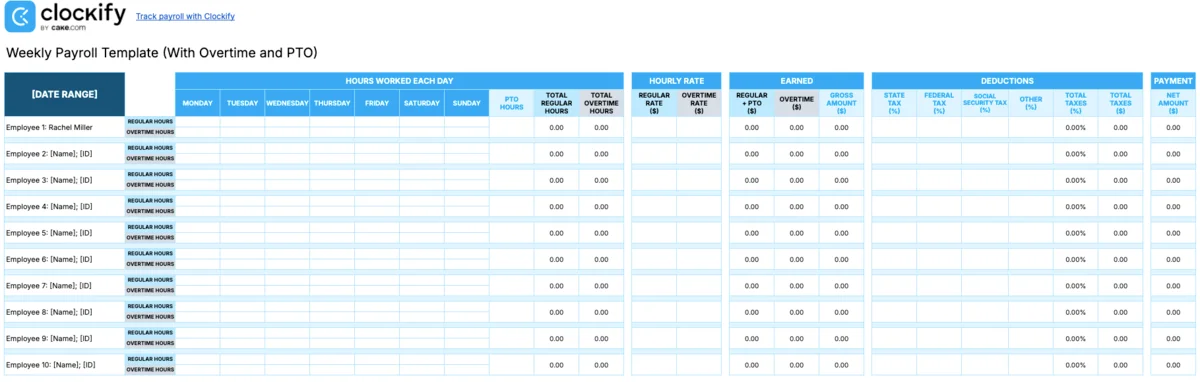
Best for: Managers in fast-paced environments who face ongoing challenges, like constant hiring and replacing. Tech businesses that employ independent contractors for backup and seasonal work. These templates help settle their individual pay rates and tax withholdings with minimal effort.
⬇️ Weekly Payroll Template (With Overtime and PTO) — Google Sheets • Excel
⬇️ Biweekly Payroll Template (With Overtime and PTO) — Google Sheets • Excel
⬇️ Monthly Payroll Template (With Overtime and PTO) — Google Sheets • Excel
⬇️ Yearly Payroll Template (With Overtime and PTO) — Google Sheets • Excel
🎓 How to Verify and Track Contractor Hours (For SMBs)
With the payroll budget template, managers can see all labor expenses over a specific period, including taxes and bonuses. With this information, you can create a proactive spending plan with money to spare for unexpected costs — like no-call no-shows or prolonged projects.
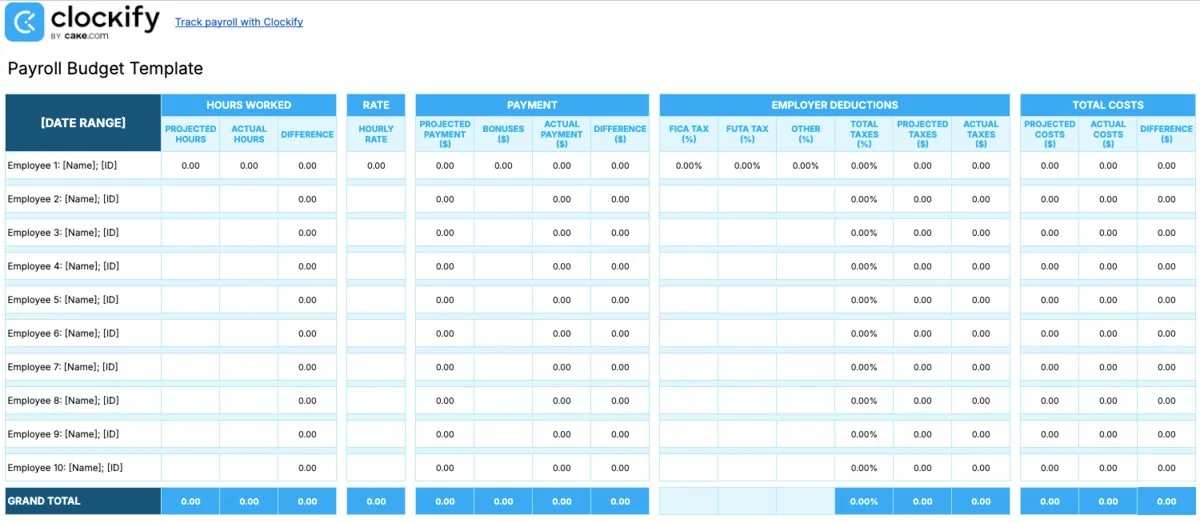
Best for: Forward-thinking businesses of all sizes. This payrol template replaces guesstimation with controlled budget planning that protects your company’s profits and employees’ rights.
⬇️ Payroll Budget Template — Google Sheets • Excel • PDF
🎓 Financial Planning | Free Budgeting Templates
Use the payroll schedule template as a checklist for all pay periods. Track timesheet submission dates and paydays to ensure consistent, on-time payments and employee trust.
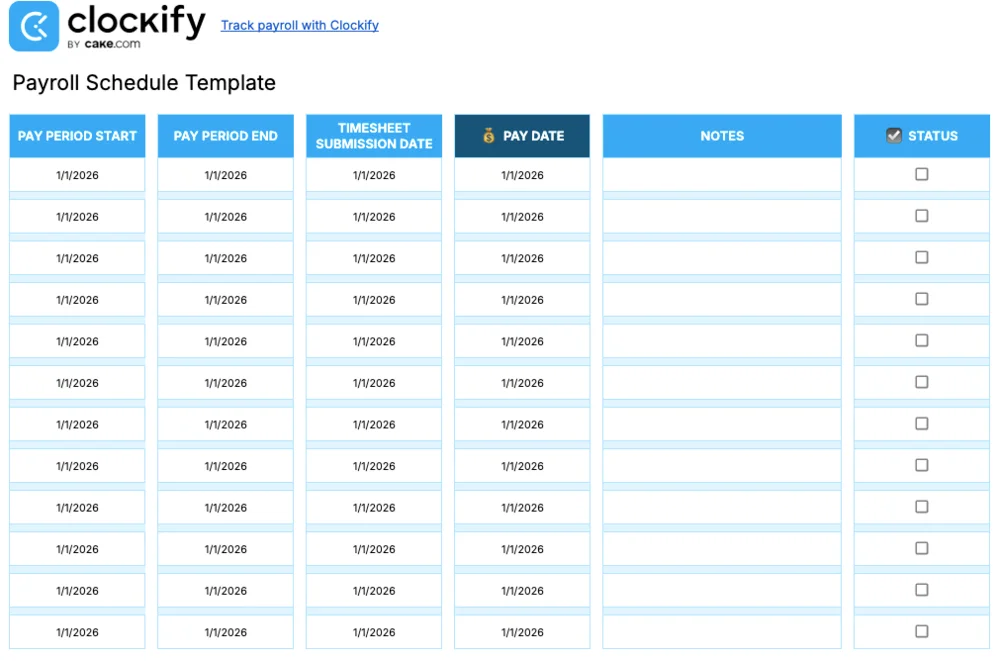
Best for: HR and accounting teams at compliant firms who use payroll schedules to plan when and how often to pay out salaries. This template also helps you stay transparent about pay dates with your staff.
⬇️ Payroll Schedule Template — Google Sheets • Excel • PDF
A payroll register is a document that lists each worker’s payment details for every pay period and pay date. Similarly, the payroll register template (or a payroll report template) is a quick summary of total staff hours, salaries, and deductions across pay cycles.
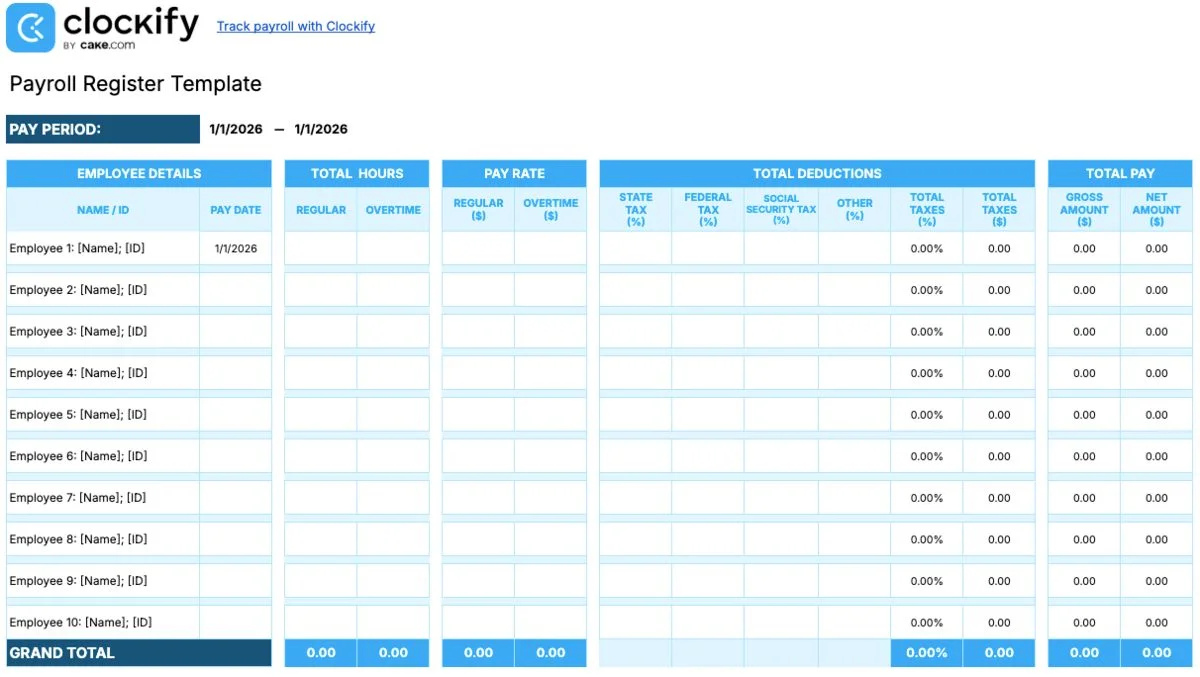
Best for: HR and payroll departments who want to run quick audits and keep data organized, ensuring full compliance. Managers can use this list of total payroll costs for clear tax reporting and expense forecasting, too.
⬇️ Payroll Register Template — Google Sheets • Excel • PDF
The payroll calendar template includes 12 calendars (one per month), updated for 2026. Once you’ve planned out your payroll schedule, simply color in the fields for timesheet submission dates and payday in each monthly calendar. This way, your chances of missing payments and risking lawsuits are minimal.
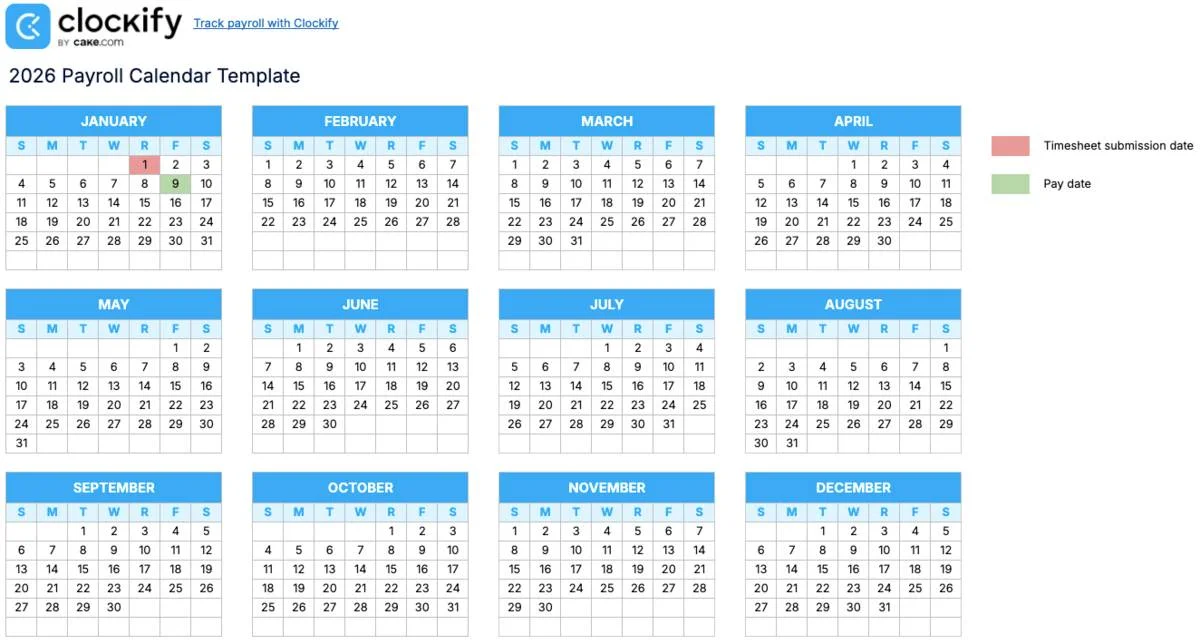
Best for: Accountable teams who need a visual aid to stay on schedule and budget. This document doesn’t contain sensitive data, so you can share it with staff to keep them posted on timesheet submission and payment deadlines.
⬇️ 2026 Payroll Calendar Template — Google Sheets • Excel • PDF
Your company’s priorities will determine how you use payroll templates. Regarding data security, you’ll apply:
Our templates also cover 3 main purposes:
The Weekly Payroll Template With Overtime and PTO illustrates all the calculations in the first 2 template types. Mastering this one will prepare you for the others. Next, we’ll run you through the Payroll Schedule Template to show how the templates from the third category work. Find the instructions for both below.
Say your team member, Rachel Miller, works 40 hours/week for $20/hour and $30/hour for overtime. She pays 15% in federal taxes and 6% in Social Security taxes. Rachel also took a day off on Friday and worked 2 extra hours on Monday.
Let’s take the following steps to work out her weekly take-home pay.
#1: Gross amount
Fill in your employee’s weekly work time and hourly rates in their assigned row. Our template only supports decimal time, so remember to convert hours and minutes into decimals. Once that’s done, the template will auto-calculate the gross amount.
The gross income should be $860.
#2: Deductions
Enter the necessary deductions to determine the exact net income for each staff member.
You should get the total net income of $679.40.
Imagine your company has 7-day pay periods, Sunday through Saturday. It expects employees to submit their timesheets by the following Monday and issues paychecks on the following Friday.
See below for how to fill out the free payroll template with the information above.
Pro tip: Use the Notes section to communicate changes or updates to your team. For example: “Since Independence Day will be observed on July 3, approve timesheets by July 2.”
Before you move on to the next cycle, check off the previous one to stay focused on pending tasks, like so:
Payroll templates will suit your compliance and accuracy needs — for a time. Built-in calculations will do the job, but you’ll still have to enter recurring information (like pay rates). That’s something a payroll app can do for you.
As your team expands, so will your payroll responsibilities, making human error more likely. One faulty pay stub can lead to staff complaints and even legal action. Based on the latest payroll statistics:
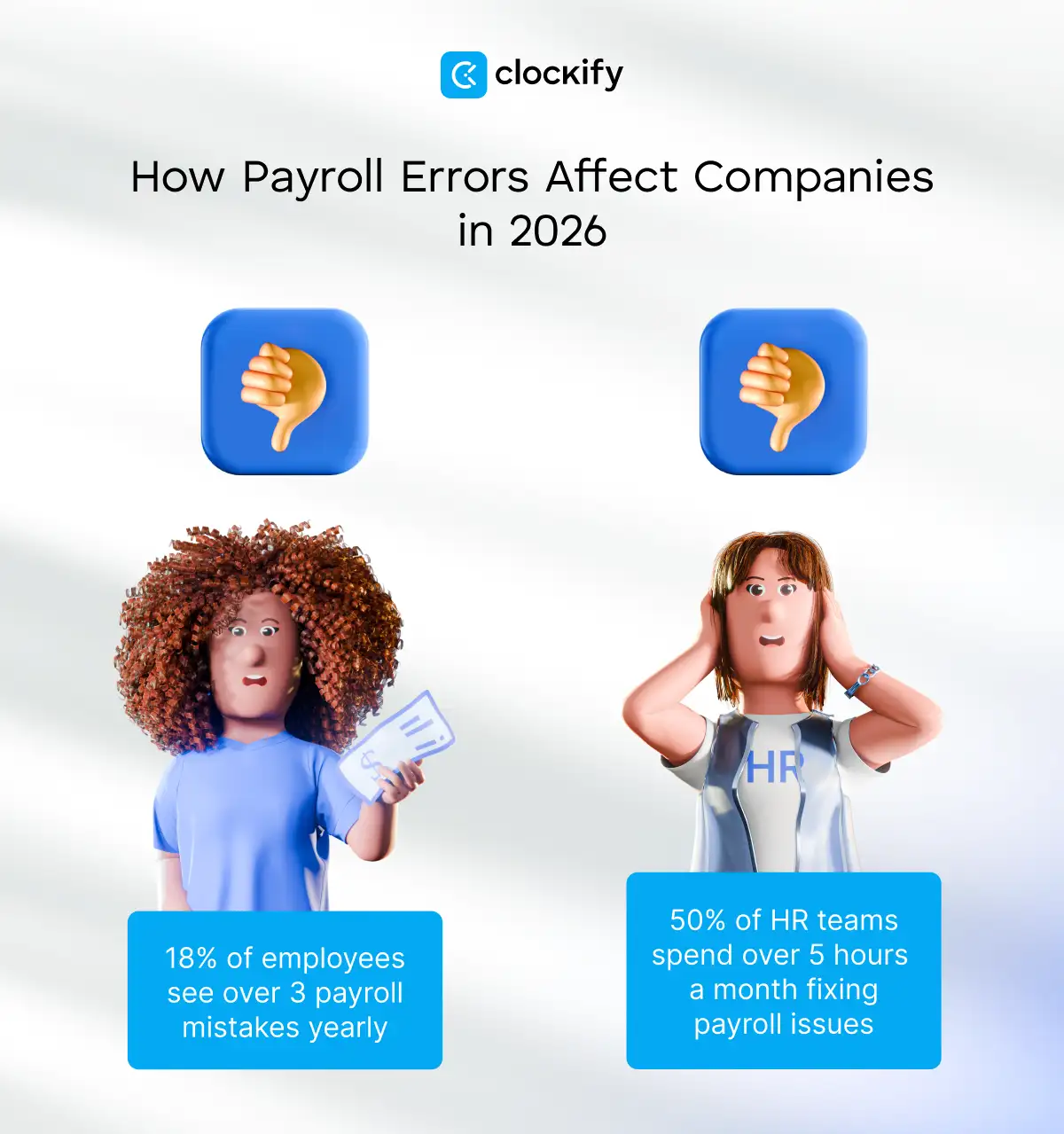
If your company is plagued by similar costly issues, consider a modern and efficient time-and-billing system. When a template isn't enough, track time and run payroll automatically with Clockify by CAKE.com:
But we’re just scratching the surface of how Clockify can cut payroll processing time — learn more below.
Clockify is a simple yet robust time app that tracks your team’s hourly pay and attendance. Enjoy fast, compliant audits with enterprise-grade security, which includes SOC 2 and ISO/IEC 27001:2022.
Sound good? Start the free trial with unlocked Pro plan features — see how our cost-effective time tracker aligns with your goals.
To build a smooth payroll system with Clockify, take the following simple steps:
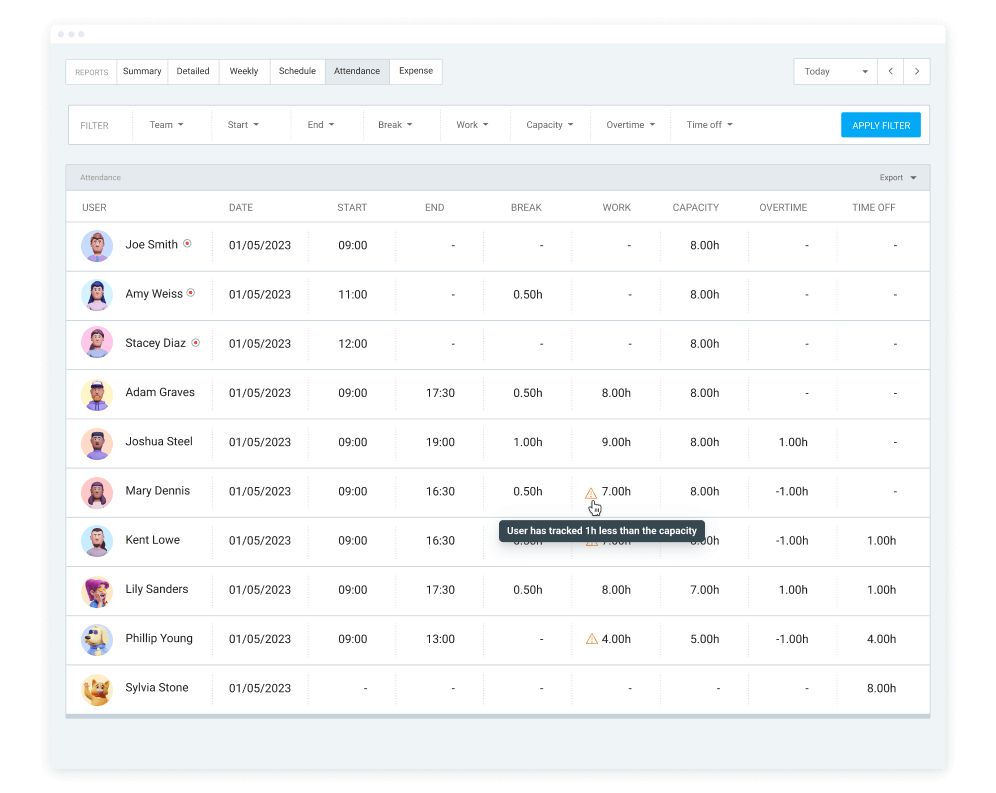
For more unified, eye-popping reporting, get the Insights add-on from the CAKE.com Marketplace — which shows:
Payroll is a touchy yet critical process for managers, so they often have the same questions. Check out the answers below!
To run payroll in Excel, you’ll need to create formulas that calculate employee time against their pay rates. However, these formulas can turn into a hair-raising mess if not set up correctly. So, instead of building a payroll system from scratch, use our pre-made Excel payroll templates.
As you onboard more people, you may require a more efficient solution than Excel payroll templates.
To cut down on admin work, try a simple yet powerful time tracker like Clockify by CAKE.com. See insightful employee lists with tracked time and pay details.
🎓 Free Excel Timesheet Template (+ Guide & Top Alternative)
You can manage payroll for free with our payroll templates. Simply choose your preferred Google Sheets, PDF, or Excel payroll template. Then, start your pay period with confidence!
As your workforce grows, Excel payroll templates may become insufficient. What’s worse, expensive payroll software and approaching tax seasons will keep you up.
Try a simple, budget-friendly payroll tracker like Clockify to track pay rates and deductions.
Let’s walk you through the 4 essential steps to handling payroll:
#1: Collect company info — Make sure you have your Employer Identification Number (assigned to every company by the IRS) and all employee tax and deduction details.
Next, check all pay rates and bank account info for accuracy. We also recommend that you define your pay cycles and paydays ahead of time.
#2: Review your team’s work — Look over their submitted timesheets for any inaccuracies, then approve them. You’ll need their total work hours, overtime, PTO, and any other employee absence to calculate their gross pay.
P.S. Incorrect timesheets may result in payment delays, so plan pay periods accordingly.
#3: Calculate the net income — Figure out the take-home pay by subtracting deductions from the gross pay. But first, you’ll need to determine the gross pay and the total deductions. For instructions on payroll calculations, read our next answer.
#4: Pay your team — Do a final checkup and reimburse your workers on payday. Store all pay records for future reference and labor law compliance.
Seems intimidating? You’ll fly through all the steps with a time tracking tool like Clockify. Keep paid hours and expenses in one place and export custom employee reports. Never miss or mess up a pay stub again!
🎓 A Step-By-Step Guide to Calculating Payroll and Hours Worked
Payroll processing should include the following core elements:
Depending on your state’s laws, some taxes are paid by both the worker and the employer. So, check the labor regulations in your area.
Payroll calculations are formulas that use employee payment data to determine their take-home pay. The payroll process involves 3 core calculations:
Find out how to calculate these figures next.
Yes, you can manually calculate payroll. Yet, it may prove challenging for bigger teams. Let’s walk you through the entire process.
First, get the gross income. Multiply an employee’s total hours by their hourly rate, like so:
40 (Total work hours) * $30 (Hourly rate) = $1,200 (Gross income)
Second, calculate tax withholding. To meet legal demands, you’ll need to make the following mandatory deductions: federal, social security, Medicare, and state taxes.
Say a worker’s deductions amount to 20%. First, convert them into decimals with this formula:
20% (Deduction percentage) / 100 = 0.2 (Deduction decimal)
Third, determine the deduction amount in dollars by multiplying the gross pay by the deduction decimal. Follow the formula below:
$1,200 (Gross income) * 0.2 (Deduction decimal) = $240 (Deduction amount)
Finally, get the net income. Simply subtract the deduction amount from the gross pay — here’s the formula:
$1,200 (Gross income) - $240 (Deduction amount) = $960 (Net income)
Need help with math anxiety? Use our free payroll templates with built-in calculations so you don’t have to crunch the numbers.
Basic Payroll Templates Payroll Templates With Overtime Payroll Templates With PTO Payroll Templates With Overtime and PTO Payroll Budget Template Payroll Schedule Template Payroll Register Template Payroll Calendar Template
