

Alex Beadon
Founder of Together We Launch
"We use Clockify to see where our time is going and how to solve any problems. It’s just so beneficial."
More stories

Find new apps that fit you team's needs
Editable free pay stub templates. Download, customize, and send them out to employees and contractors right away.

A pay stub — also called an earnings statement or check stub — is a document that contains all the details of employees’ payments. Employers issue pay stubs monthly or weekly, depending on how frequently they pay their employees.
Basic Pay Stub Template With a Calculator Pay Stub Template With PTO + Calculator Pay Stub Template With Overtime + Calculator Pay Stub Template With Overtime Pay Stub Template With PTO and Overtime + Calculator Basic Pay Stub Template Contractor Pay Stub Template With a Calculator Pay Stub Template With PTO Pay Stub Template With PTO and Overtime Contractor Pay Stub Template
Although a pay stub might consist of many details that amount to employees’ final net pay, there are several items that every pay stub should include:

Whether you’re required to issue pay stubs or not depends on the location of your business. While pay stubs are legally required in Europe, there’s no federal law that requires employers to provide pay stubs in the US. However, certain US states do require employers to issue pay stubs, so it’s always best to be familiar with your state labor laws.
Certain US state laws require employers to provide specific types of pay stubs:
In opt-out states (e.g., Delaware, Minnesota, and Oregon), employers are required to obtain explicit consent before changing how they issue pay stubs.
In opt-in states (e.g., Hawaii), employers must issue employees’ paper pay stubs — unless an employee requests their pay stubs to be provided electronically.
There’s also the access or access + printable requirement. These requirements mean the employer must either provide pay stubs or provide and print them out for employees.
Check out our quick reference table to see your state’s pay stub requirements.
| State | Requirement category | Delivery rules |
| Alabama | No requirement | Not mandated by state law |
| Alaska | Access | Electronic or paper allowed |
| Arizona | Access | Electronic or paper allowed |
| Arkansas | Access | Electronic or paper allowed (approved on March 20, 2025) |
| California | Access & Print | Written/printed required, or electronic with print access |
| Colorado | Access & Print | Written/printed required, or electronic with print access |
| Connecticut | Access & Print | Written/printed required, or electronic with print access |
| Delaware | Opt-out | Electronic default allowed; employees can request paper |
| Florida | No requirement | Not mandated by state law |
| Georgia | No requirement | Not mandated by state law |
| Hawaii | Opt-in | Paper default; electronic only with written consent |
| Idaho | Access | Electronic or paper allowed |
| Illinois | Access | Electronic or paper allowed (effective Jan. 1, 2025) |
| Indiana | Access | Electronic or paper allowed |
| Iowa | Access | Electronic or paper allowed |
| Kansas | Access | Electronic or paper allowed |
| Kentucky | Access | Electronic or paper allowed |
| Louisiana | No requirement | Not mandated by state law |
| Maine | Access | Electronic or paper allowed |
| Maryland | Access | Electronic or paper allowed |
| Massachusetts | Access & Print | Written/printed required, or electronic with print access |
| Michigan | Access | Electronic or paper allowed |
| Minnesota | Opt-out | Electronic default allowed; employees can request paper |
| Mississippi | No requirement | Not mandated by state law |
| Missouri | Access | Electronic or paper allowed |
| Montana | Access | Electronic or paper allowed |
| Nebraska | Access | Electronic or paper allowed |
| Nevada | Access & Print | Written/printed required, or electronic with print access |
| New Hampshire | Access | Electronic or paper allowed |
| New Jersey | Access | Electronic or paper allowed |
| New Mexico | Access | Electronic or paper allowed |
| New York | Access & Print | Electronic and paper (extra fields for tipped workers) |
| North Carolina | Access | Electronic or paper allowed |
| North Dakota | Access | Electronic or paper allowed |
| Ohio | Access | Electronic or paper allowed (effective April 9, 2025) |
| Oklahoma | Access | Electronic or paper allowed |
| Oregon | Opt-out | Electronic default allowed; requires a detailed written explanation of payroll codes to new employees (effective Jan. 1, 2026) |
| Pennsylvania | Access | Electronic or paper allowed |
| Rhode Island | Access | Electronic or paper allowed |
| South Carolina | Access | Electronic or paper allowed |
| South Dakota | No requirement | Not mandated by state law |
| Tennessee | No requirement | Not mandated by state law |
| Texas | Access & Print | Written/printed required, or electronic with print access |
| Utah | Access | Electronic or paper allowed |
| Vermont | Access | Electronic or paper allowed |
| Virginia | Access | Electronic or paper allowed |
| Washington | Access & Print | Written/printed required, or electronic with print access |
| West Virginia | Access | Electronic or paper allowed |
| Wisconsin | Access | Electronic or paper allowed |
| Wyoming | Access | Electronic or paper allowed |
Although a pay stub might be attached to a paycheck, they’re not the same. Paychecks usually only state an employee’s total net pay, while a pay stub contains all the details regarding the payment, including:
A check stub is another synonym for a pay stub — it contains all of the same information. Other pay stub synonyms include:
While accurate invoices include information about payment — such as payment terms and payment method — they differ from pay stubs.
Invoices are mostly issued by independent contractors to request payment from clients for concrete services. Pay stubs, on the other hand, are issued by companies as part of a payroll process.
🎓 Free Invoice Templates for Freelancers
Whether you’re about to start a new business or you’ve been issuing check stubs for years, having a pre-made, customizable check stub template can help you:
Apart from that, a detailed check stub template that comes with a calculator can reduce the possibility of making mistakes in final calculations and help you keep all your numbers in check.
These templates are also practical to download, print, or send out to your employees.
Whether you need a basic pay stub template or a detailed one that does most of the payment calculations for you — you don’t need to create anything from scratch.
These free earnings statement templates might just become your go-to option whenever you’re about to issue payments.
Our first 5 free pay stub templates include a calculator:
If you’re looking for a free, editable pay stub template that reduces the time to calculate employees’ total payments and minimizes errors, this is the most straightforward choice.
⬇️ Basic Pay Stub Template With a Calculator (Google Sheets)
⬇️ Basic Pay Stub Template With a Calculator (Excel)
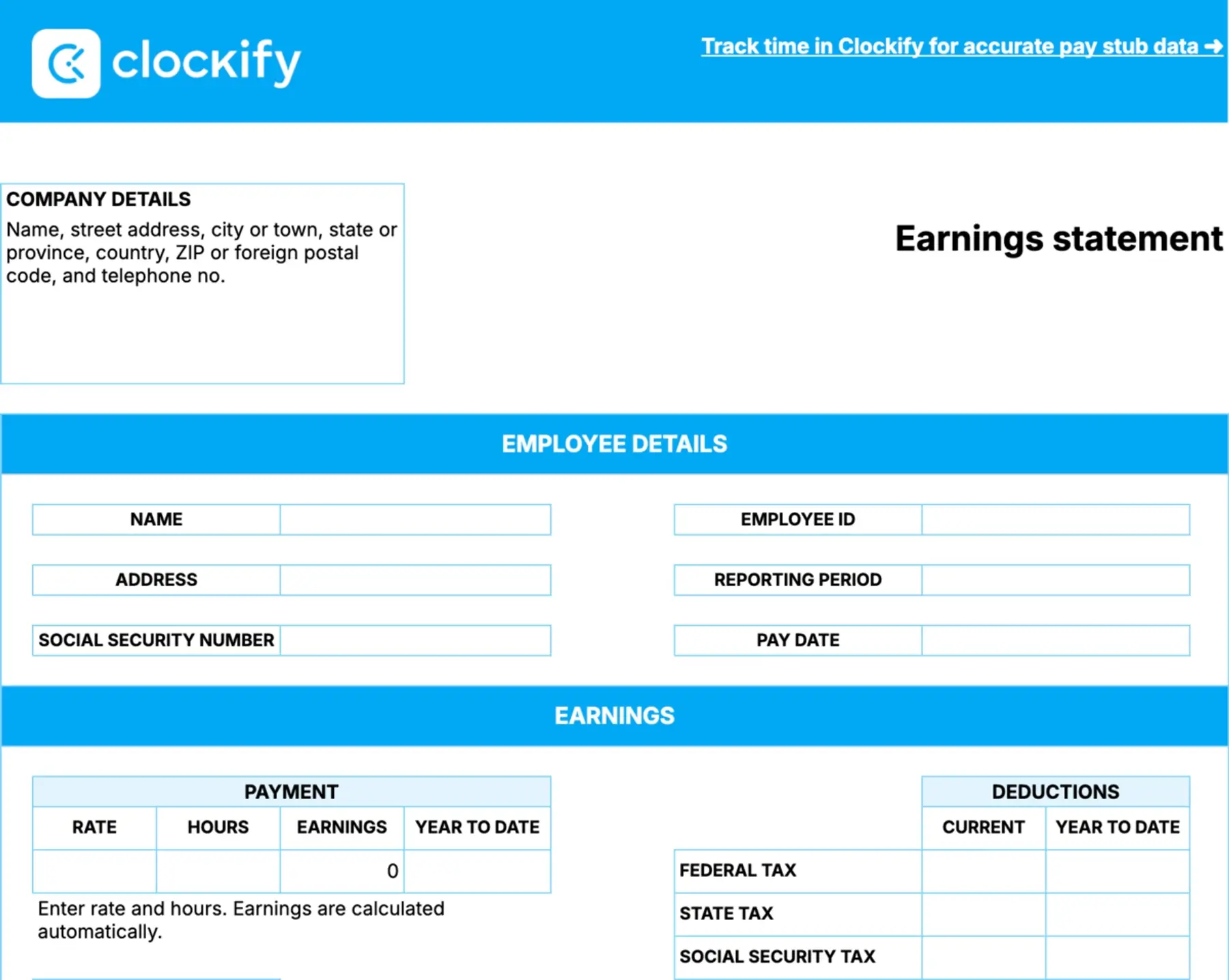
Why use the Basic Pay Stub Template With a Calculator?
Use this template to minimize errors in your employees’ pay stubs and automatically calculate gross earnings, tax deductions, and net total.
How to fill out the Basic Pay Stub Template With a Calculator step by step:
The Gross earnings, Total deductions, and Net total values will be calculated automatically.
If you’re looking for a detailed pay stub template that includes PTO — but also does the math for you — then the Pay Stub Template With PTO + Calculator is a good fit for you.
⬇️ Pay Stub Template With PTO + Calculator (Google Sheets)
⬇️ Pay Stub Template With PTO + Calculator (Excel)
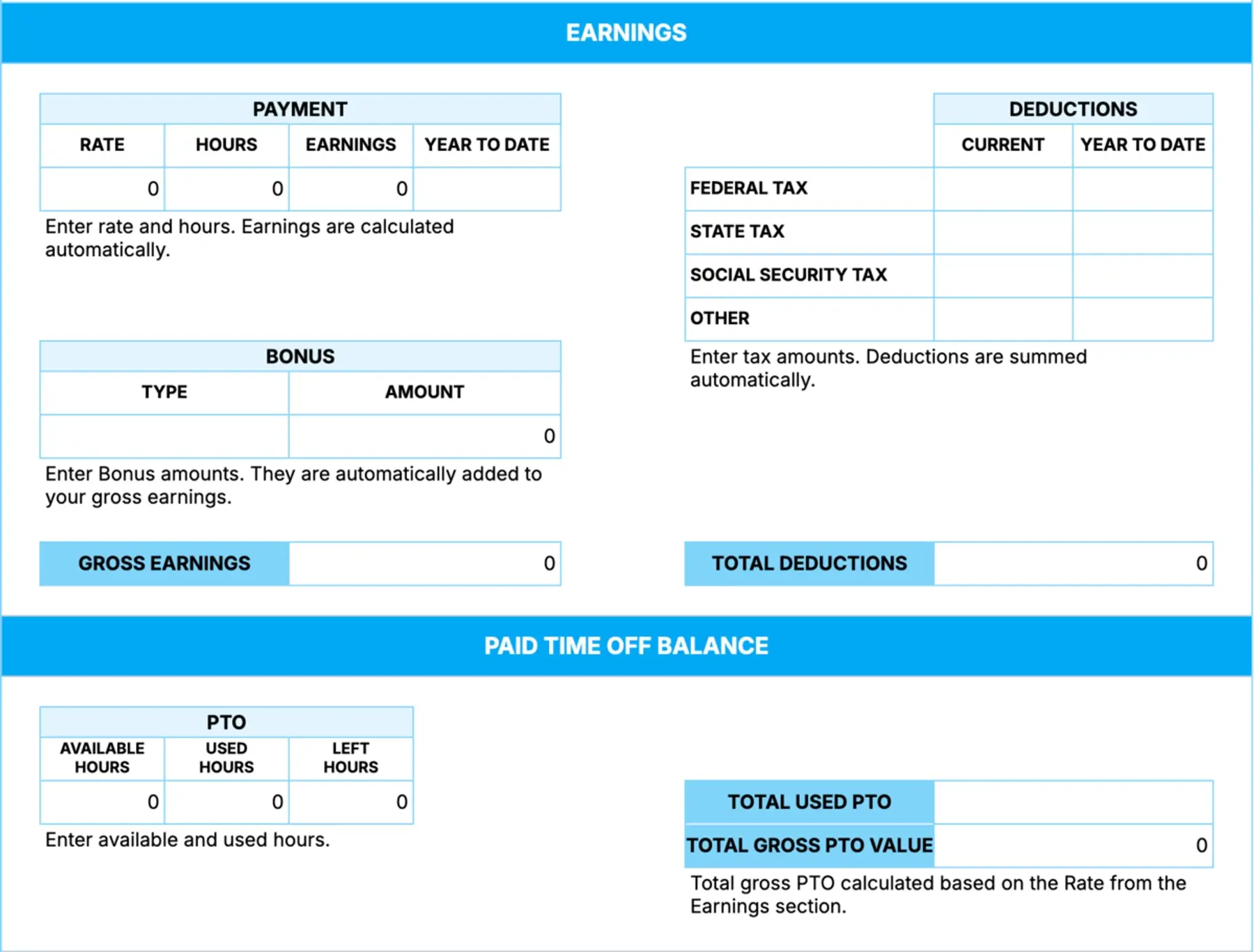
Why use the Pay Stub Template With PTO + Calculator?
This template is a great workaround if you need to include PTO calculations in your pay stub, but don’t want to waste time calculating everything by hand.
How to fill out the Pay Stub Template With PTO + Calculator step by step:
The Gross earnings, Total deductions, Total gross PTO value, and Net total fields will be calculated automatically.
ℹ️ Although there’s no federal law mandating minimum annual PTO hours, most US employers offer 10–20 days of paid vacation based on tenure.
If you need to include employees’ overtime pay in your pay stubs, but you’d like to eliminate possible calculation errors, then this template is a great solution.
⬇️ Pay Stub Template With Overtime + Calculator (Google Sheets)
⬇️ Pay Stub Template With Overtime + Calculator (Excel)
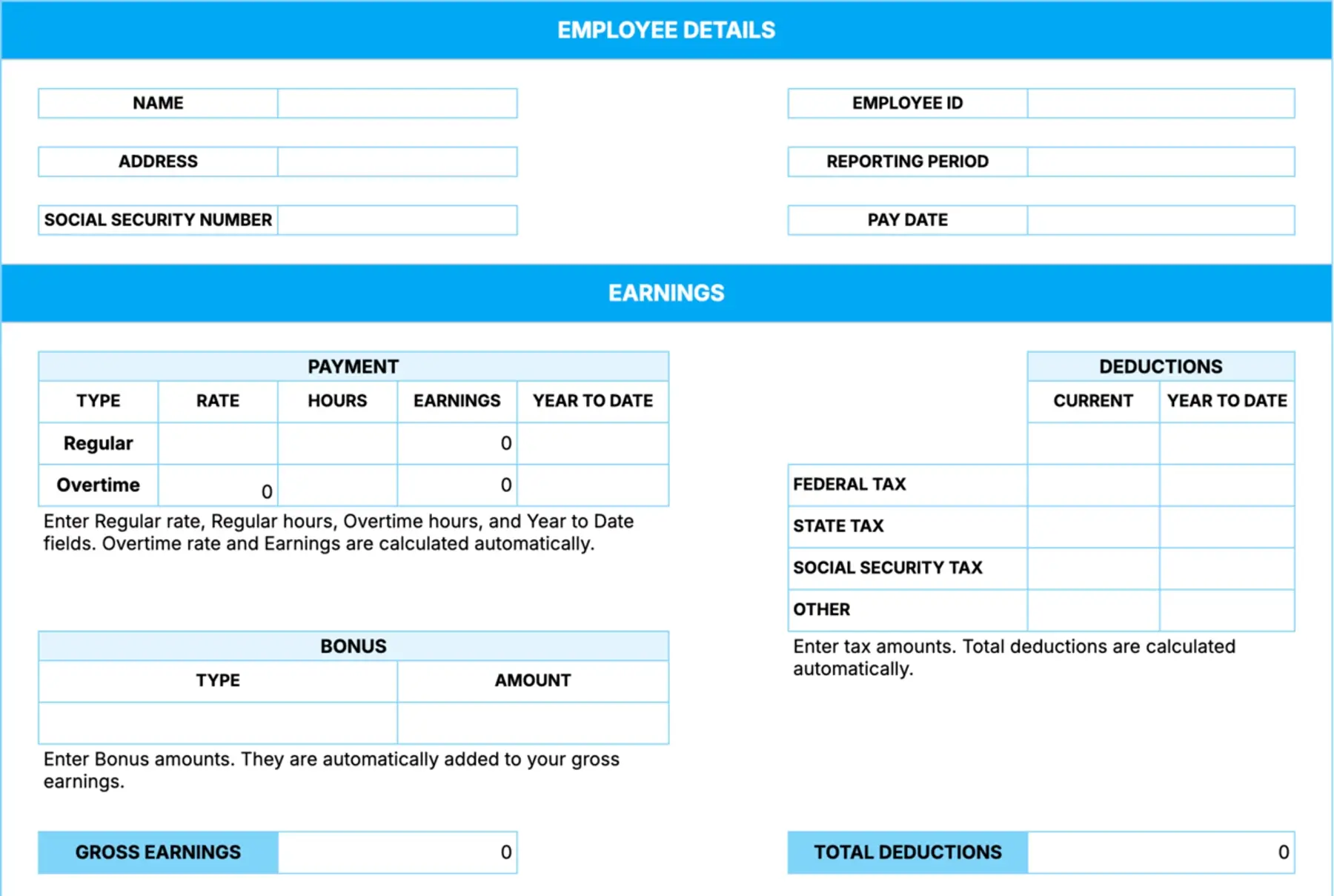
Why use the Pay Stub Template With Overtime + Calculator?
The template is best used to issue pay stubs with overtime hours, while removing manual calculations from the process.
How to fill out the Pay Stub Template With Overtime + Calculator step by step:
The Gross amount, Total deductions, and Net total fields are automatically calculated.
ℹ️ Make sure to include any bonuses, if applicable. They will be automatically added to the worker’s Gross earnings. Check state overtime laws to see whether your employees’ regular rate should be 1.5 or 2 times the regular rate. (e.g., in California, every hour after the 12th work hour in a day is counted as 2 times the regular rate.)
This template includes the common 1.5 multiplier for the Overtime rate field. Feel free to change the formula or add a separate double-time column if needed.
Calculating on top of creating pay stubs with multiple items can be time-consuming, but a ready-made template that handles the final calculations will reduce the time required.
⬇️ Pay Stub Template With PTO and Overtime + Calculator (Google Sheets)
⬇️ Pay Stub Template With PTO and Overtime + Calculator (Excel)
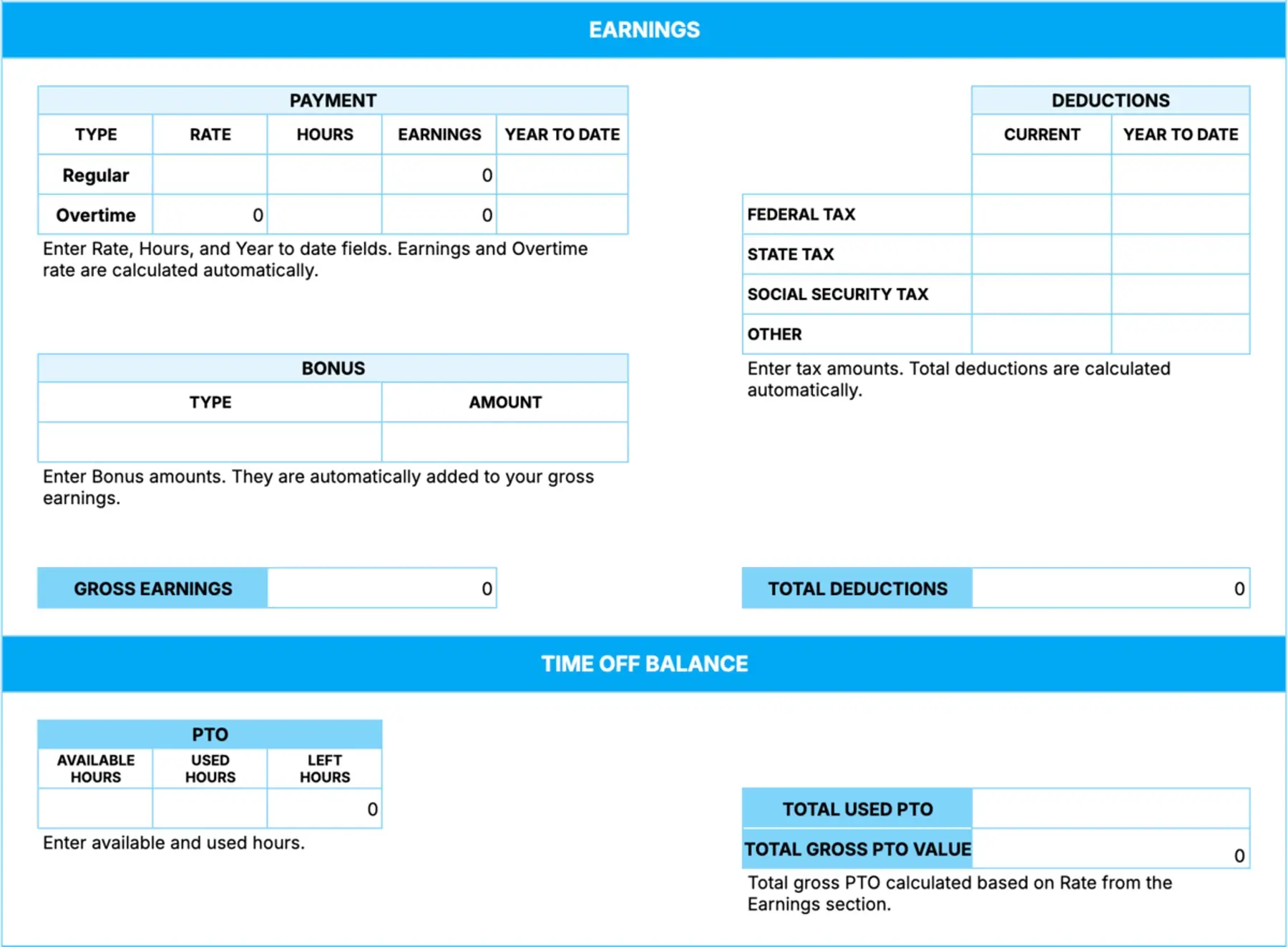
Why use the Pay Stub Template With PTO and Overtime + Calculator?
This template is the most intuitive choice if you require both PTO and overtime on your pay stubs. The included calculator will ease any miscalculations worries you might have.
How to fill out the Pay Stub Template With PTO and Overtime + Calculator step by step:
The Gross earnings, Total deductions, Total gross PTO value, and Net total fieldswill be automatically calculated.
ℹ️ Make sure the worker’s overtime rate is properly calculated and FLSA compliant. Also, don’t forget to fill out the Bonus column, if applicable.
This pay stub template helps you easily calculate payment details for an independent contractor you collaborate with. The included calculator does the addition and subtraction automatically.
⬇️ Contractor Pay Stub Template With a Calculator (Google Sheets)
⬇️ Contractor Pay Stub Template With a Calculator (Excel)
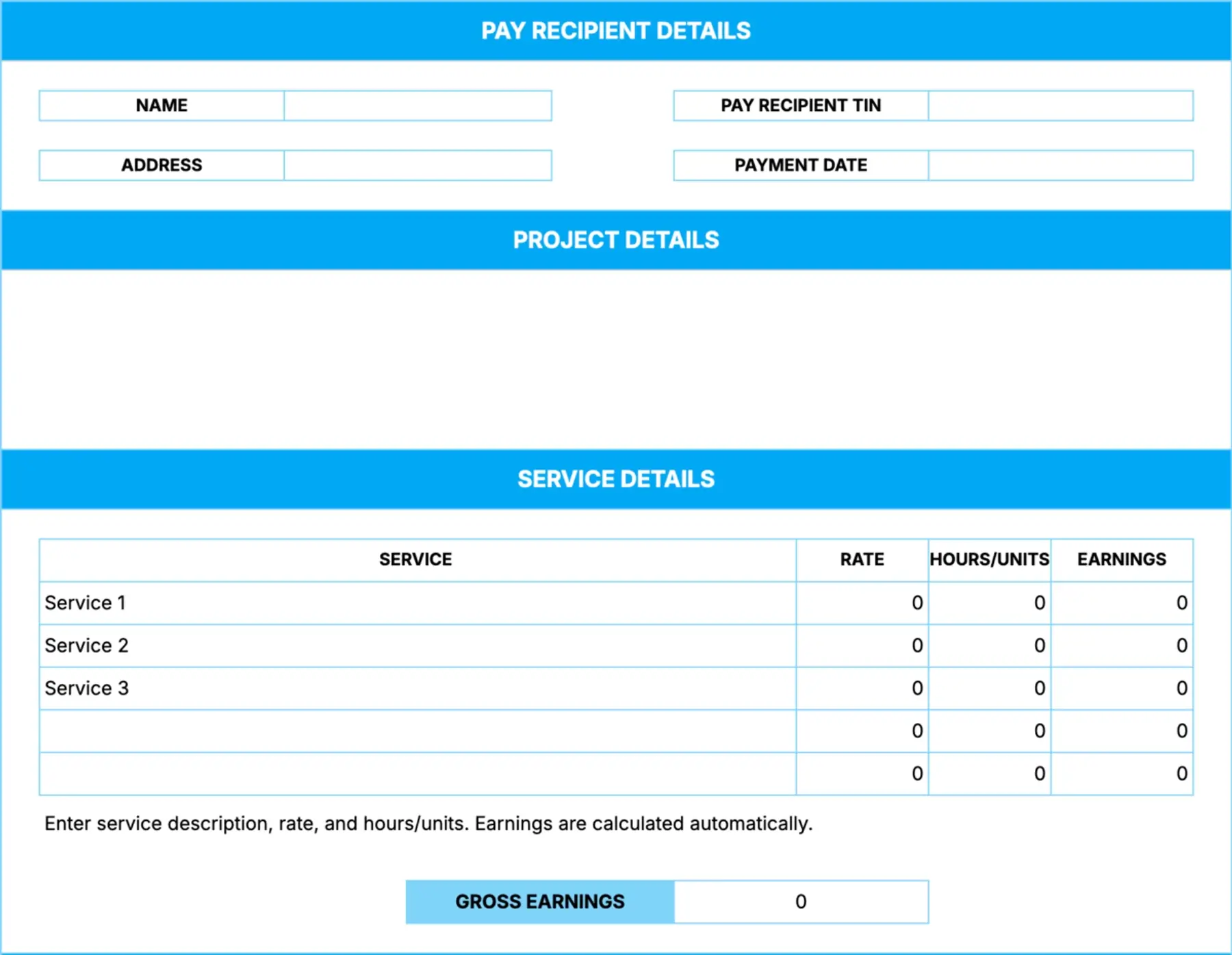
Why use the Contractor Pay Stub Template With a Calculator?
The contractor pay stub template — also known as a 1099 pay stub template can be sent out regularly to your 1099 workers. Although not required by law, this document serves as a replacement for the earnings statement issued to regular employees.
Note: This document is not to be confused with the Form 1099-NEC, which is filled out only once a year (if you paid the contractor more than $600) and contains similar details.
How to fill out the Contractor Pay Stub Template With a Calculator step by step:
The contractor’sEarnings and Total net pay will be calculated automatically.
ℹ️ Leave the Tax deductions fields blank — the contractor will fill them out on their own. You can fill out the Year-to-Date field or leave it to the contractor to complete. Just make sure to work out the dynamic beforehand.

If you’re looking for pay stub templates without a calculator, you can check our simplified pay stub template versions. Our 5 simple pay stub templates include:
Note that for these templates, you’ll need to have all relevant values calculated and prepared in advance.
If you need a simple pay stub template you can download and customize within seconds, then the Basic Pay Stub Template is just what you are looking for.
⬇️ Basic Pay Stub Template (Google Sheets)
⬇️ Basic Pay Stub Template (Excel)
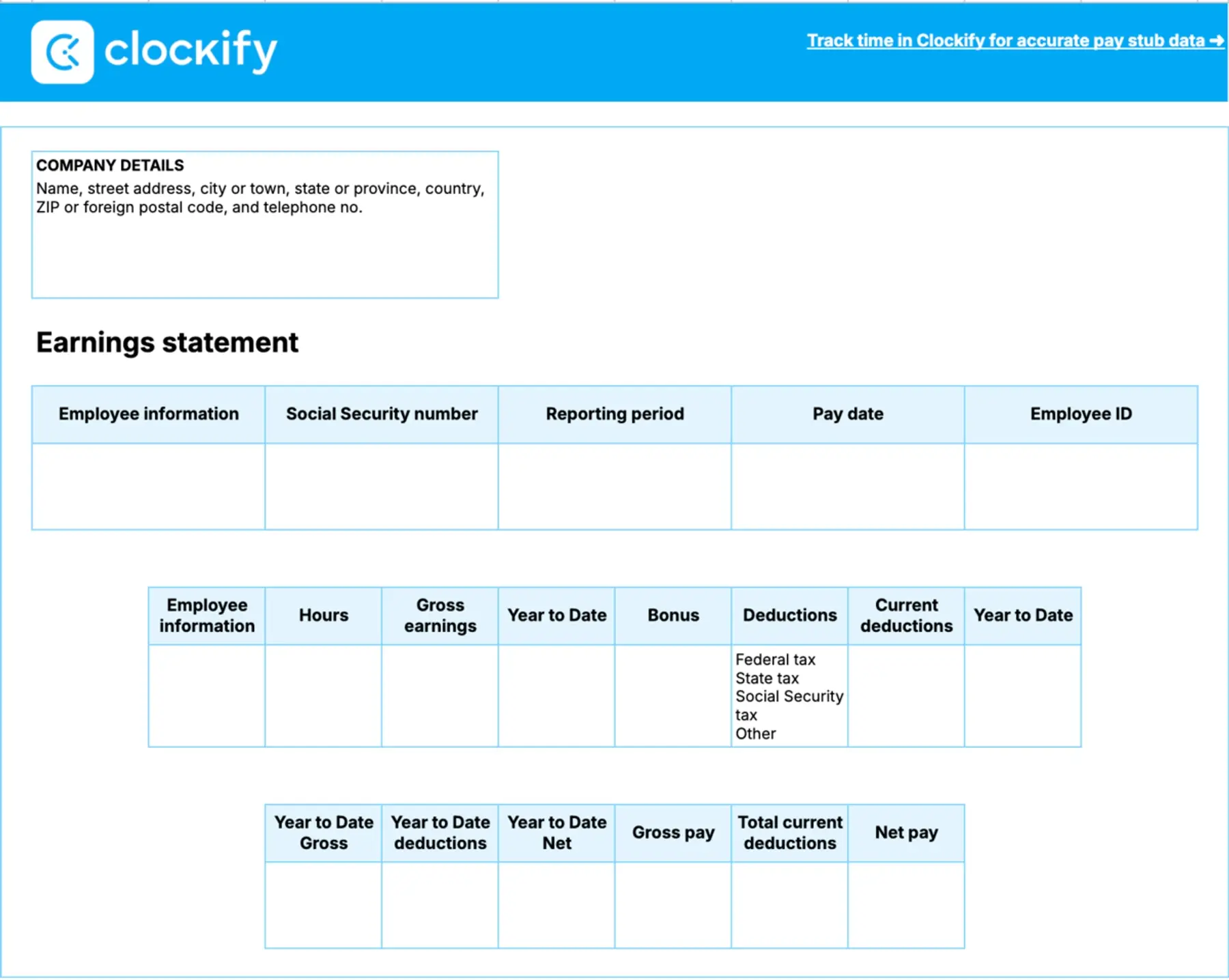
If you thought that introducing a PTO policy would require you to make significant changes to your payroll processing, think twice. This free pay stub template includes just enough details to help you include PTO in your payment calculations without additional paperwork.
⬇️ Pay Stub Template With PTO (Google Sheets)
⬇️ Pay Stub Template With PTO (Excel)
If you’re looking for a speedy way to add overtime to employees’ pay stubs, try using the Pay Stub Template With Overtime.
⬇️ Pay Stub Template With Overtime (Google Sheets)
⬇️ Pay Stub Template With Overtime (Excel)
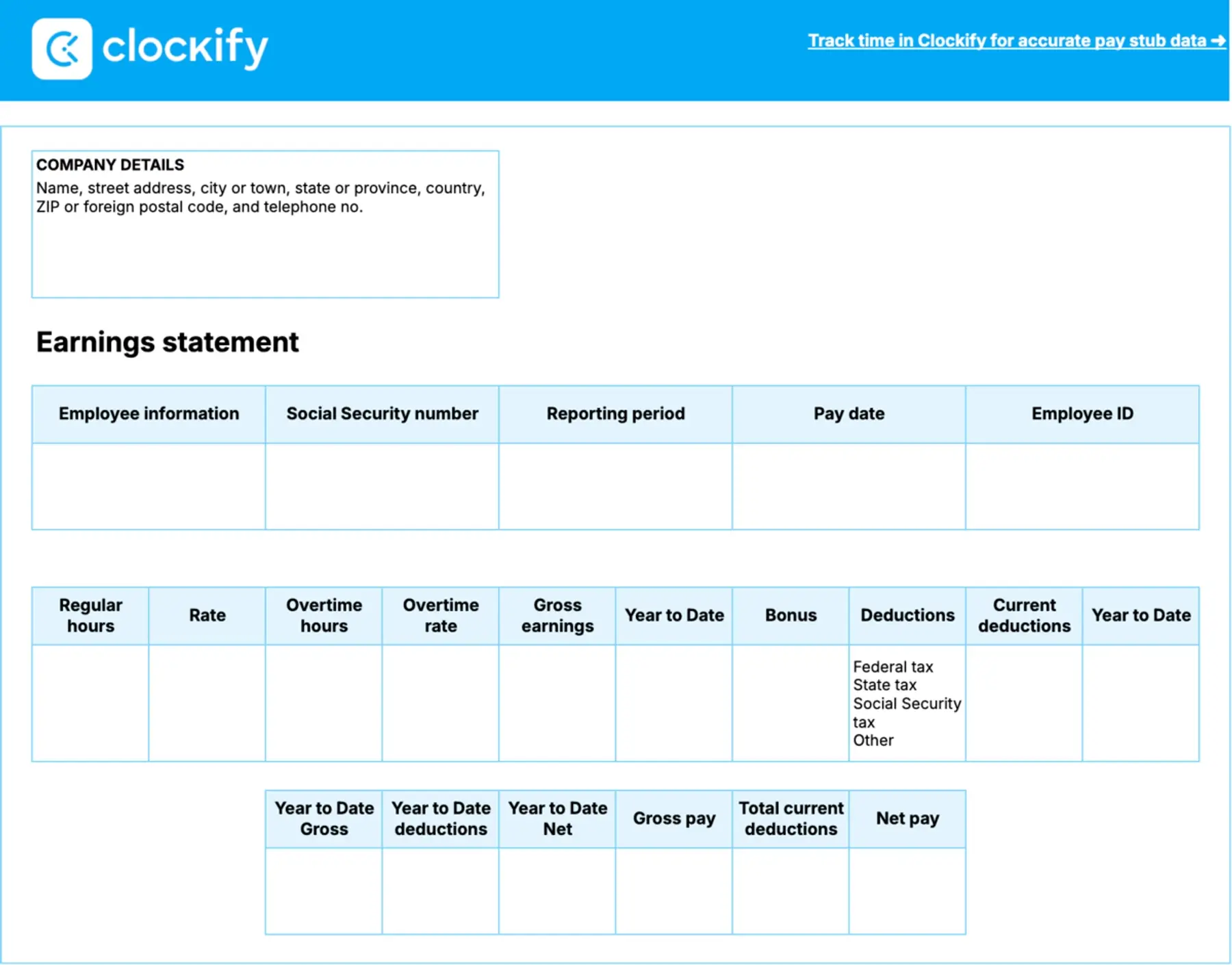
How to calculate overtime hours manually?
You can calculate overtime hours for each worker with this simple formula:
Overtime Pay = (Regular Hourly Rate × 1.5) × Overtime Hours
Let’s break it down, step by step:
Here’s an example for a worker earning $20 per hour, with 5 hours of overtime in a week:
Note that overtime rate multipliers can vary based on hours worked in a day, not just weekly overtime hours. Double-check your state’s laws and people’s individual workdays to compensate them properly and keep pay stubs accurate and compliant.
🎓 A Useful Guide on Double Time vs Overtime
In case your payroll calculations need to include both PTO and overtime, you’re probably overwhelmed just by thinking about creating pay stubs with so many different items. This is where the Pay Stub Template With PTO and Overtime comes into play.
⬇️ Pay Stub Template With PTO and Overtime (Google Sheets)
⬇️ Pay Stub Template With PTO and Overtime (Excel)
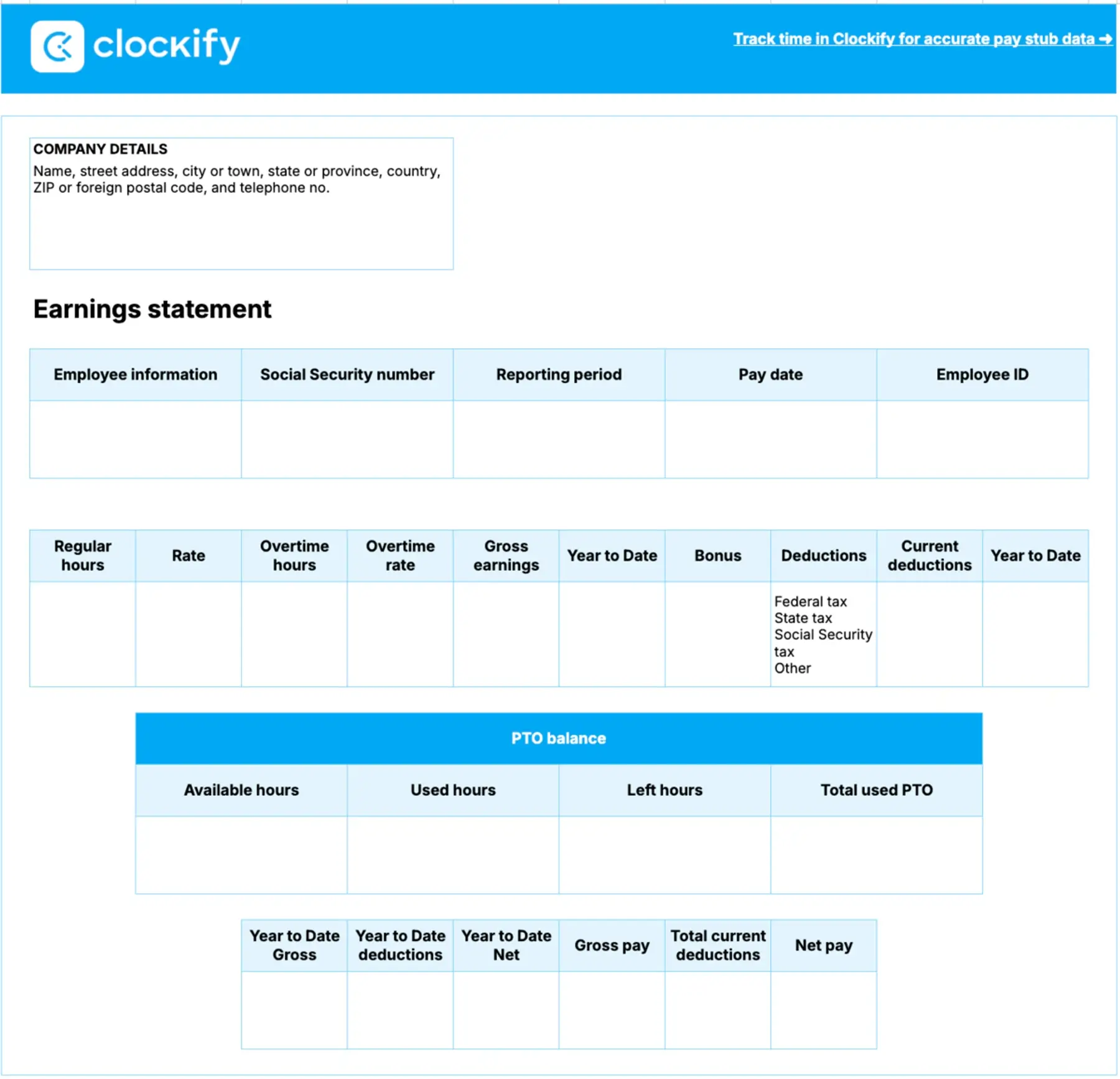
If you want to notify independent contractors about their earnings, consider the independent contractor pay stub template — also known as the 1099 pay stub template.
The simple Contractor Pay Stub Template helps your 1099 employees manage their finances and provides proof of income. It’s a non-mandatory earnings statement that you can provide to your contractor on a weekly, monthly, quarterly, or annual basis.
⬇️ Contractor Pay Stub Template (Google Sheets)
⬇️ Contractor Pay Stub Template (Excel)
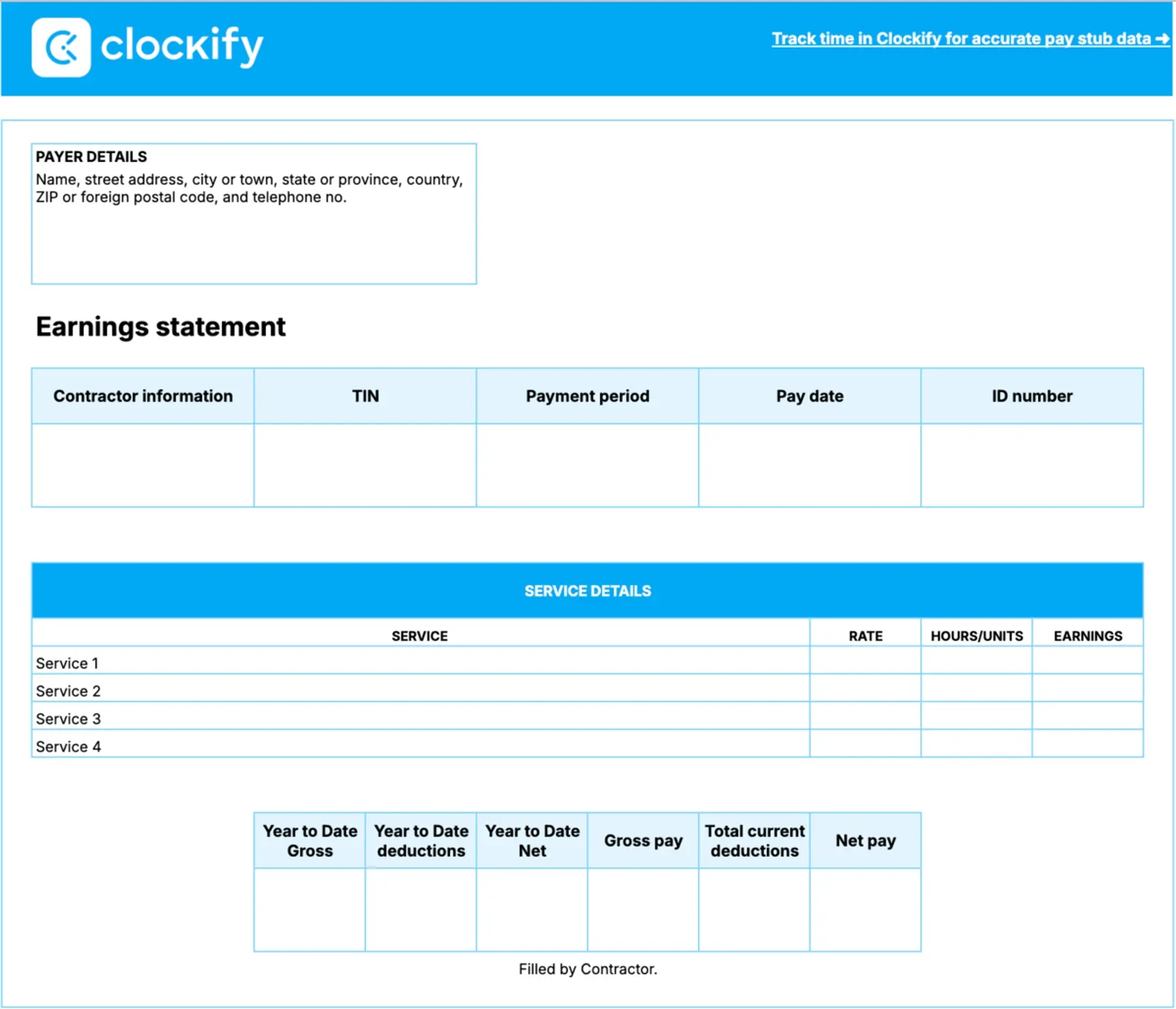

Before you can create a reliable pay stub, you’ll need a lot more than just a practical template. In fact, pay stubs can only be accurate if you've accurately tracked employee hours. This is where a payroll tracker comes into the picture.
A good employee time tracker will provide all the necessary data for complete and compliant pay stubs. This data can also be imported into payroll software such as ADP for further processing.
A payroll tracker like Clockify by CAKE.com helps you stay on top of your employees’ work hours and hourly rates for crafting pay stubs. Just follow 3 simple steps:
After your users have tracked their time, access all the relevant information in Clockify Reports and use it to craft an accurate pay stub.
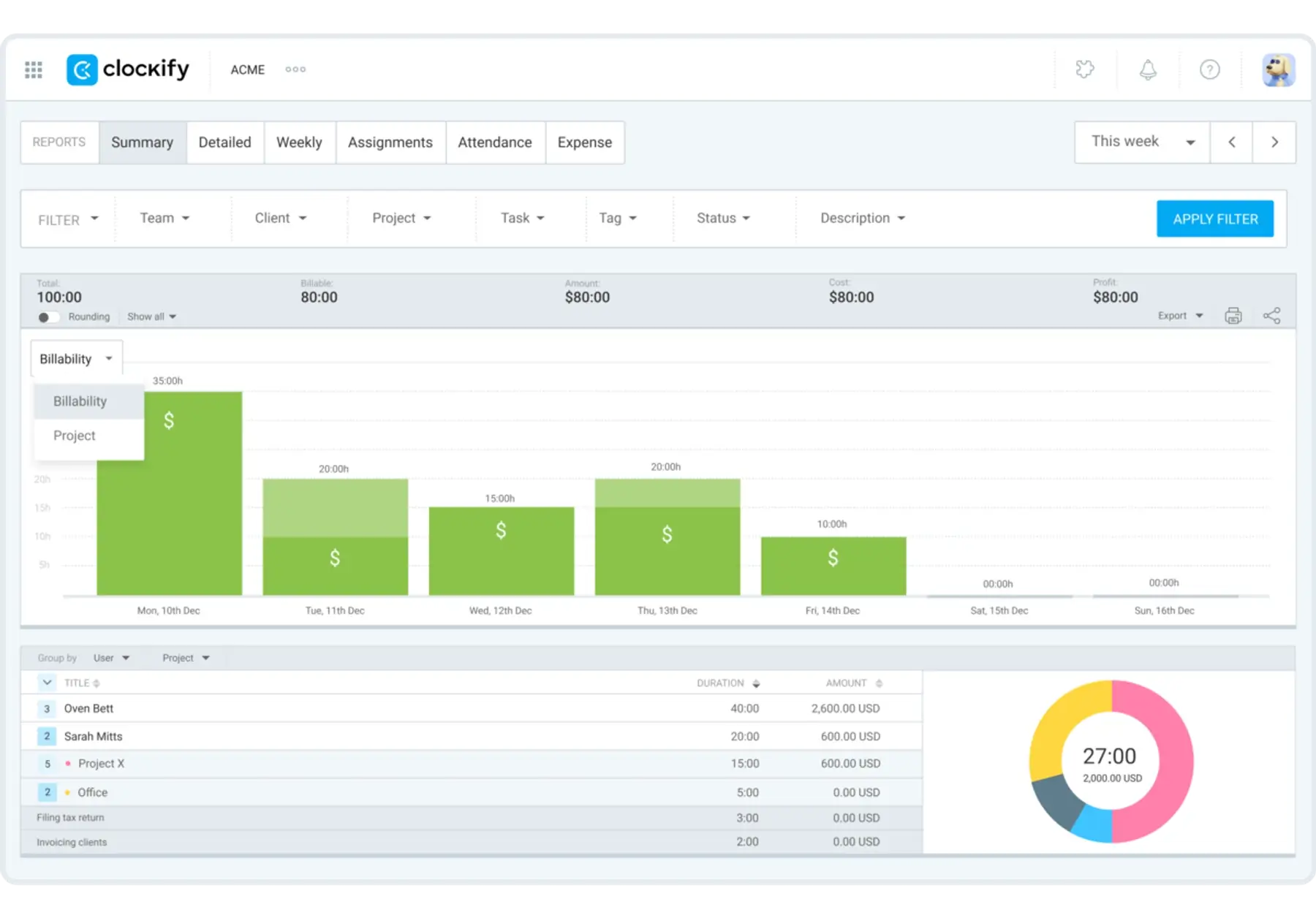
Alongside accurate employee hours, Clockify also allows you to:
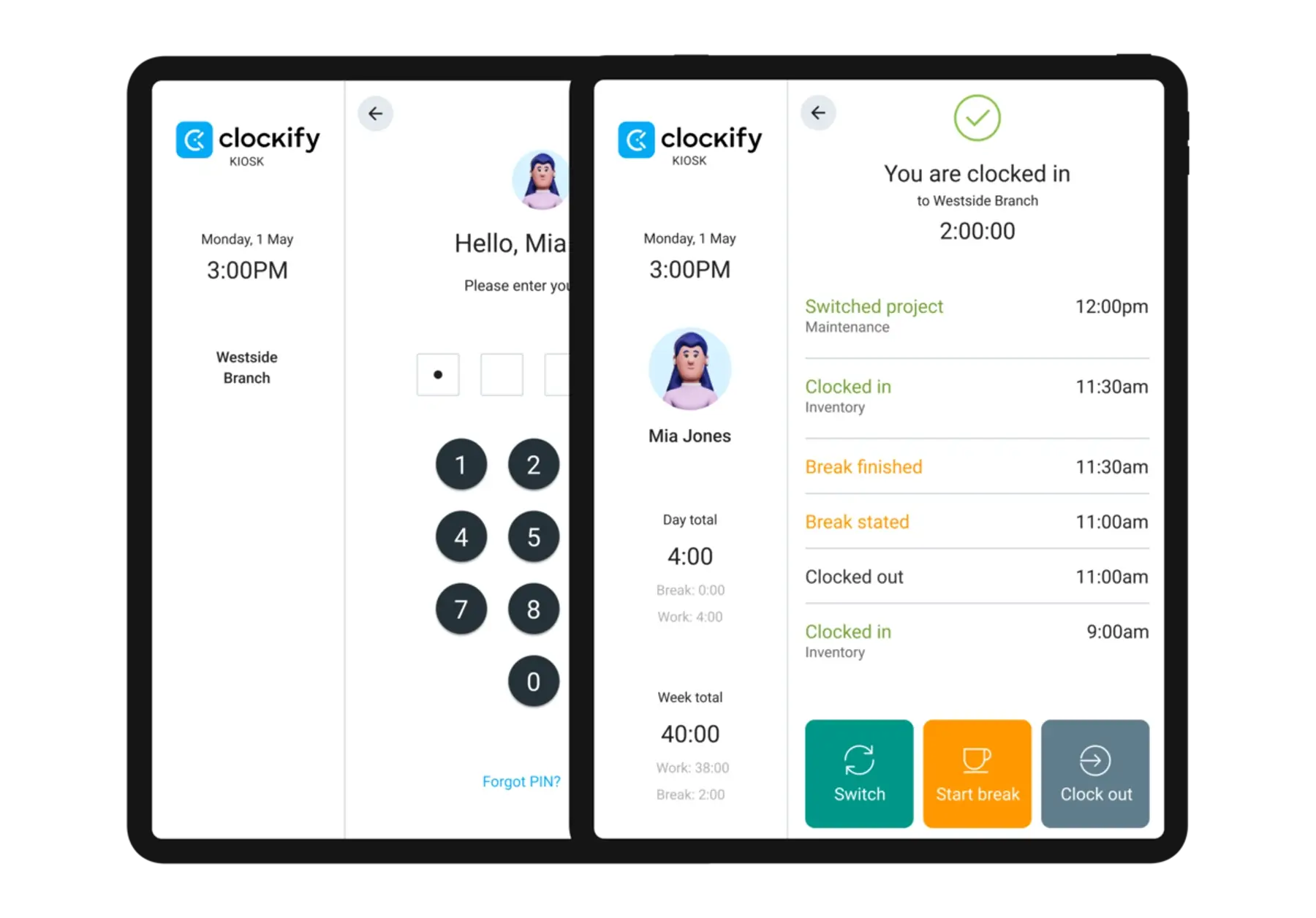
If you run a business primarily on-site, Clockify Kiosk is your go-to choice. Workers clock in on a dedicated device at a physical location and clock out when their shift ends. This data is used to determine their monthly hours for pay stubs and payroll.
Finally, let’s take a look at some of the most commonly asked questions about pay stubs.
To create your own pay stub, you can use a manual template or an online generator. In any case, you must ensure your format meets specific state-level transparency and compliance laws. Explore your state’s mandates for required fields, access rules, and retention policies for pay stubs.
You can fill out a pay stub in a few necessary steps:
The best format for a pay stub in 2026 is one that clearly separates earnings and deductions. The format should be logically organized, easily readable, and quickly skimmable.
You do not legally require special software to create pay stubs. On the other hand, your state may require you to include specific information, such as accrued sick leave (Colorado). Clockify is powerful timekeeping software that helps you set up automatic accruals and generate custom reports to complete pay stubs in minutes.
