

Alex Beadon
Founder of Together We Launch
"We use Clockify to see where our time is going and how to solve any problems. It’s just so beneficial."
More stories

Find new apps that fit you team's needs
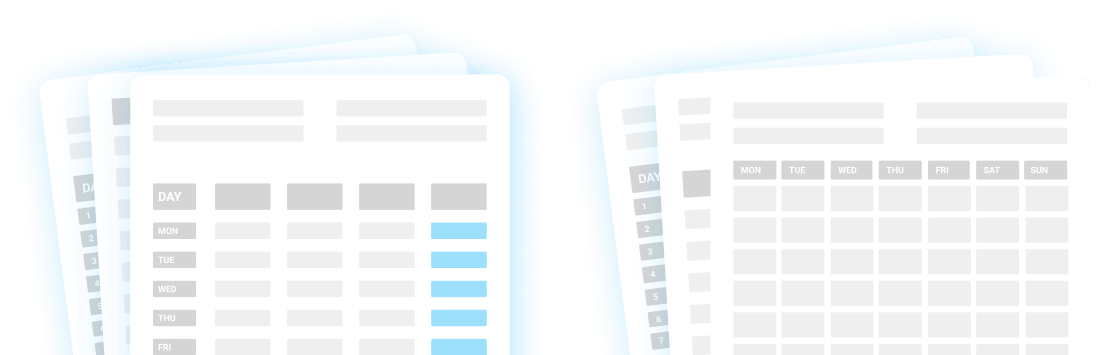
Free attendance sheet templates for tracking employee presence, absences, PTO, and leave — by day, week, month, or year. Download, customize, and fill out.
Time-bound employee attendance tracker templates
Daily Employee Attendance Template
Weekly Employee Attendance Template
Monthly Employee Attendance Template
Yearly Employee Attendance Template
Event-based employee attendance tracker templates
Meeting Attendance Template
Training Attendance Template
Event Attendance Template
Volunteer Sign-In Template
Employee absence tracker templates
Simple Yearly PTO, Vacation, and Sick Leave Tracker Template
Visual Yearly PTO, Sick Leave, and Vacation Tracker Template
Attendance tracking can offer a lot more than just knowing who showed up. Here’s what a consistent attendance register helps you do:
Attendance tracking is also how you separate different types of absence — sick days, vacation, personal leave, PTO — so your records are clean when payroll or HR needs them.
🎓 PTO vs. Vacation: What Is the Difference?
A good employee attendance sheet doesn’t need to be complicated, but it should be consistent. Here are the fields that every staff attendance register should include:
Not every template needs all of these fields. A daily sheet for a small office looks different from a monthly attendance sheet at a 100-person company. The templates below cover both ends.
The templates below are grouped into 3 categories:
For example, you can use a colored label or a status code in your templates, like in the table below.
| Code | Status |
| ✔ | Attended work |
| S | Sick leave |
| P | Personal leave |
| V | Vacation |
| X | Absent (no notice) |
| H | Holiday |
To make your templates visually distinct, easy to read, and easy to analyze, copy and paste the correctly colored labels into the appropriate slots. For a quicker approach, write the appropriate letters in the right slots.
You’ll be able to calculate and track this data for each individual employee and the time period covered by the template.
Each template also offers you a space to write your notes and observations.

The time-bound employee attendance tracker templates let you track employee attendance by day, week, month, or year.
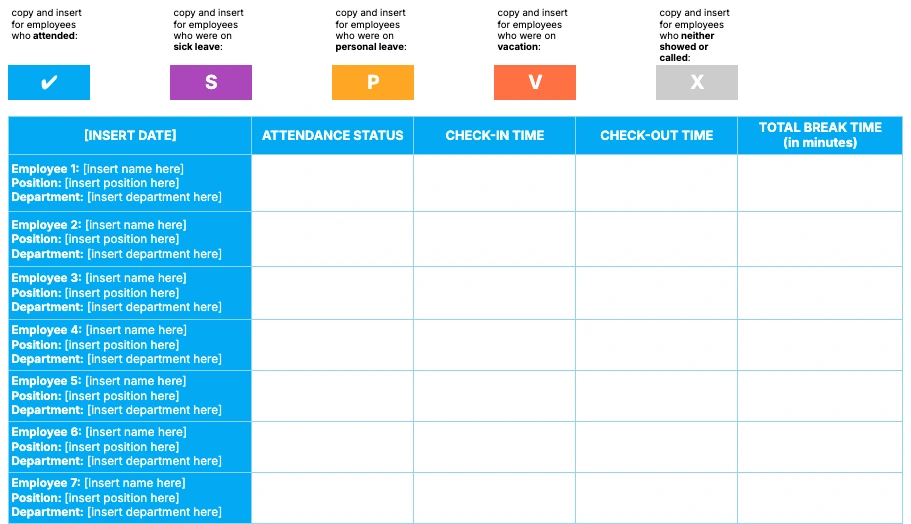
The Daily Employee Attendance Template lets you track employee attendance by day.
Enter each employee’s name, position, and department, then mark their status for that day (✔, X, S, P, V). You can also log their check-in and check-out times, as well as their total break time.
A counter next to the main table automatically totals how many employees attended, how many are on different leaves, the number of no-call no-show employees, and total break time for everyone — no manual counting needed.
Best for: Teams that need a simple daily headcount, shift-based workplaces, or anyone who wants a quick daily record without a complex setup.
⬇️ Daily Employee Attendance Sheet (Excel — Free Download)
⬇️ Daily Employee Attendance Sheet (Google Sheets — Free Download)
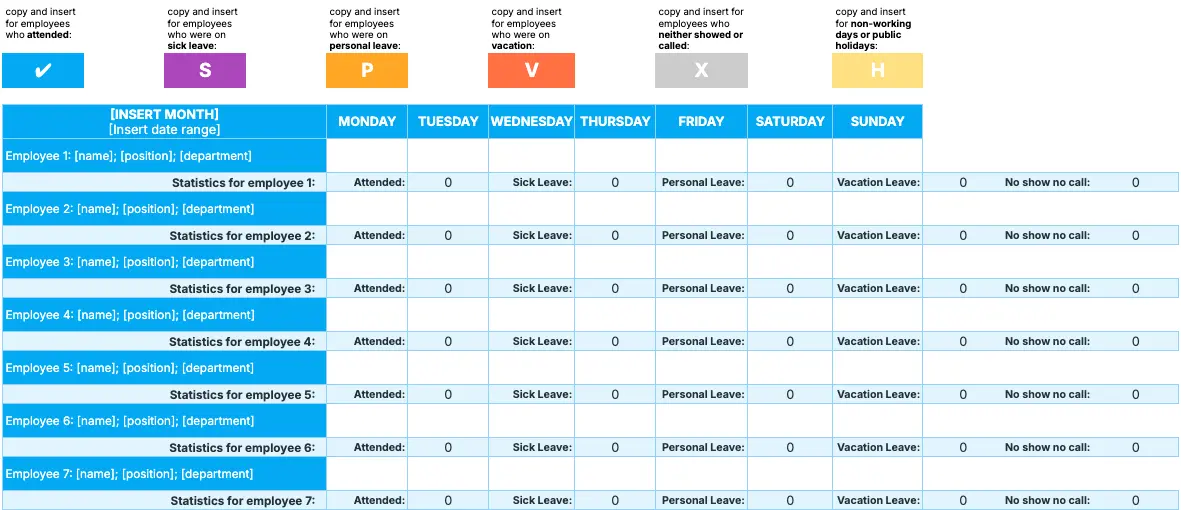
The Weekly Employee Attendance Template lets you track employee attendance by week.
Specify the month and week date range, then add employee details and mark their status for each day. Totals are calculated automatically — per employee (shown under each row) and for the full team (shown below the main table).
Best for: Managers who review attendance weekly, teams with rotating shifts, or companies that run weekly payroll.
⬇️ Weekly Employee Attendance Sheet (Excel — Free Download)
⬇️ Weekly Employee Attendance Sheet (Google Sheets — Free Download)
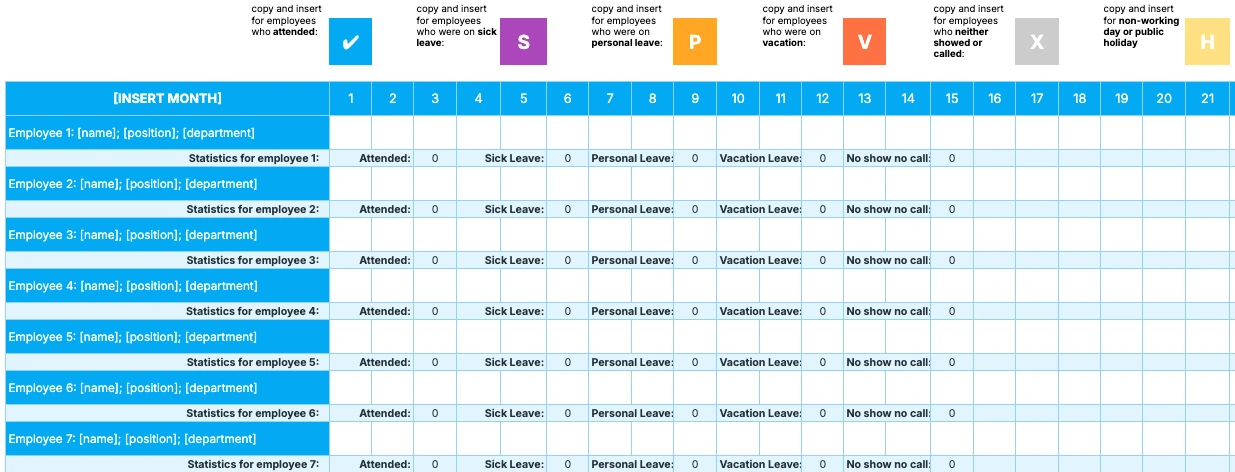
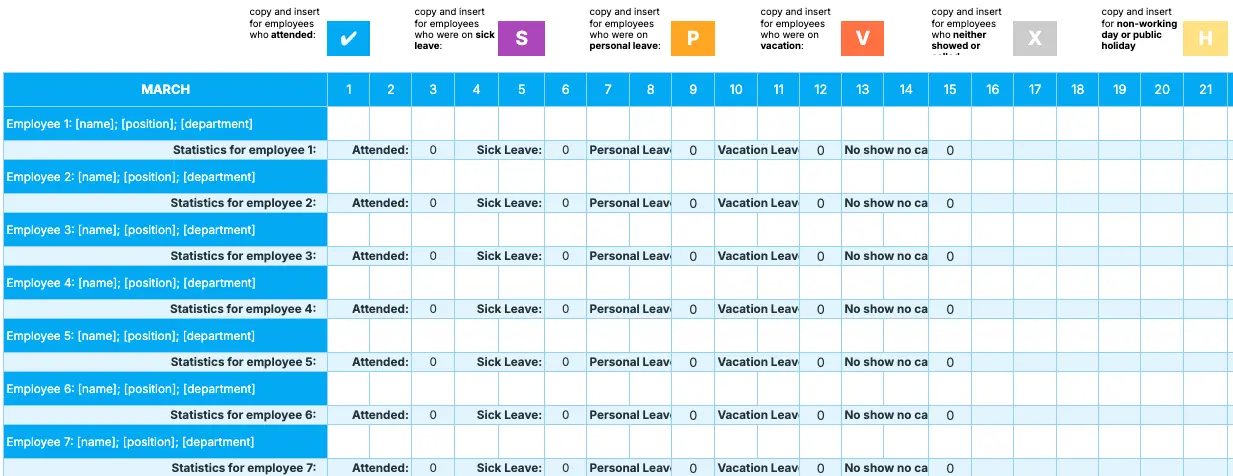
The Monthly Employee Attendance Template lets you track employee attendance by month.
Specify the month, add your employees, and mark their daily status throughout. The template automatically totals each employee’s attended days, different leaves, and unexplained absences — and gives you team-wide totals below the main table.
Note: To get a monthly attendance percentage, manually enter the total number of working days per month and the number of employees, and have your employees track their daily attendance.
Best for: HR managers running monthly payroll, operations managers focused on absenteeism tracking, or any team that reports attendance monthly.
⬇️ Monthly Employee Attendance Sheet (Excel — Free Download)
⬇️ Monthly Employee Attendance Sheet (Google Sheets — Free Download)
The Yearly Employee Attendance Template lets you track employee attendance by year.
Add employee information once, then mark daily statuses month by month. Per-employee totals update automatically under each row. Team-wide totals appear below the main table for each month.
Note: To get a monthly attendance percentage, manually enter the total number of working days per month and the number of employees, and have your employees track their daily attendance.
Best for: Companies that need a full-year attendance report, annual HR reviews, or compliance audits.
⬇️ Yearly Employee Attendance Sheet (Excel — Free Download)
⬇️ Yearly Employee Attendance Sheet (Google Sheets — Free Download)
Use these Google Sheets and Excel attendance tracker templates to track who showed up to a specific event (not their day-to-day attendance).
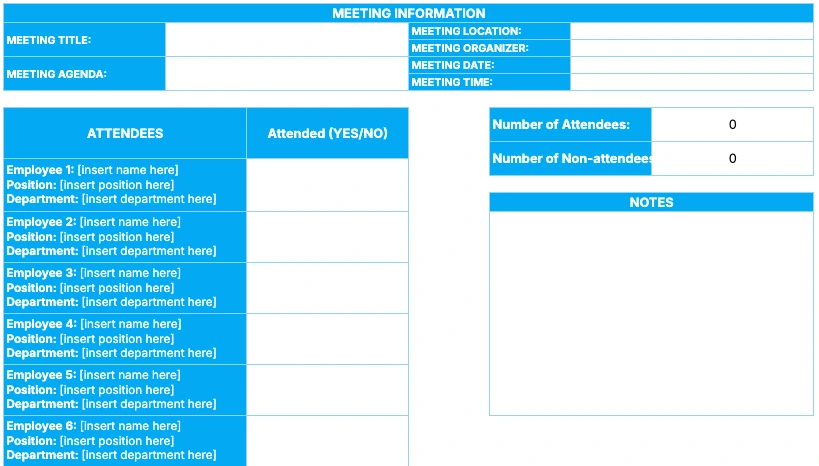
The Meeting Attendance Template lets you track the attendance of employees in meetings.
Log the meeting title, agenda, location, organizer, date, and time. Then add attendees and mark each one as “Yes” (attended) or “No” (didn’t attend). The counter calculates totals automatically.
Best for: Weekly standups, team meetings, board meetings, or any recurring meeting where attendance matters.
⬇️ Meeting Attendance Sheet (Excel — Free Download)
⬇️ Meeting Attendance Sheet (Google Sheets — Free Download)
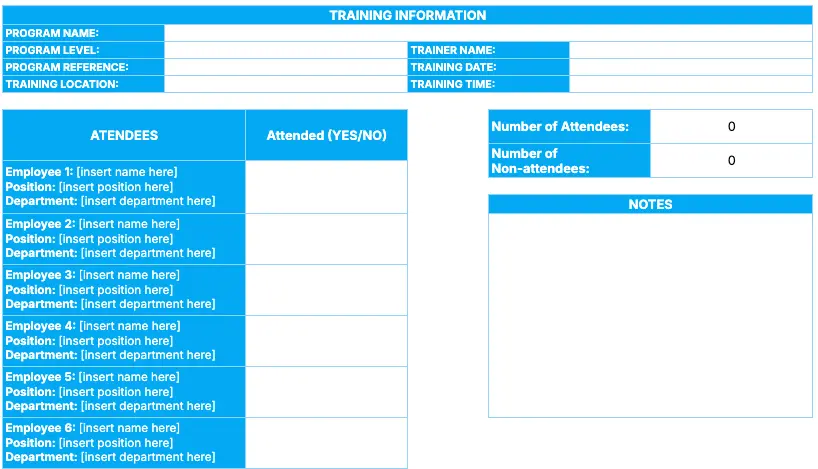
The Training Attendance Template lets you track employee attendance in mandatory and/or voluntary training programs.
Enter the program name, level, reference, location, date, time, and trainer. Add participants and mark attendance as “Yes” or “No.”
Best for: Mandatory compliance training, onboarding sessions, skills workshops, or any program where you need a record of who completed it.
⬇️ Training Attendance Sheet (Excel — Free Download)
⬇️ Training Attendance Sheet (Google Sheets — Free Download)
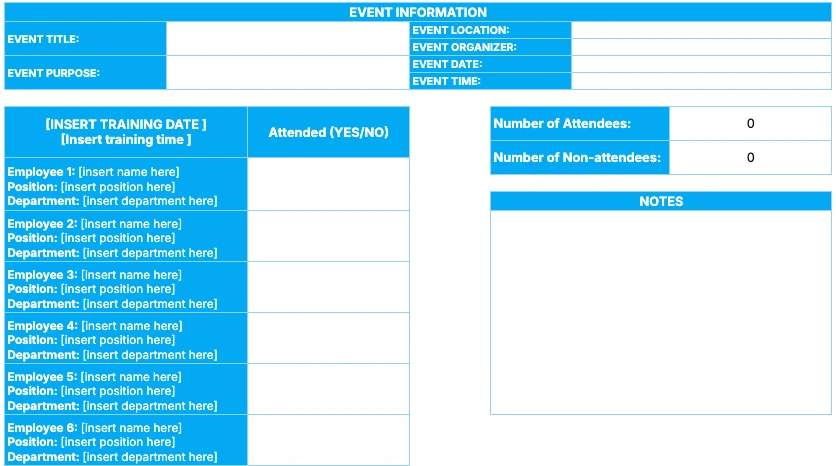
The Event Attendance Template lets you track employee attendance at mandatory and/or voluntary company events.
Log the event title, its purpose, location, organizer, date, and time. Add attendees and mark their status. Totals calculate automatically.
Best for: Company seminars, town halls, appreciation events, or off-site sessions.
⬇️ Event Attendance Sheet (Excel — Free Download)
⬇️ Event Attendance Sheet (Google Sheets — Free Download)
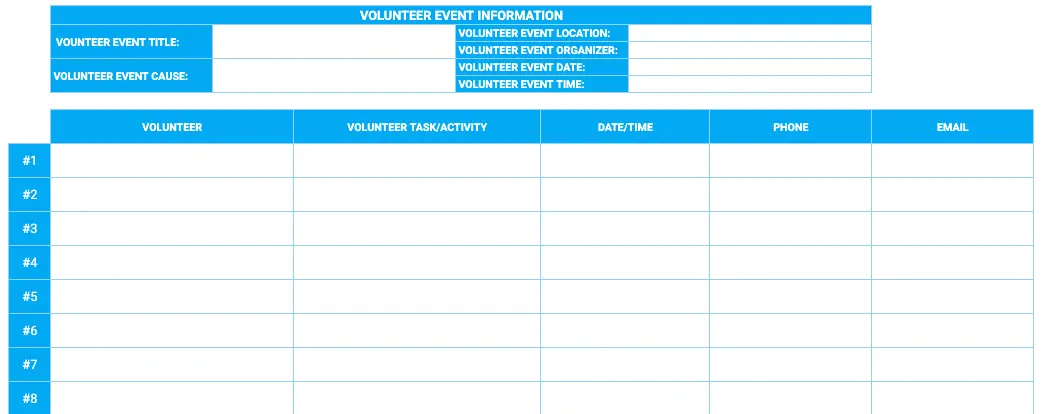
The Volunteer Sign-in Template lets you track the people who have volunteered to help at a company event.
Enter the volunteer event details, then add each volunteer’s name, department, assigned task, scheduled time, email, and phone number — so organizers can reach them quickly if plans change.
Best for: Companies organizing volunteer events or charity days where employees sign up for specific tasks.
⬇️ Volunteer Sign-In Template (Excel — Free Download)
⬇️ Volunteer Sign-In Template (Google Sheets — Free Download)
The following employee absence sheets let you track the number of days your employees didn’t attend work due to time off, such as vacations, sick leave, or personal leave.
🎓 How to Request Time Off and Track It Successfully
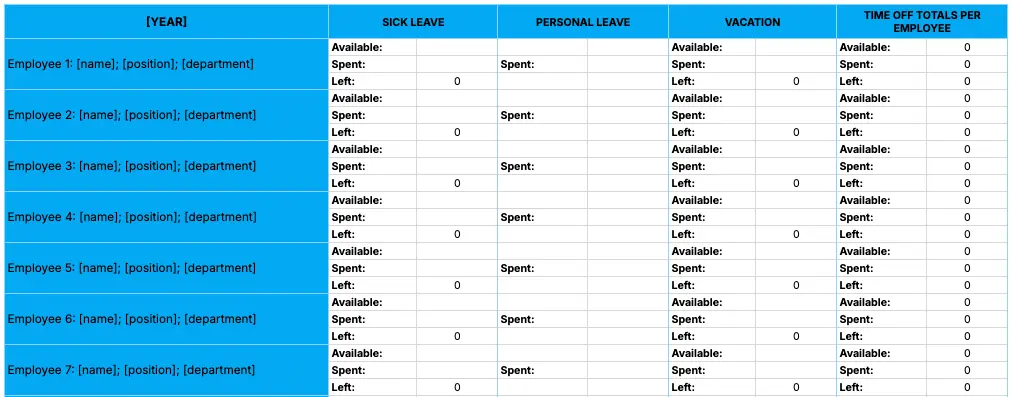
The Simple Yearly PTO, Vacation, and Sick Leave Tracker Template lets you track sick, personal, and vacation days on an annual basis using a simple counter.
Set the available days per employee at the start of the year. Each time leave is taken, add it to the “Spent” field. The “Left” field updates automatically. Team-wide totals for all leave types are calculated at the bottom of the table.
Best for: HR managers and founders who want a fast and clear overview of team leave balances.
⬇️ Simple Yearly PTO, Vacation, and Sick Leave Tracker Template (Excel — Free Download)
⬇️ Simple Yearly PTO, Vacation, and Sick Leave Tracker Template (Google Sheets — Free Download)
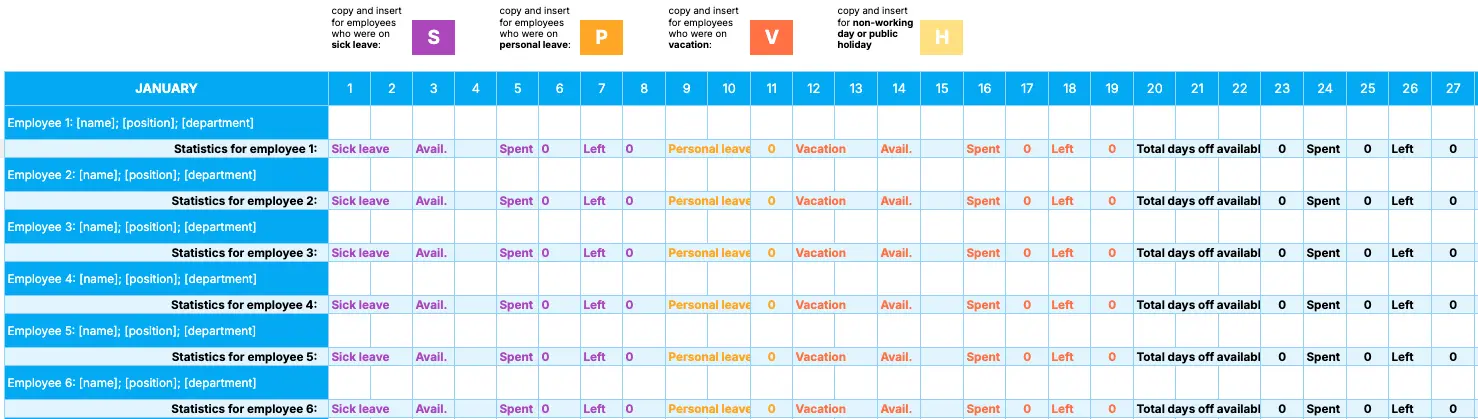
The Visual Yearly PTO, Sick Leave, and Vacation Tracker Template lets you track who’s off and why, day by day, across the full year.
Use the status codes (S, P, V, H) to mark each employee’s absence type for each calendar day. Navigate by month using the sheet tabs.
Totals per employee update automatically under each row. Copy remaining leave balances from one month’s sheet to the next to keep balances accurate throughout the year.
This visual layout makes it easy to see at a glance who’s on a vacation between the 10th and 20th of April, for example, or that May 25th is a public holiday — before you schedule a deadline or assign a project.
Best for: Teams that need a visual leave calendar, managers doing shift or project scheduling, or HR tracking day-to-day absenteeism patterns.
⬇️ Visual Yearly PTO, Sick Leave, and Vacation Tracker Template (Excel — Free Download)
⬇️ Visual Yearly PTO, Sick Leave, and Vacation Tracker Template (Google Sheets — Free Download)

Here’s how to build your own attendance sheet in Excel from scratch.
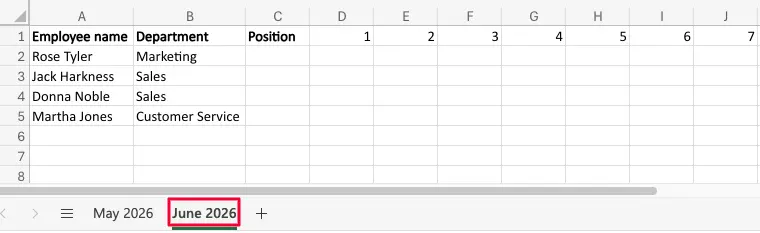
Step #1: Set up your header row
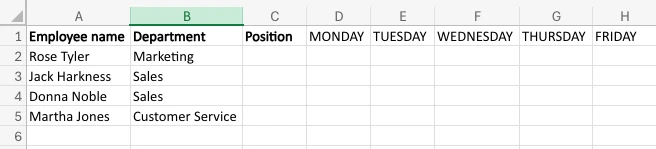
In row 1, add your column headers — employee name, department, position — and then one column per day (or one column per status type, depending on your format).
Step #2: Add your employee list
List each employee in a separate row. If you’re tracking a full month, you’ll have one row per employee and 28–31-day columns. Use separate tabs for each month.
Step #3: Add a status legend
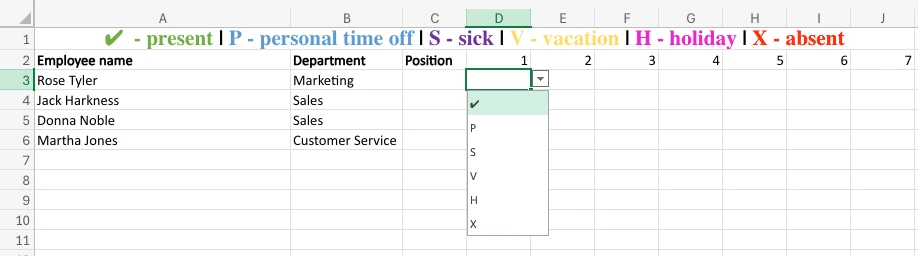
Somewhere visible — top of the sheet or a separate tab — define what each code means. For instance, ✔ ️ for present, S for sick, V for vacation, and so on.

Step #4: Use data validation for status codes
As an optional step, you can create a dropdown list with your status codes. Select your attendance cells and go to Data > Data Validation to set it up and prevent potential typos.
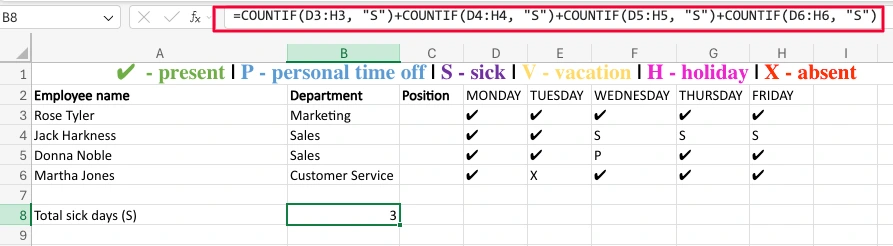
Step #5: Add COUNTIF formulas for totals
Below the main table, use COUNTIF to total each status type per employee. For example, =COUNTIF(D3:H3, “S”) counts sick days for the employee Rose Tyler. You can do the same at the bottom of each column for daily or weekly team totals. For the team total formula, simply add all employee rows together, like in the image below.
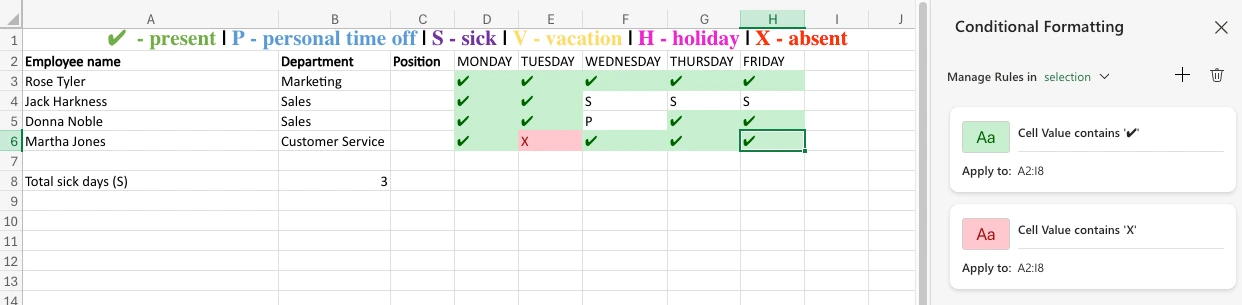
Step #6: Use conditional formatting
Highlight cells automatically based on their value. Go to Home > Conditional Formatting and, for example, color “X” cells red and “✔“ cells green. This makes the pattern visible at a glance.
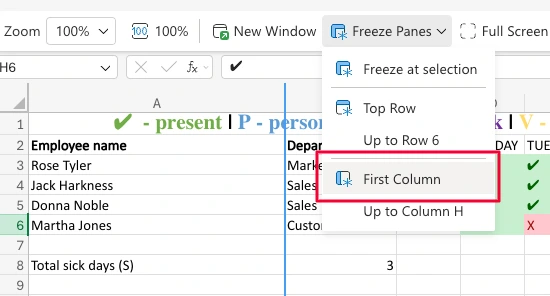
Step #7: Freeze your header row and employee column
Go to View > Freeze Panes > Freeze First Column, then freeze row 1 as well. This keeps employee names and dates visible when you scroll.
Attendance percentage tells you what share of scheduled workdays an employee (or team) actually showed up.
The formula: Attendance % = (Days Present / Total Working Days) x 100
Example: An employee worked 18 out of 22 working days in a month — (18/22) x 100 = 81.8%
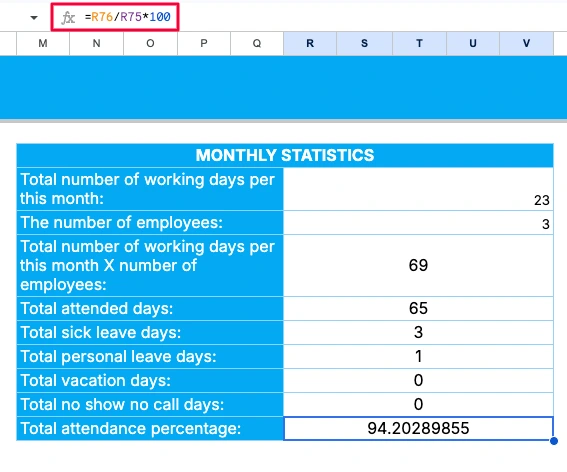
And if you’re doing a total attendance percentage for the whole team, this would be your formula:
Total attended days / Total number of working days per this month X number of employees X 100.
“Attendance sheet” and “timesheet” are sometimes used interchangeably, but they track different things.
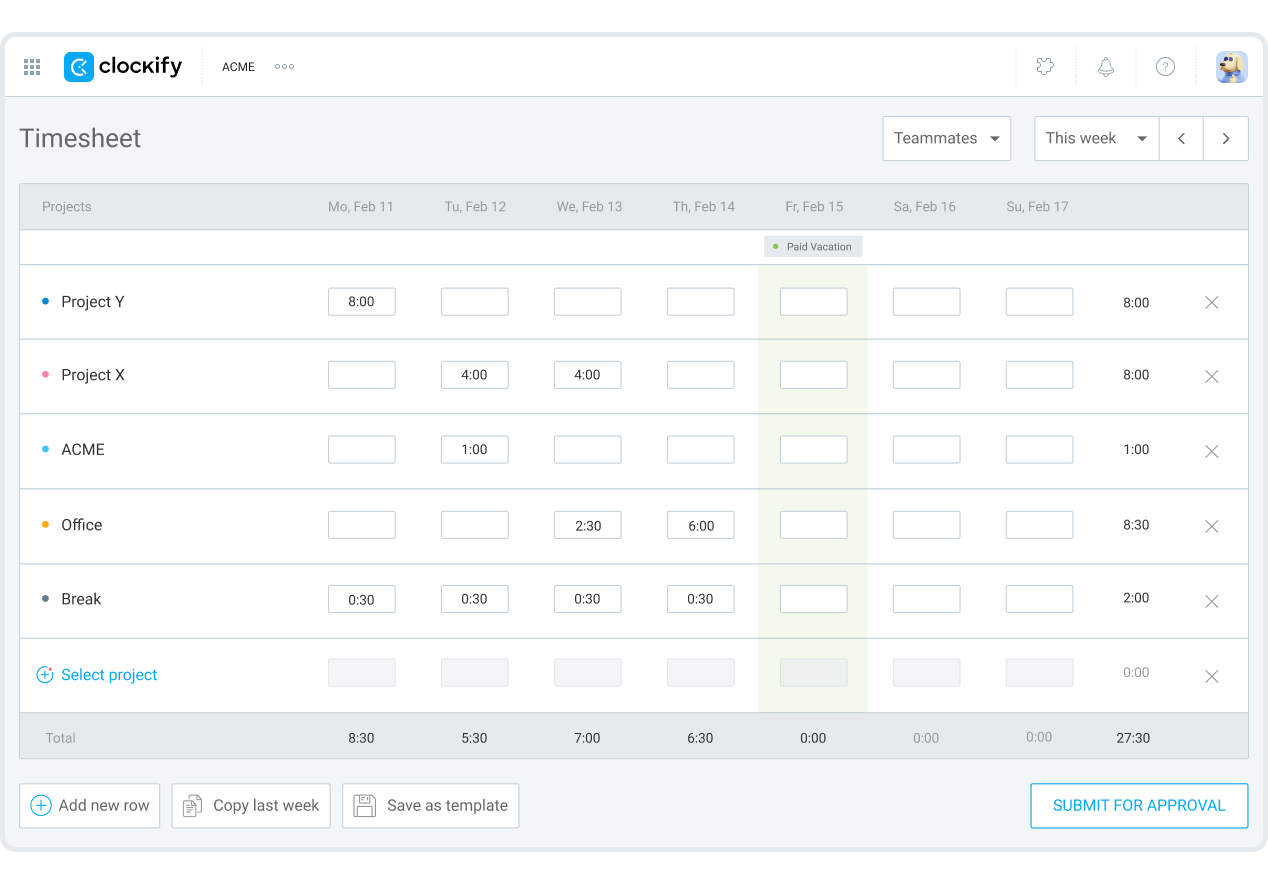
An attendance sheet answers: Was this employee at work? It records presence, absence, and leave type — but not necessarily what the employee did or exactly how long they worked.
A timesheet answers: How many hours did this employee work, and on what? It records clock-in and clock-out times, tasks, projects, and billable hours.
| Purpose | Attendance sheet | Timesheet |
| Tracks presence/absence | ✅ | Sometimes |
| Tracks leave types | ✅ | Rarely |
| Tracks hours worked | Sometimes | ✅ |
| Tracks tasks/projects | ❌ | ✅ |
| Used for | HR, payroll compliance | Billing, project management |
🎓 How Spreadsheet Time Tracking Works (+ Free Templates)
All templates on this page are also available in Google Sheets — not just Excel.
Google Sheets works better than Excel for distributed teams because:
To use the Google Sheets versions of our free employee attendance templates:
You can restrict editing so that employees can only fill in their own rows, and you can use Google Sheets’ built-in notification rules to get an alert when someone updates the tracker.
For teams that are already working in Google Workspace, the Google Sheets attendance templates are the easiest choice.
Excel attendance sheets work well — up to a point. They break down when:
Clockify by CAKE.com lets you track attendance with a simple Timer or Timesheet, log leave types, and pull attendance reports by employee, team, or date range — without touching a spreadsheet.
To set up attendance tracking software, follow these steps:
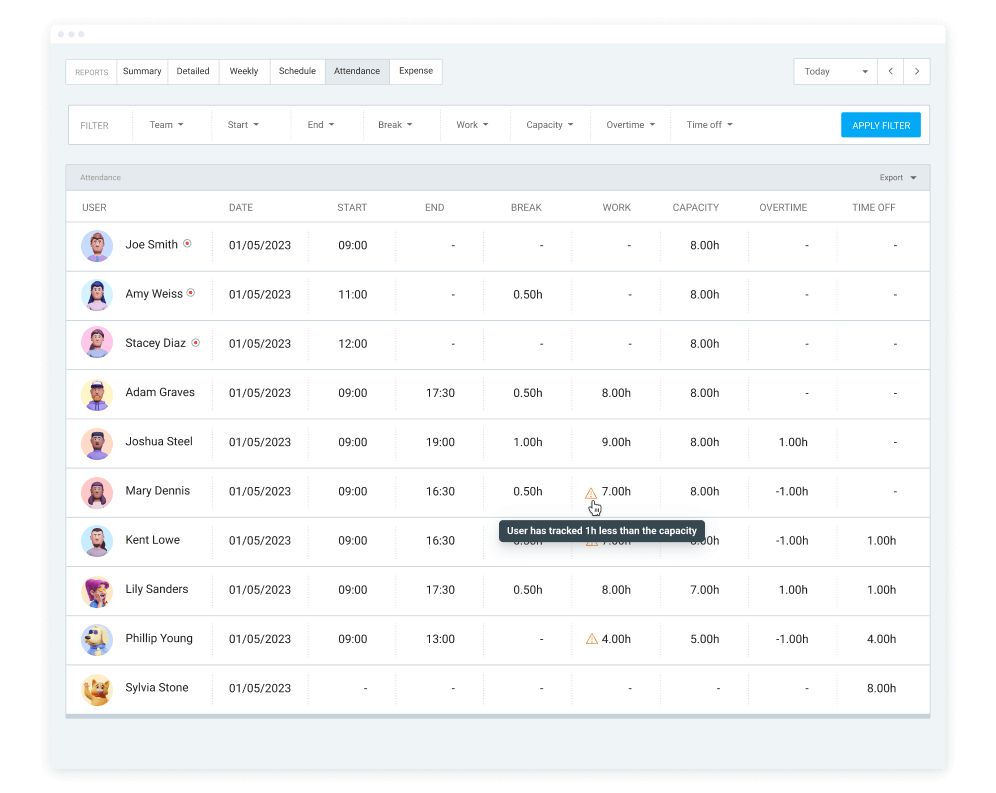
As a result, you’ll see everything in the Reports — attendance, absences, and hours — filtered by person, team, or time period. That way, you can identify absenteeism patterns to improve scheduling and hiring decisions.
If you have more questions about using the attendance sheet format in Excel, check out the following section.
An attendance sheet should include employee name, date, and attendance status (present, absent, or leave type) at a minimum.
For more details, you can add department, time in/out, break time, and notes. The more complex your team’s schedule, the more fields you might need.
The formula for attendance count in Excel is COUNTIF. For example, to count how many days an employee was present in cells C2 to AG2, you would use the following formula: =COUNTIF(C2:AG2, “✔“).
Replace “✔“ with “S”, “V”, or “X” to count other status types.
If clock-in time is in column C, row 2 (e.g., 9 a.m.) and clock-out time is in column D, row 2 (e.g., 5 p.m.), the formula for hours worked is: =(D2-C2)x24.
For this to work, it’s necessary to include a.m. and p.m. in the fields. Multiply by 24 to convert the time to decimal hours.
The simplest method to track staff attendance is to use a shared spreadsheet where employees (or a manager) mark attendance status daily.
For more accuracy, use an employee time tracking tool where team members clock in and out directly.
Yes — all 10 templates on this page are free to download in Excel and Google Sheets.
The best format for an attendance sheet depends on your reporting cycle. A monthly format works best for most HR and payroll purposes. A daily format suits shift-based workplaces. And a yearly visual tracker is best for scheduling and leave management.
The downloadable templates on this page are free.
Also, both automated and manual time tracking are available on Clockify’s Free plan. For attendance and overtime tracking, subscribe to Clockify’s Standard plan.
Clockify is also part of the CAKE.com Productivity Suite, together with Pumble for team communication and Plaky for project management — you can get all 3 for a bundled price.

