

Alex Beadon
Founder of Together We Launch
"We use Clockify to see where our time is going and how to solve any problems. It’s just so beneficial."
More stories

Find new apps that fit you team's needs
Time registration will become mandatory in Belgium as of 2027. The law will change how companies record breaks, overtime, and working hours.
This guide explains the ins and outs of the upcoming mandatory time tracking regulations in Belgium.

No, time tracking is not mandatory in Belgium as of October 2026. Here’s a quick list of what’s been confirmed and what is likely to happen next:
| Confirmed | Expected | Still open |
| November 2025: the Belgian Chamber of Representatives agrees to propose mandatory time registration by Jan. 1, 2027 | End of 2026: when the parliamentary vote and voting sessions are expected to take place | What the time tracking registration law will actually look like in practice and the extent to which it will limit the employer’s ability to track work hours |
| November 2025: The time tracking law will apply to public and private sectors in Belgium, according to Vice-Prime Minister David Clarinval | Non-compliance tolerated until March 31, 2027; full compliance from April 1, 2027 | What will be the sanctions for those who violate this future law |
| February, 2026: the Belgian Chamber of Representatives formally requests the federal government to ensure that the impending 2027 time tracking law remains highly flexible for employers | No specific system or punch clock required | How the time tracking law will precisely apply to teleworkers (i.e. remote workers) |
Belgium is introducing mandatory time registration because a 2019 European Court of Justice (ECJ) ruling requires Belgium (and other EU countries) to adopt and implement a time registration law to comply with the Court’s decision (which is an interpretation of EU Directive No. 2003/88/EC).
In late 2025, Belgium’s authorities launched legislative action to make time tracking mandatory. The Belgian Chamber of Representatives, the Government, and other authorities are currently considering the draft law and resolutions.
Another reason for introducing mandatory time registration is that the new law will settle the burden-of-proof issue. Until now, some labor courts have placed the burden of proving unpaid overtime on employers without time records. In other words, the employer has to provide evidence that the claimed hours were not actually worked.
Labor courts also refer to the EU Time Tracking Law, which requires employers to implement an objective, reliable, and accessible system “to measure the daily working time of each employee.”

All employers in the private and public sectors must comply with the upcoming Belgian time tracking legislation. As of 2026 and according to the Federal Public Service for Employment, Labor and Social Dialogue, the following are categories of workers who are exempt from working time regulations based on the Belgian Labor Act of 16 March 1971:
All exempted categories are expected to remain in place under the 2027 time registration law.
Note that this is not a final list of exemptions (we may expand it by the end of 2026 to make sure it’s up to date).
🎓 Can Companies Track Work Hours? Full Guide & Accuracy Tips
To stay compliant with upcoming time tracking law, simplify inspections, and prevent disputes about working hours, Belgian employers must record the following baseline information:
However, absences like vacation, training, and sick leave aren’t explicitly mentioned in the formal documentation as of 2026.
Time registration in Belgium in 2027 is about to get a lot more complicated. Time tracking systems like Clockify by CAKE.com help employers meet these requirements easily:
#1: Start and end times: Employees get to track work hours using the Timer, Timesheet, or Manual mode. Managers can review these work hours and approve or reject timesheets.
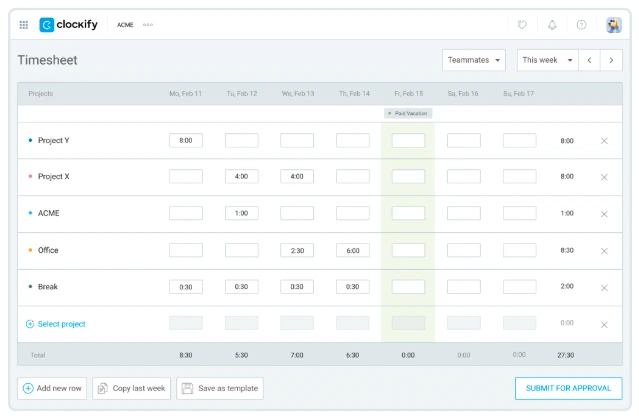
#2: Breaks and interruptions: Clockify records mandatory rest periods accurately across web, mobile, and Kiosk. When your team tracks breaks separately from work hours, you get a more accurate representation of actual productive hours. (This matters when you bill clients by the hour or calculate labor costs.)

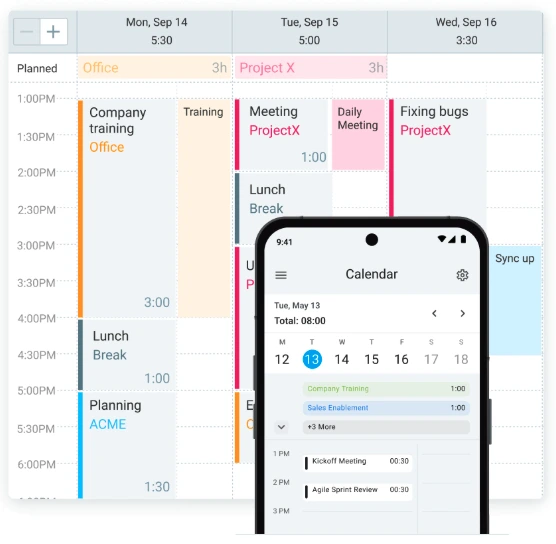
#3: Overtime and schedule deviations: Clockify automatically calculates overtime, flags schedule mismatches, and locks timesheets for compliance approval. To track overtime easily, Clockify lets you set employee daily capacity (e.g., 8 hours). Any hours an employee tracks beyond those 8 hours are automatically calculated as overtime.
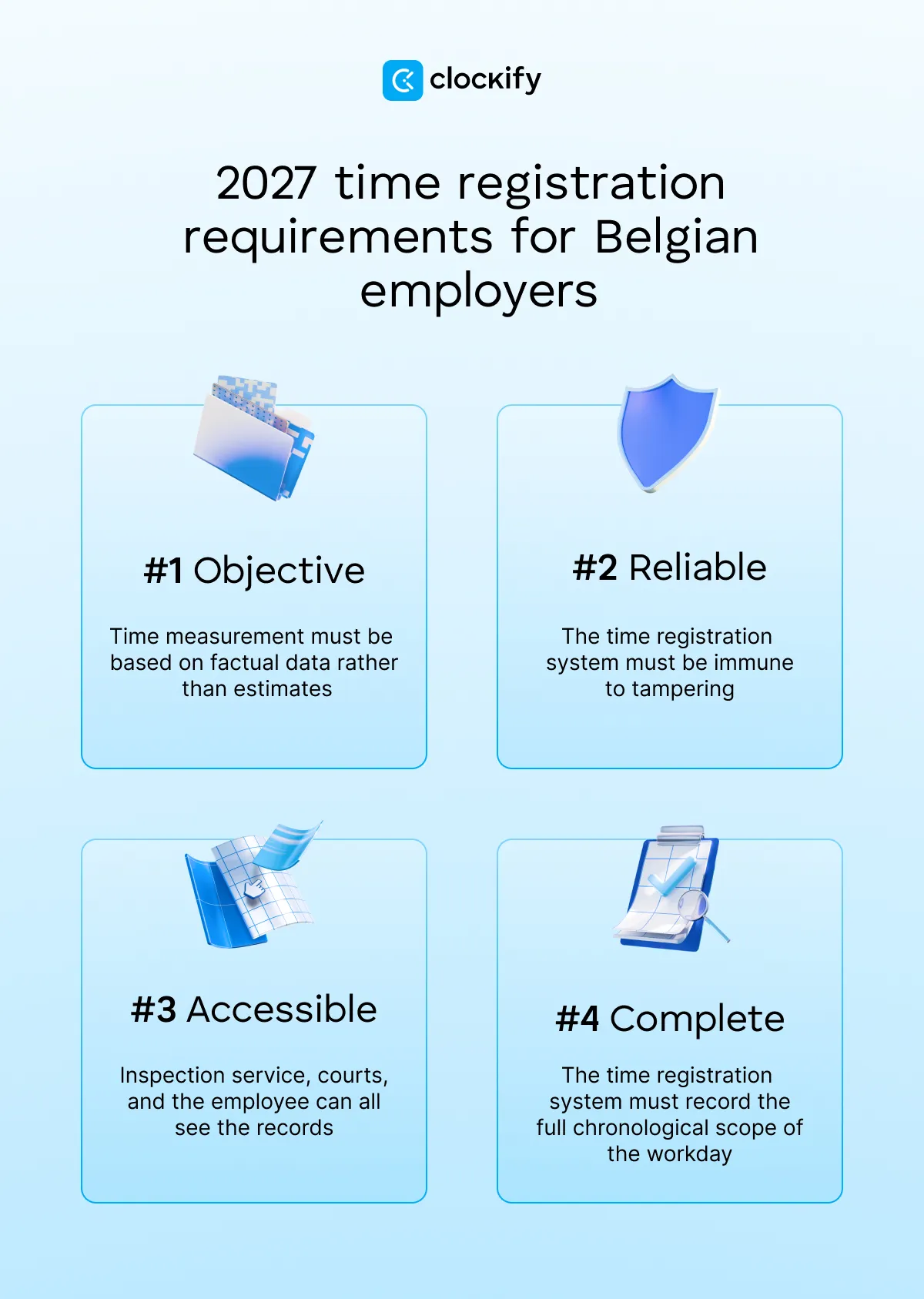
Here are some of the known requirements a compliant time registration system in Belgium must meet as of 2027.
The time tracking system must record the time employees actually worked, without one-sided manipulation. According to the ECJ ruling, time measurement must be based on factual data rather than estimates. The Court stated that, without an objective system, it is “excessively difficult, if not impossible in practice, for workers to ensure that their rights are respected.”
Records can’t be changed unilaterally by either side (the historical data integrity must be preserved). According to the ECJ ruling, the system must be immune to tampering, as the workers are “structurally the weaker part in an employment relationship.” This means that a reliable time registration system prevents employers from arbitrarily altering hours or pressuring employees to underreport their time.
Accessible time tracking means the inspection service, the courts, and the employee can all see the records. In other words, neither employers nor employees can hide the records.
Breaks, overtime, and rest must be recorded for each 12-month period. The time registration system must record the full chronological scope of a workday. Logging “8 hours worked” is not legally sufficient. You must also record the duration of paid and unpaid breaks, and the exact start and end times. In Paragraph 50l, the ECJ specifies that a system must prove whether the mandatory minimum daily rest period (11 consecutive hours) was respected.
Belgium currently enforces strict, highly specific time-and-attendance registration rules based on the type of work contract and sector. Here are 5 rules you need to consider:
Flexi-jobs allow workers to earn untaxed supplemental income, but employers must adhere to strict time registration scrutiny to prevent abuse. If an employer uses a written framework contract for a flexi-worker, the employer can’t simply register the worker for a whole quarter without tracking their exact daily hours.
Flexitime was introduced in 2017 and allows employees to choose their own working hours within mandatory core periods. Since the schedule fluctuates daily, the law explicitly requires employers to use a digital time tracking system to calculate whether the employee has met their required weekly hours or accrued legal overtime.
Checkinatwork was introduced for industries with a high risk of social fraud and undocumented labor, like construction, cleaning, transportation, and logistics. Checkinatwork requires real-time geolocation and attendance logging at the exact work site.
Part-time deviations mean that if a part-time employee works outside their formally published schedule (starting earlier, ending later, or working during a scheduled break), the employer must record the deviation immediately.
The part-time deviations rule applies to both fixed and variable part-time schedules. According to the Federal Public Service Employment, employers must use a reliable time tracking system (like an app or a digital clock) or a specific paper deviation document.
Horeca daily registration means that the employer (or their representative) must “communicate the daily start and end times of employment for permanent workers” in the hospitality industry. There are 3 types of daily registration declarations:
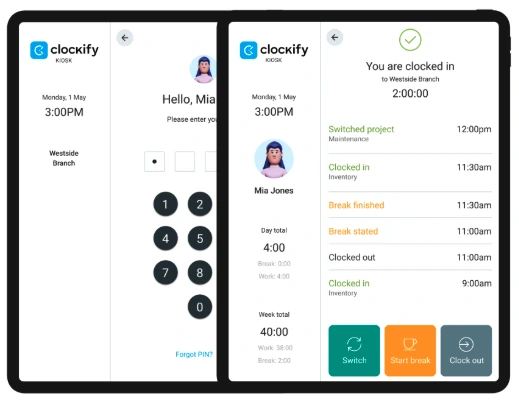
Clockify Kiosk lets hospitality workers check in, take a break, and check out easily. Employers can choose how employees clock in and out: with PIN, QR code, or photo capture.
Here’s an 18-step time tracking compliance checklist to help you prepare for the upcoming time registration law in Belgium.
Download: Excel | Google Sheets
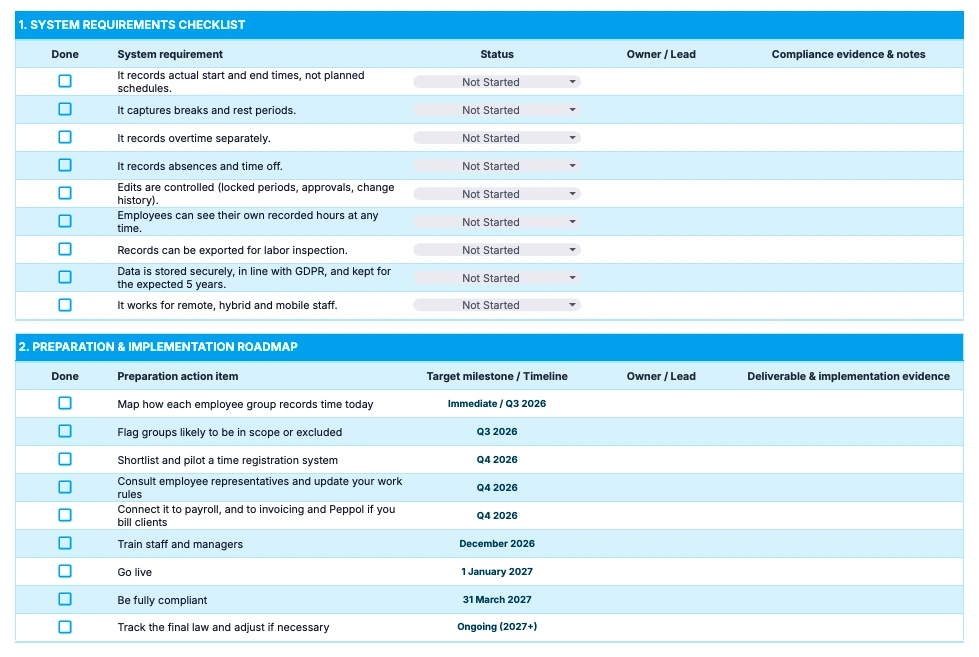
To determine whether your system is compliant, consult the following checklist:
To make sure you meet every deadline, check this list:
🎓 Best Scheduling Software: 6 Tools Compared for Teams (2026)
Peppol BIS is the Belgian government’s preferred invoicing format. If employers lack the technical means to issue and receive a structured electronic invoice, the authorities will impose fines of:
To comply with mandatory time tracking in Belgium and Peppol requirements, you can use the Clockify-Peppol integration. If you bill by the hour, you can:
That way, you ensure full compliance with a quick, single workflow.
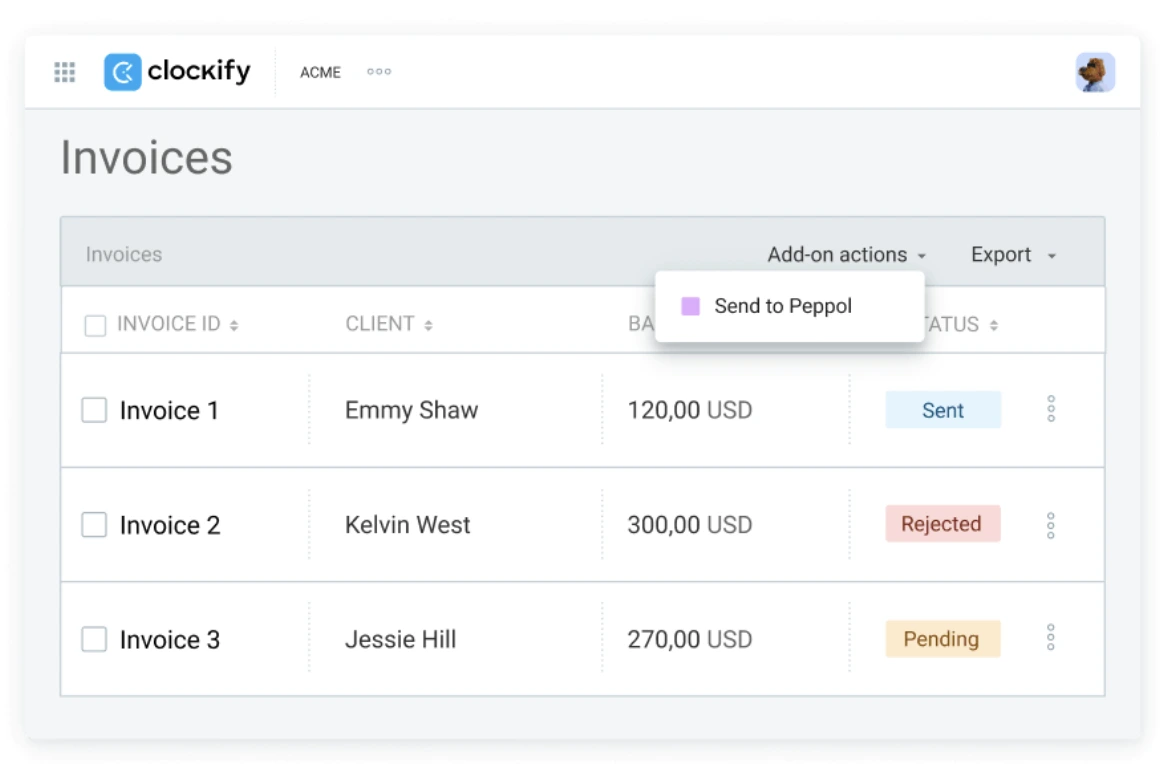
The Sent invoices tab gives you maximum customization: set invoice status to Due, Sent, Rejected, Pending, and more. That way, you can speed up client payments and avoid critical data slipping through the cracks.
🎓 Fed Up With Late Client Payments? Get Paid Faster With 3 Tips
If you don’t comply with mandatory time tracking in Belgium in 2027, there are no sanctions as of October 2026. Sanctions and other details of the law are expected to be made public by the end of 2026, once the legislative branch of power has finished its part of the work.
The only risk employers could face immediately is weak evidence in overtime disputes. (The new law will also cover overtime.)
Clockify ties tracked time, payroll, and Peppol invoicing into one workflow.
Here’s a list of Clockify features that can help Belgian business owners, HR leads, and finance managers stay compliant (without breaking the bank):
| Required by law | Clockify feature | Plan |
| Objective | Kiosk | Basic |
| Objective | Force timer, GPS tracking | Pro |
| Objective/reliable | Breaks on web and Kiosk | Basic |
| Reliable | Lock timesheets, Time approval | Standard |
| Reliable | Audit log | Enterprise |
| Accessible/reliable | Time off, Attendance, Overtime | Standard |
| Accessible/complete | Data region EU (Germany) | Pro |
Clockify time tracking helps with payroll and billing, so you don’t have to switch tools or pay for expensive add-ons.
To wrap up, here are 6 frequently asked questions about the upcoming time registration law in Belgium.
Yes, the 4-day week is legal in Belgium, since it was officially introduced as part of the country’s 2022 Labor Deal. The legislation allows full-time employees to compress their standard working hours into 4 days instead of 5.
With this schedule, employees work longer hours per day (up to 9.5 hours) to earn an extra day off. At the same time, employees don’t experience any reduction in salary or benefits.
🎓 A Detailed Guide to the 4-Day Work Week Concept
Time registration in Belgium becomes mandatory on Jan. 1, 2027, with full compliance expected by April 1, 2027.
Yes, an Excel sheet is enough for mandatory time tracking in Belgium, as long as it is objective, reliable, accessible, and complete. But Excel sheets are also more complicated to manage than dedicated timekeeping software.
Tools like Clockify by CAKE.com automatically track employee hours, breaks, and rest periods, and then feed that information into payroll and billing.

Yes, remote workers (called “homeworkers” and “teleworkers”) will likely be covered by Belgium’s mandatory time tracking as of Jan. 1, 2027. Before that date, some form of time registration is still required for Flexi-jobs, Flexitime, Checkinatwork, Part-time deviations, Horeca, and other scheduling arrangements.
No, you don’t need a punch clock in Belgium. Details on mandatory time tracking in Belgium are still pending, but punch clocks likely won’t be required.
Sanctions for employers who don’t comply with Belgian time tracking law are unknown as of October 2026. However, sanctions for not complying with Peppol electronic invoicing are €1,500 for the first offense, €3,000 for the second, and €5,000 for subsequent offenses.
Disclaimer: We hope this guide has been helpful. Information found here is not legal advice. We strongly advise you to consult with relevant institutions or certified representatives before taking action on legal matters. Clockify is not responsible for any losses or risks incurred.
